Irregularly Surging Workloads, Management Staff Deployed to Meet Deadlines
Calls for Legislative Improvements Including Expansion of Flexible Working Hours Period and Enhancement of Special Overtime Reporting System
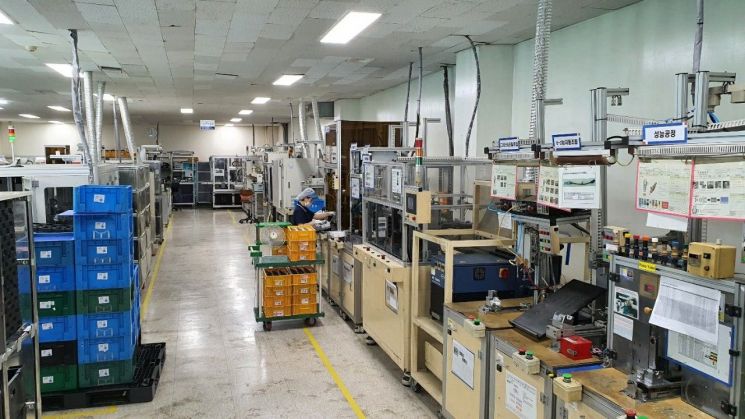 The grace period for implementing the 52-hour workweek for businesses with fewer than 300 employees is set to end by the end of this year, increasing difficulties for small and medium-sized enterprises. An employee is conducting inspection work at an auto parts manufacturing plant in Cheonan, Chungnam. Photo by Kim Heeyoon
[Asia Economy Reporters Daeseop Kim, Heeyoon Kim] Small and medium-sized enterprises (SMEs) empathize with the government's intention to introduce the 52-hour workweek system but urgently demand system improvements that fit the realities of businesses. Despite increased management burdens due to the impact of the novel coronavirus disease (COVID-19), various self-help measures are being prepared to comply with the Labor Standards Act, but the situation remains challenging. Concerns run deep over the need to expand necessary personnel for the introduction of the 52-hour workweek system, increased additional cost burdens, and foreign worker turnover due to wage reductions.
Amt, a film processing company in Yesan, Chungnam, applied a comprehensive wage system to all production workers ahead of the implementation of the 52-hour workweek system. Due to the nature of the industry, which involves many made-to-order orders through B2B (business-to-business) sales, a reduction in production workers' labor hours inevitably causes significant damage to the company. Producing and delivering products by the deadline is the fate of subcontractors, but when production workers who have completed their working hours leave, irregularly piling-up tasks remain. Ultimately, even simple packaging tasks require the involvement of management staff.
Namhoon Kim, CEO of Amt, said, "Next year, when the grace period for the 52-hour workweek system ends and it is applied uniformly, we will inevitably have to hire about five more employees," adding, "The prolonged COVID-19 pandemic has worsened market conditions, and we have to increase employment before recovering the amount prepaid for equipment investment last year, so there are many operational concerns."
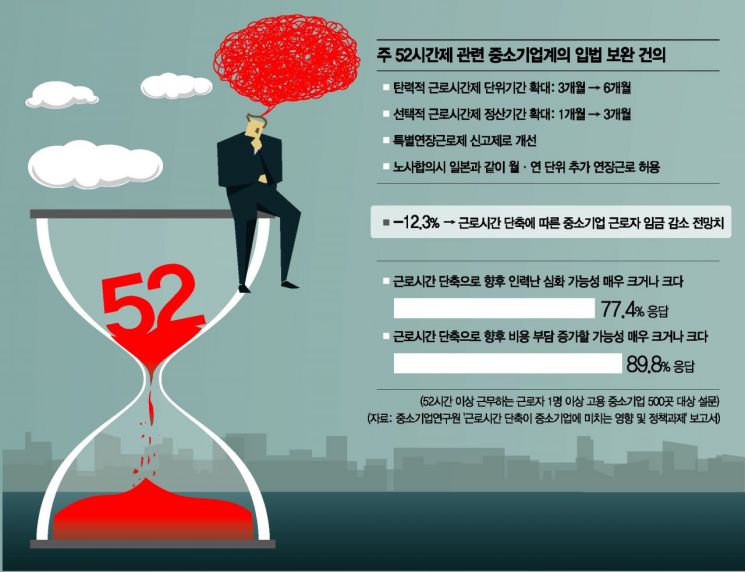 Table = Legislative Supplement Proposals from the Small and Medium Business Sector Regarding the 52-Hour Workweek System. Source = Korea Institute for Small and Medium Enterprises Research
According to the report "The Impact of Working Hours Reduction on SMEs and Policy Tasks," published by the Small and Medium Business Research Institute citing data from the National Assembly Budget Office (2018), wages for workers in workplaces with 30 to 299 employees are expected to decrease by 12.3% due to the reduction in working hours.
The report surveyed 500 SMEs employing at least one worker working more than 52 hours per week, and 77.4% of respondents answered that "there is a very high or high possibility that labor shortages will worsen due to the reduction in working hours." By industry, manufacturing (82.5%) showed a higher concern for the possibility of worsening labor shortages compared to service industries (60.0%) and other sectors (78.1%). Additionally, 89.8% of respondents answered that "there is a very high or high possibility that cost burdens will increase due to the reduction in working hours."
Legislative Improvements Needed to Minimize Side Effects of 52-Hour Workweek Introduction in SMEs
Automotive parts manufacturer Company B in Cheonan, Chungnam, has recently seen a slight increase in orders. Currently, there is no significant difficulty in supply due to production being nearly halved by COVID-19 damage, but if the situation calms and production recovers to last year's level, it will be necessary to expand production personnel by 20% to properly apply the 52-hour workweek system. Currently, they operate two shifts of 10 hours each, but plan to switch to a three-shift system with four days of work followed by two days off. Of the company's 220 employees, 170 are production workers.
Kim Sungwoo, the plant manager (pseudonym) of this company, expressed concern, saying, "The operating profit margin in the automotive parts industry is in the 3% range, and before the shock of COVID-19 has even subsided, the increased minimum wage has added to management burdens, making it very difficult for the company to handle the introduction of the 52-hour workweek system."
The SME sector is strongly demanding legislative improvements at the National Assembly level to minimize the side effects of the 52-hour workweek system introduction on the ground. The main proposals include ▲expanding the unit period of the flexible working hours system (from 3 months to 6 months) ▲extending the settlement period of the selective working hours system (from 1 month to 3 months) ▲improving the special extended working hours system to a reporting system ▲allowing additional extended working hours on a monthly or yearly basis with labor-management agreement, similar to Japan.
Chumungap Chu, head of the Economic Policy Department at the Korea Federation of SMEs, emphasized, "If COVID-19 calms down next year and global economic activities resume, a consumption surge is expected," adding, "To fully utilize this opportunity, laws and systems must be improved in advance, and the most urgent part is the supplementation of the 52-hour workweek system." Nominseon, head of the Future Strategy Research Group at the Small and Medium Business Research Institute, stressed, "For effective reduction of working hours, productivity improvement in SMEs must accompany it."
© The Asia Business Daily(www.asiae.co.kr). All rights reserved.


















