Long-term, High-sensitivity Observation of Gene Movement Inside Cells
Observation of 'DNA Condensation Structures' Affecting Gene Expression Possible
[Asia Economy Reporter Hwang Junho] A technology has been developed to track the movement of genes (DNA) inside cells using gene-editing scissors (CRISPR) technology. This allows real-time observation of changes in chromatin structure, which is the condensed form of DNA. It is expected to contribute to finding the link between chromatin structural changes, gene expression, aging, and cancer.
The research team led by Professor Kim Hajin of the Department of Biomedical Engineering at Ulsan National Institute of Science and Technology announced on the 12th that they developed a technology to track the movement of genes clustered inside the cell nucleus by applying gene-editing scissors technology. The results of this study were recently published in Genome Research.
Real-time Chromatin Tracking with Gene-Editing Scissors

Gene-editing scissors are a technology that edits specific regions (genes) within genes to correct genetic diseases. It consists of a 'scissor enzyme' that cuts specific regions (genes) of DNA and a 'gRNA' that guides this enzyme.
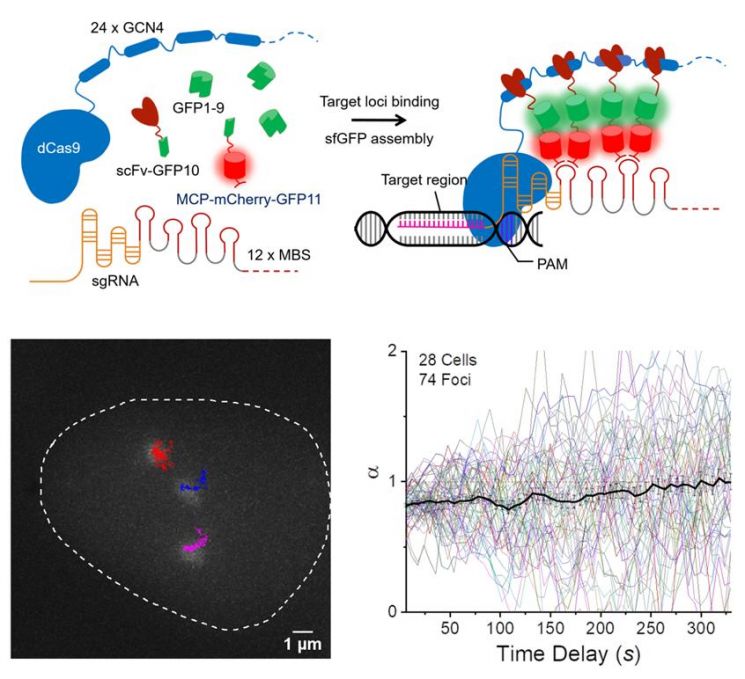
The research team attached a fluorescent protein composed of three fragments that bind to specific regions of the gene to the scissor enzyme. By analyzing the light emitted from the fluorophore, the position and shape of the gene can be tracked in real time. Additionally, a technique to reduce 'noise signals' during the position tracking process was applied, resulting in higher accuracy and resolution than existing gene-editing scissor-based imaging methods, and enabling long-term tracking of gene positions.
The research team stated that this technology allows real-time observation of chromatin structural changes. Chromatin is a structure that condenses 2 meters of DNA into a cell nucleus only a few microns in size.
Professor Kim Hajin explained, "To find the precise link between chromatin structural changes, gene expression, aging, and cancer, it is necessary to develop new technology that can observe chromatin movement in real time."
Genes Unfold but Also Move

In particular, the research team confirmed that genes not only show passive diffusion like ink spreading in water but also actively move their positions. This was the result of long-term tracking of the movement of specific DNA regions using the newly developed imaging technique.
First author researcher Narendra Chadri stated, "Since genes are tangled long threads, it was expected that without active movement they would not diffuse, but this study confirmed that they exhibit superdiffusion."
This aligns with recent research findings that genes actively move during various genetic information processing steps. Previously, it was known that genes do not move, and protein enzymes find the genes to repair damaged parts or express the genetic information stored in the genes.
Professor Kim expressed hope, saying, "By combining the developed chromatin imaging technology with chromatin 3D structural measurement technology, new biomarkers for genomic diseases such as cancer can be discovered and utilized for disease diagnosis and treatment."
© The Asia Business Daily(www.asiae.co.kr). All rights reserved.



















