Citizens' 'Complaints' Over Not Visiting Hometown
Chuseok Holiday Followed by Hangul Day Holiday

[Asia Economy Reporters Choi Dae-yeol, Lee Seung-jin, Jung Dong-hoon] Concerns over the resurgence of COVID-19 continue unabated as the Hangul Day holiday follows the Chuseok holiday. During the five-day Chuseok holiday, there was a possibility of 'silent transmission,' and since the incubation period for infections during the holiday is uncertain, cluster outbreaks could occur anytime and anywhere. Although the special quarantine period set by the authorities is scheduled to last until the 11th, travel is expected to be crowded nationwide during the Hangul Day holiday as well, keeping health authorities on high alert.
Hotels and resorts at major tourist destinations across the country were already almost fully booked on the 8th, a day before the holiday. Jeju Shilla Hotel has no vacancies for three days starting from the 9th, and Shilla Stay Jeju, a business hotel in Jeju City, is also fully booked. Jeju Art Villas, operated by Lotte Resort, is expensive at around 500,000 to 1,800,000 KRW per night, but rooms are hard to find. During last Chuseok, the reservation rate was about 90%, and now only one room remains available for the Hangul Day holiday.
It is estimated that about 195,000 travelers visited Jeju during the last holiday. Jeju Province expects more than half of that number, around 100,000 people, to visit during the Hangul Day holiday. Other tourist destinations are in similar situations. Lotte Resorts in Sokcho and Buyeo are fully booked for all rooms during this holiday following last Chuseok. Additionally, all major pensions and campgrounds nationwide are fully booked, with more travelers than during the summer vacation season in July and August.
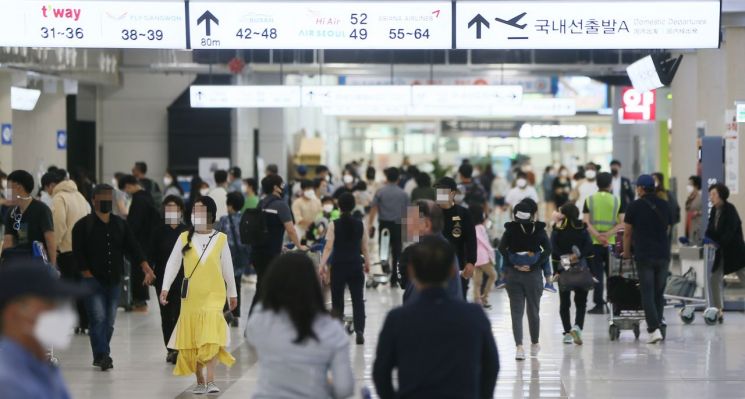 On the morning of the 2nd, the departure lounge on the 2nd floor of Jeju International Airport was bustling with returning travelers and tourists leaving Jeju after the Chuseok holiday.
Tourist Destinations Crowded with 100,000 Visitors in Jeju
Tourism Involving Contact with Numerous Unspecified People
Health Authorities on Alert for Cluster Outbreaks
The perception that 'being outdoors is safe' has spread, but health authorities explained that COVID-19 infection is quite possible if people are densely gathered and in close contact, even outdoors. According to the Central Disease Control Headquarters, since August, three members of a Sokcho travel group caused additional transmissions, resulting in 29 confirmed cases. Cluster outbreaks related to travel and tourist sites have continued steadily, including a Gonjiam acquaintance trip (12 people), Yeongnam golf trip (30 people), and Jeju guesthouse (17 people).
Health authorities have decided to adjust the current level 2 social distancing measures based on this week's situation. However, with increased travel expected during the upcoming holiday, it is difficult to lower restrictions immediately. Jeju Province will continue COVID-19 diagnostic testing for travelers showing fever symptoms upon arrival until the 11th. Busan, which saw many new cases during the holiday, has designated an entire building as a special quarantine zone, tightening control measures. Gangwon Province, which had no new local cases during the holiday, plans to continue restrictions on high-risk facilities for the time being.
As tourism involving contact with numerous unspecified people increases significantly, citizens who refrained from visiting their hometowns during Chuseok and followed quarantine rules feel a sense of frustration. They say COVID-19 after the holiday is more frightening than going to work. Office worker Lee Chan-ah (36) said, "I stayed home during the Chuseok holiday, but when I went to work, everyone was talking about their trips," adding, "I feel frustrated, wondering if following the quarantine rules alone is worth it."
© The Asia Business Daily(www.asiae.co.kr). All rights reserved.


















