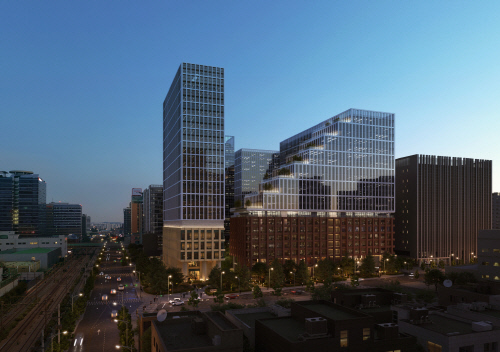
In the era of low interest rates, small residential facilities within industrial complexes are gaining popularity among investors. Being located within industrial complexes, they can secure a strong demand base from workers who have a high need for proximity between home and workplace. Additionally, they are preferred because they can be operated stably due to easy access to transportation networks and convenience facilities, as well as other living infrastructure.
According to KB Kookmin Bank's real estate market prices, the ‘Hanla Villions’ officetel in Guro-dong, Guro-gu, located within the Seoul Digital Industrial Complex, records an annual yield of about 5.1% (based on a sale price of 162.5 million KRW, deposit of 10 million KRW, and monthly rent of 650,000 KRW) for a 25㎡ exclusive area. Considering that the average officetel yield in Seoul is in the 4% range (according to Real Estate 114), this is a higher level.
Also, the ‘Nonhyeon Duson Gisel Tower’ officetel in Nonhyeon-dong, Namdong-gu, Incheon, near the Namdong National Industrial Complex, shows an annual yield of 6.1% (sale price 102.5 million KRW, deposit 5 million KRW, monthly rent 500,000 KRW) for a 31㎡ exclusive area. This also exceeds the average officetel yield in Incheon (in the 5% range).
The high value of income-generating residential facilities near industrial complexes is due to the stable demand base. For example, Seoul’s representative industrial complex, Seoul G-Valley, employs about 150,000 people; Gyeonggi-do’s Banwol National Industrial Complex has about 130,000 workers; and Incheon’s Namdong National Industrial Complex has about 100,000 workers. With hundreds of thousands of employees working in these industrial complexes, securing demand is relatively easy.
Furthermore, since tens of thousands of workers are employed in industrial complexes, transportation conditions such as railroads and road networks, as well as living infrastructure like cultural and convenience facilities, are well established, making actual residence comfortable without inconvenience.
An industry insider said, “In areas where industrial complexes are established, various convenience facilities are provided nearby, making the living environment convenient. Also, with the element of proximity between home and workplace that facilitates commuting, the investment value is high. Due to the steady demand base, vacancy rates are low and yields are high, which greatly influences asset value appreciation. Therefore, in the era of low interest rates, these properties are expected to continuously attract investors' attention.”
This year as well, income-generating residential facilities targeting industrial complex workers are being supplied and are noteworthy. Hyundai Construction will sell ‘Public House,’ a dormitory within the Hyundai Knowledge Industry Center Gasan Public, in October. It is located in a separate building (Building C) from the 6th to the 26th floor within the ‘Hyundai Knowledge Industry Center Gasan Public,’ with exclusive areas ranging from 20 to 30㎡ and a total of 567 units.
In particular, this complex is located within the Seoul Digital National Industrial Complex, the largest national industrial complex in Seoul, characterized by a rich demand base. Currently, about 10,000 companies and approximately 150,000 workers are employed in the Seoul Digital National Industrial Complex.
Also, being located within a national industrial complex makes it easy to use various living infrastructures. First, it is a station-area complex within walking distance of Gasan Digital Complex Station, a transfer station for subway lines 1 and 7, making commuting easy for employees. Nearby are road networks such as Seobu Expressway, Nambu Circular Road, and Export Bridge.
Additionally, fashion outlets such as Mario Outlet, W Mall, Hyundai Outlet (Gasan branch), and Lotte Factory Outlet (Gasan branch) are within walking distance, and large distribution facilities like Big Market (Geumcheon branch), Homeplus (Geumcheon branch), and E-Mart (Guro branch) are located within about 1 km radius.
Since Public House is developed within the Seoul city’s largest knowledge industry center with a total floor area of about 260,000㎡, which is 36 times the size of a soccer field (7,140㎡), various convenience facilities are easily accessible. Approximately 42% of the entire complex is composed of green spaces such as large planting areas, waterside gardens, and small gardens, creating a pleasant residential environment. Village-type commercial facilities including mall functions are arranged around a park, allowing for comfortable shopping.
The interior is designed as a product at the level of an officetel reflecting a hotel-style concept. It is equipped with appliances and furniture such as a washer and dryer, built-in freezer and refrigerator, built-in wardrobe, built-in storage, a dry powder room combined lower cabinet washbasin, and pantry.
Additionally, next to the entrance door, delivery services that handle laundry collection and delivery, as well as service boxes for parcel storage, are installed to enhance convenience for residents. Especially for privacy, the entrance is separated from the office facilities, and various auxiliary facilities such as a lounge, coin laundry, and shared kitchen (open kitchen) are created on the 3rd floor above ground to improve residents’ convenience.
© The Asia Business Daily(www.asiae.co.kr). All rights reserved.
![User Who Sold Erroneously Deposited Bitcoins to Repay Debt and Fund Entertainment... What Did the Supreme Court Decide in 2021? [Legal Issue Check]](https://cwcontent.asiae.co.kr/asiaresize/183/2026020910431234020_1770601391.png)















