Over 105,000 Agree to Cheongwadae Petition
Realtors Angry as Regulations Increase Amid Transaction Cliff
Transaction System Without Realtors... Threatening Livelihoods
Public Opinion Cold... Commission Fees Must Be Lowered First
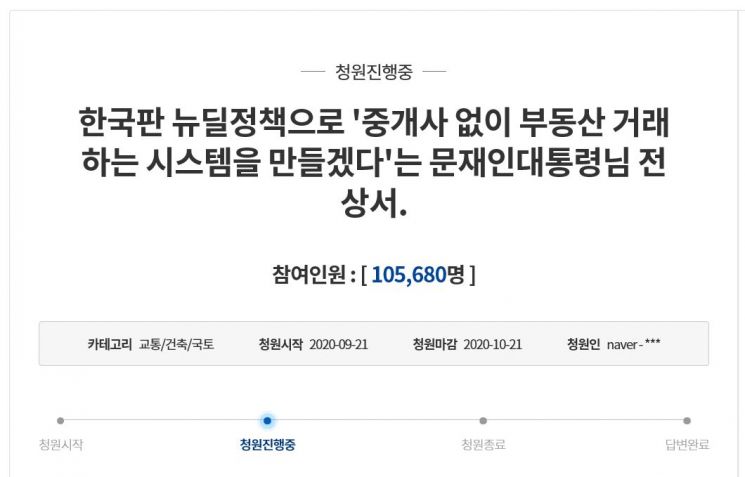
[Asia Economy Reporter Moon Jiwon] The survival rights struggle of real estate agents, which began after the government announced plans to establish a system that allows real estate transactions without licensed real estate agents, has continued for more than ten days.
Analysts say that the agents' anger exploded as the government repeatedly announced policies to review brokerage fee adjustments and reform the real estate transaction system amid a situation where their workload has decreased due to successive real estate measures.
However, public opinion is divided. While some argue that the government's unilateral policy without prior discussion has caused another backlash, others believe innovation is inevitable considering high brokerage fees, false listings, and brokerage accidents.
Cheong Wa Dae Petition Surpasses 100,000 Signatures... Opposition Intensifies
According to the real estate brokerage industry on the 4th, opposition from agents continues against the government's plan to reform the real estate transaction system. As of this day, over 105,600 people have agreed to a related petition posted on the Cheong Wa Dae (Blue House) National Petition Board on the 21st of last month.
On social networking services (SNS) where agents gather, voices are pouring in saying, "The government's plan to build a transaction system without agents is an attempt to suffocate agents," and "We must fight to protect our survival rights."
The reason agents are reacting so strongly is that the Ministry of Economy and Finance announced on the 1st of last month in the government budget plan that it intends to build a real estate transaction system that does not require licensed real estate agents.
The government explained that it plans to invest 800 billion KRW in the AI government construction project, one of the ten major tasks of the Korean New Deal, and that a demonstration project using blockchain for agentless real estate transactions is included in the detailed tasks.
In response, the association immediately issued a statement criticizing, "Talking about agentless transactions is desk administration and a dangerous idea that could cause consumer harm," and demanded, "Stop threatening the survival rights of agents immediately."
The association is continuing protests in front of the National Assembly in Yeouido, Seoul, even during the Chuseok holiday. An association official said, "Although the Ministry of Land, Infrastructure and Transport and others have stated they have no policy promotion plans, since the budget has been requested, we cannot trust this," adding, "We will continue to fight until we receive a clear answer from the government."
Increasing Brokerage Offices... Intensified Competition and Strengthened Regulations
Within the industry, it is analyzed that the strong opposition from agents is also influenced by accumulated dissatisfaction. The number of agents has increased significantly every year, making an already difficult situation tougher, and recent successive government regulations have reduced their workload and made their tasks more complicated.
Currently, about 450,000 people have obtained real estate agent licenses in Korea, and about 106,000 of them work as licensed real estate agents. There is much dissatisfaction that the number of active licensed agents has exceeded an appropriate level, leading to overheated competition and unnecessary openings and closures.
The association has been insisting for years that the agent exam should be changed to a relative evaluation system to gradually reduce the number of successful candidates, but the Ministry of Land, Infrastructure and Transport has not accepted this, citing the principle of freedom of career choice and stabilization of brokerage fees through competition.
The government's recent amendment of the Licensed Real Estate Agents Act, which significantly increased regulations on agents, has also fueled dissatisfaction. Since August, agents who post false or exaggerated advertisements on the internet face fines of up to 5 million KRW, and regulations have been strengthened to require disclosure of lot numbers when advertising all types of housing except detached houses.
Public Opinion Is Cold... Excessive Brokerage Fees Should Be Lowered First
Despite the agents' opposition, public opinion is generally cold.
One reason many consumers do not sympathize with the agents' survival rights struggle is the high brokerage fees. As housing prices continue to rise but the brokerage fee rates linked to them remain unchanged, voices are growing that the fee burden for real estate transactions is excessive.
In fact, on real estate online communities, complaints such as "The brokerage fee was much higher than my monthly salary" or "Agents receive too much money compared to the service" are easily found.
Currently, in Seoul, the brokerage fee rates for sales transactions are based on the transaction amount: under 50 million KRW 0.6% (up to 250,000 KRW), 50 million to 200 million KRW 0.5% (up to 800,000 KRW), 200 million to 600 million KRW 0.4%, 600 million to 900 million KRW 0.5%, and over 900 million KRW up to 0.9%.
If a sales contract is made for a 1 billion KRW house, applying the highest rate, the brokerage fee that the agent receives from both buyer and seller amounts to 18 million KRW. Even if the rate is negotiated down, buyers and sellers inevitably face an additional burden of several million KRW.
Another problem is that the indemnity insurance that brokerage offices subscribe to for transaction accidents is only at least 100 million KRW, so it is hard to say that transactions through agents are absolutely safe.
Moreover, the 100 million KRW indemnity is the total compensation amount that one brokerage office can pay in one year, so even if consumers suffer damages due to agent negligence, it is not easy to receive full compensation.
In response, Minister of Land, Infrastructure and Transport Kim Hyun-mi stated at the National Assembly Land, Infrastructure and Transport Committee plenary meeting at the end of August, "We will consider improvement measures for (brokerage fee rates)."
However, since opposition from more than 100,000 agents is significant, actual system reform is expected to be difficult. A Ministry of Land, Infrastructure and Transport official explained, "We are looking at the market situation, but since we have to consider both the domestic brokerage industry and overseas situations, it is not an easy issue."
© The Asia Business Daily(www.asiae.co.kr). All rights reserved.
![Clutching a Stolen Dior Bag, Saying "I Hate Being Poor but Real"... The Grotesque Con of a "Human Knockoff" [Slate]](https://cwcontent.asiae.co.kr/asiaresize/183/2026021902243444107_1771435474.jpg)

















