"An Organization Needed to Oversee the Entire Process of Attracting Reshoring Companies"
[Asia Economy Reporter Kim Eun-byeol] Since the outbreak of the novel coronavirus disease (COVID-19), the 'Reshoring' policy, which encourages companies that expanded overseas to revitalize their home country's economy to return, is gaining momentum. From the companies' perspective, there is demand to return to the domestic market where infectious disease prevention measures are relatively better, so it is said that companies need to strategically prepare response plans by thoroughly understanding their core considerations.
According to the Korea Trade-Investment Promotion Agency and the Bank of Korea's regional economic reports on the 30th, since the enactment of the Returnee Company Act in December 2013, a total of 71 companies have returned to Korea as of May this year. Among them, small and medium-sized enterprises accounted for the majority with 62 companies.
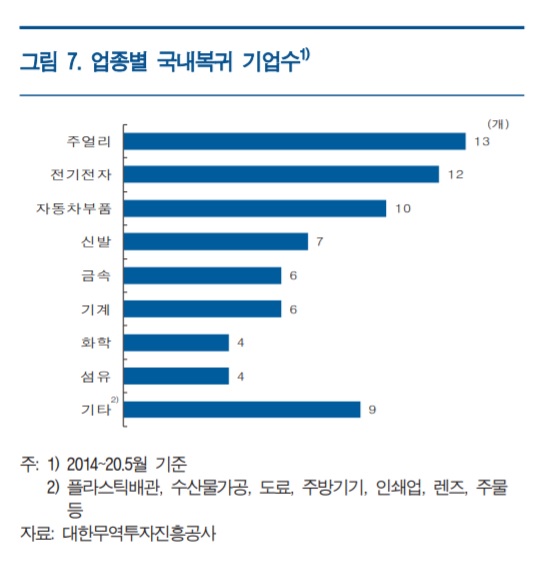
By industry, jewelry was the most common sector among returning companies with 13 companies, followed by electrical and electronics with 12 companies, automotive parts with 10 companies, and footwear with 7 companies. By region, Jeonbuk and the Busan·Ulsan·Gyeongnam areas each had 17 companies, followed by Daejeon·Chungnam (12 companies), Daegu·Gyeongbuk (11 companies), and Gyeonggi·Incheon (10 companies).
By country, most returns came from China, which initially had a high proportion of overseas expansion, with 64 companies returning.
The main reason overseas companies returned to Korea was primarily due to rising production costs abroad, which reduced profitability. Companies had moved to China to take advantage of low-wage structures, but as local wages increased, costs rose.
The second reason was the pursuit of high value-added products and utilization of the domestic market. Many companies have increasingly needed to use Korea's excellent labor force and components as they pursue strategies to increase product value-added. The reduction of incentives for foreign-invested companies in China and other countries, as well as the rising brand value of 'Made in Korea,' were also cited as reasons.
A Bank of Korea official stated, "Due to global trade disputes and COVID-19, the need to diversify global supply chains and production bases has increased, and the demand for companies to return domestically is likely to grow," and pointed out ▲ efforts to improve infrastructure ▲ fostering regional new growth industries ▲ industrial clustering as response measures.
They emphasized that direct financial support to returning companies could cause reverse discrimination, so efforts should focus on improving conditions such as infrastructure and creating long-term employment by linking with regional development strategies.
They also advised, "Rather than concentrating attraction efforts only on companies expressing interest in returning domestically, it is necessary to proactively identify target companies and systematize the entire process from selection to actual attraction." They stressed the need for a dedicated organization and specialized personnel to manage reshoring companies.
© The Asia Business Daily(www.asiae.co.kr). All rights reserved.

















