Foreign Media "Disappointed LNG and Byproduct Hydrogen Vehicles Included in Green New Deal Production"
KIET "Greenhouse Gas Reduction Target of 37% Compared to BAU Linked to Green New Deal
Must Ensure Consistency with Year-End Announcement of '2050 Long-Term Low Carbon Development Strategy'"
Consideration of Establishing a Whole-Government Agency for Green New Deal Promotion After 2025 Mentioned
"KEPCO and Samsung C&T's Investment in Vietnam Coal Power Plant Poses Diplomatic Risk Potential"
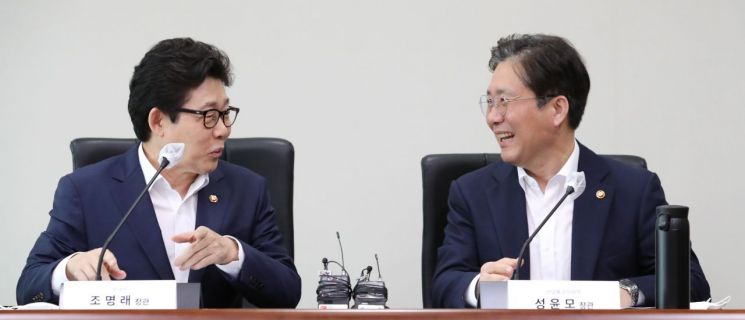 Minister of Environment Cho Myung-rae (left) and Minister of Trade, Industry and Energy Sung Yun-mo (right), the two leading figures of the "Green New Deal," attending the "1st Green New Deal Subcommittee Meeting" on the 12th of last month. The Ministry of Environment and the Ministry of Trade, Industry and Energy are the main ministries responsible for the Green New Deal policy. (Image source=Yonhap News)
[Asia Economy Reporter Moon Chae-seok] A national research institute has released a study suggesting that to achieve 'carbon neutrality (net zero carbon emissions)' by 2050, specific reduction targets linked to the '2030 National Greenhouse Gas Reduction Basic Implementation Plan,' which aims to reduce emissions by 24.4% compared to 2017 levels, must be presented.
Earlier, on July 24, 2018, the Ministry of Environment set a goal through a roadmap to reduce greenhouse gas emissions by 37% from the existing BAU (Business As Usual) level of 850.8 million tons to maintain emissions within 536 million tons.
On the 29th, the Korea Institute for International Economic Policy (KIEP) made this recommendation in a report titled "Policy Implications of the European Green Deal for Korea's Green New Deal."
◆ "Korea's Green New Deal, Part of Growth Strategy... Establish a Pan-Governmental Agency to Continue Efforts Beyond 2025"
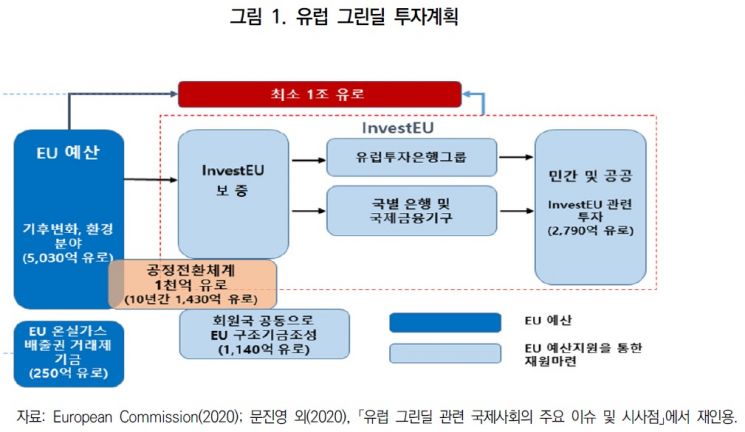
According to KIEP, Korea's Green New Deal has been criticized by foreign media for focusing more on job creation and corporate profits rather than the environment.
The Diplomat negatively evaluated Korea's Green New Deal for including projects such as the construction of liquefied natural gas (LNG) power plants that emit large amounts of methane gas and the production of hydrogen fuel cell electric vehicles (FCEVs) using by-product and extracted hydrogen.
KIEP acknowledged that Korea's Green New Deal is meaningful in raising awareness about the climate change crisis.
However, it emphasized the need to present bolder, more consistent, and clearer policy goals to guide society as a whole toward a transition to an eco-friendly green economy.
It also stressed the importance of linking the Green New Deal with the 'strengthening of safety nets,' another pillar of the 'Korean New Deal,' emphasizing a just transition, including the transition to a circular economy as a core agenda, and clearly defining the role of the Green New Deal under long-term goals beyond 2025.
KIEP suggested, "To ensure the Green New Deal is pursued consistently in the medium to long term, it may be worth considering establishing a pan-governmental promotion system or agency."
◆ "Link with Targets Presented in the '2030 Roadmap'... Consistency with the '2050 Low Carbon Strategy' by Year-End"
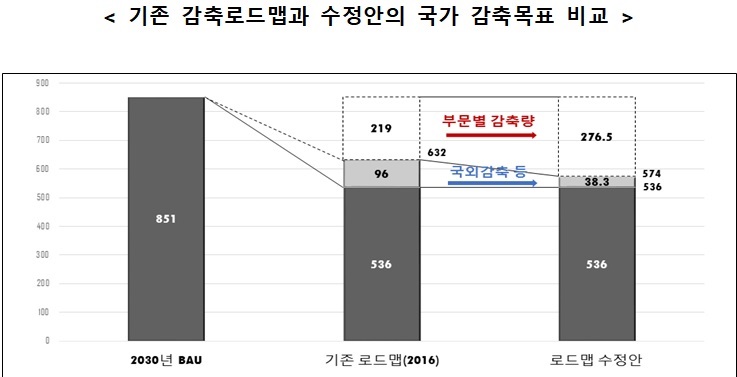 The Ministry of Environment announced the "2030 Greenhouse Gas Reduction Roadmap Revision and 2018-2020 Emission Allowance Allocation Plan" on July 24, 2018. The Ministry set a goal to reduce 37% from the original roadmap's greenhouse gas emission forecast of 850.8 million tons, maintaining emissions within 536 million tons. (Source: Ministry of Environment)
KIEP reported that the European Green Deal prioritizes '2050 carbon neutrality' and proposed the 'European Climate Law,' which stipulates specific implementation and evaluation plans.
It argued that Korea should not only specify 'carbon neutrality by 2050' but also present a long-term and detailed roadmap.
During the 21st National Assembly, resolutions such as the 'Climate Crisis Response Urging Resolution,' 'Climate Crisis Emergency Resolution,' and 'Climate Crisis Emergency Declaration' were proposed, and related content is expected to be included in the 'Green New Deal Basic Act.'
However, to achieve 'carbon neutrality by 2050,' carbon emissions must be drastically reduced over the next decade, requiring more proactive goals and measures than existing reduction plans.
KIEP emphasized, "It is necessary to present specific sectoral reduction targets linked at least to the '2030 National Greenhouse Gas Reduction Basic Implementation Plan' targets and design them to be consistent with the '2050 Long-term Low Carbon Development Strategy' to be announced later this year."
◆ "KEPCO and Samsung C&T's Investment in Vietnam Coal Power Plant Could Become a Diplomatic and Trade Risk"
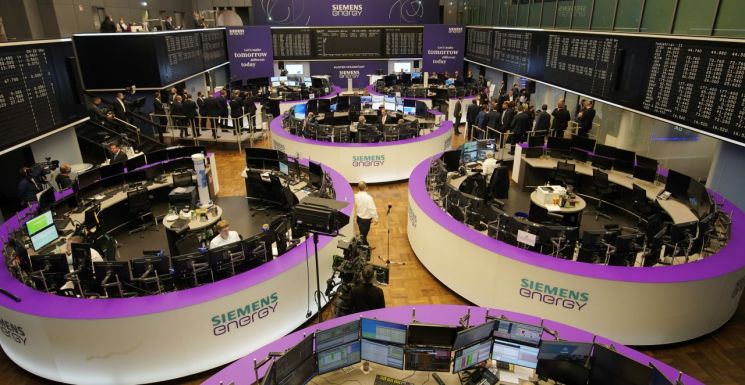
KIEP urged Korea to lead the climate change agenda by supporting the green transition not only in the EU and the US but also in developing countries such as China and India. It stressed the need to have a concrete strategy to prepare for the EU's carbon border tax, which will be implemented in 2023.
It recommended supporting companies and institutions to lead in standard competition in fields such as renewable energy, electric vehicle batteries, and hydrogen.
It warned to be cautious as inconsistencies between environmental policies and diplomatic, trade, and international cooperation policies could lead to disadvantages.
As a representative example, it pointed out the Vung Ang 2 coal-fired power plant project in Vietnam, being pursued by Korea Electric Power Corporation (KEPCO) and Samsung C&T.
KIEP warned, "This project is reportedly facing divestment pressure from European pension fund asset managers such as Norway's KLP and Denmark's MP Pension."
© The Asia Business Daily(www.asiae.co.kr). All rights reserved.
![Clutching a Stolen Dior Bag, Saying "I Hate Being Poor but Real"... The Grotesque Con of a "Human Knockoff" [Slate]](https://cwcontent.asiae.co.kr/asiaresize/183/2026021902243444107_1771435474.jpg)


















