Seoul Sauna Cluster Infection Continues
5 Additional Cases Confirmed Related to Gwanak-gu Sauna
Infection Risk Factors Include Close Contact Such as Family Meals and Conversations
Experts Warn "High Infection Risk in Saunas and Jjimjilbangs, Caution Needed"
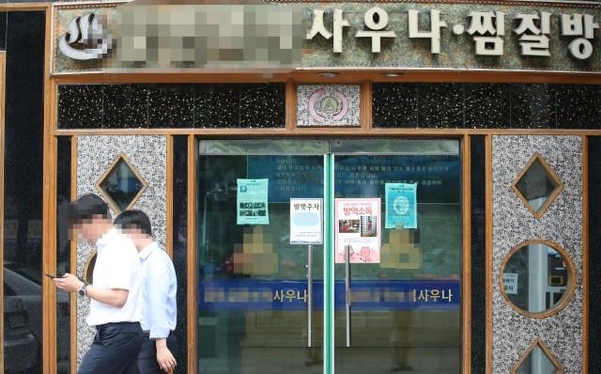 On the afternoon of June 12, citizens are passing by a jjimjilbang in Seocho-gu, Seoul, where a confirmed case of the novel coronavirus infection (COVID-19) had visited. Photo by Yonhap News
[Asia Economy Reporter Kim Suwan] "Saunas are fine!", "I go because the membership is a waste."
As the spread of the novel coronavirus infection (COVID-19) continues in saunas in Dobong-gu and Gwanak-gu, Seoul, some people appear to have no hesitation in using saunas, raising concerns that COVID-19 might be spreading centered around saunas.
According to the Central Disease Control Headquarters (CDCH) of the Korea Disease Control and Prevention Agency on the 28th, a cluster infection that occurred at the Yemarudaycare Center, a senior care facility in Dobong-gu, spread to the nearby 'Hwangsil Sauna,' resulting in 3 additional confirmed cases related to this sauna.
According to epidemiological investigations, a confirmed case who used the center visited Hwangsil Sauna, and sauna staff and users who came into contact with this confirmed case were additionally infected.
Also, the number of confirmed cases related to the Sammos Porex Sauna in Gwanak-gu increased by 5, reaching a total of 29 (26 in Seoul). All additional confirmed cases are family members and acquaintances of sauna users who tested positive, representing 'n-th generation infections.'
The health authorities identify close contact such as family meals and conversations as risk factors for infection.
Jung Eun-kyung, head of the CDCH, said on the day, "Looking at the main transmission patterns in the past week, transmissions through multi-level marketing, investment briefings, medical institutions, restaurants, saunas, and other multi-use facilities have continued to occur," adding, "The risk routes for cluster outbreaks are similar. The risk factors for infection are presumed to be transmission through close contact such as family meals and conversations."
Despite the situation, voices saying it is okay to go to saunas have emerged, causing controversy. On various online communities such as mom cafes, it is not difficult to find posts like "My mother says saunas are okay," "People around me are suggesting going to saunas," and "How can we change people's complacent thinking?"
One member said, "My mother keeps going to the sauna despite the COVID-19 situation. I tried telling her not to go and even argued, but she just insists," adding, "She says washing with water and soap makes it safer than other places, but I was at a loss for words. In fact, there are many elderly people like my mother. Shouldn't we completely block access to such risky facilities?"
Another member said, "I often hear people around me suggesting going to saunas. Although confirmed cases have decreased significantly, social distancing is still in effect and the risk remains high. It seems many people are thoughtless," criticizing, "Why don't they realize that someone's complacency can cause suffering for many?"
The bigger problem is that infections can occur within families in such cases. Also, with the Chuseok holiday approaching, there are concerns that it could spread as a cluster infection in the community.
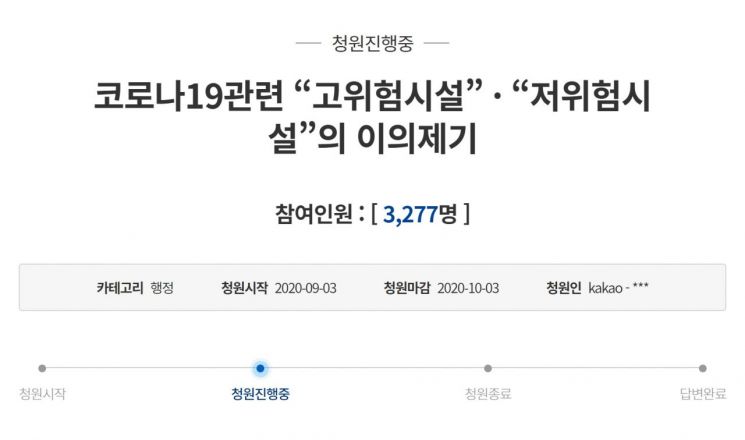
As a result, some voices call for a complete suspension of facility use amid concerns. Despite the continuous occurrence of COVID-19 confirmed cases, using multi-use facilities like bathhouses is considered an act that harms family and others.
On the 3rd, a petition titled "Objection to High-Risk and Low-Risk Facilities Related to COVID-19" was posted on the Blue House National Petition Board. The petitioner questioned, "How are industries such as churches, academies, shopping centers, department stores, coffee shops, restaurants, saunas, massage parlors, and massages classified as 'low-risk facilities' compared to 'high-risk facilities,' allowing them to continue operating in the blind spots of COVID-19?" adding, "All places where people go have heating and cooling, are enclosed spaces, and have the same risks. Close contact risks lurk everywhere. Rather, facilities classified as 'low-risk' may cause us to be more complacent in our vigilance against COVID-19 because of that label."
Experts pointed out the need for active management of spaces with conditions conducive to easy infection transmission.
Professor Eom Jung-sik, an infectious disease specialist at Gachon University Gil Medical Center, advised, "In enclosed spaces such as saunas, bathhouses, and jjimjilbangs where ventilation is poor, the risk of infection increases when people have close contact without masks," adding, "Active management and measures are necessary for such high-risk spaces."
© The Asia Business Daily(www.asiae.co.kr). All rights reserved.
![Clutching a Stolen Dior Bag, Saying "I Hate Being Poor but Real"... The Grotesque Con of a "Human Knockoff" [Slate]](https://cwcontent.asiae.co.kr/asiaresize/183/2026021902243444107_1771435474.jpg)


















