Ministry of Environment's '3rd Greenhouse Gas Emission Allowance Allocation Plan' Approved at Cabinet Meeting
6.097 Billion Tons of Greenhouse Gas Emissions Allowed from 2021 to 2025
Emission Factors: Coal Reduced, LNG Increased
Free Allocation Allowances: Coal Decreased, LNG Increased
Power Industry "Electricity Rates Will Rise Due to Cost Increase" vs Government "No Cause for Rate Increase"
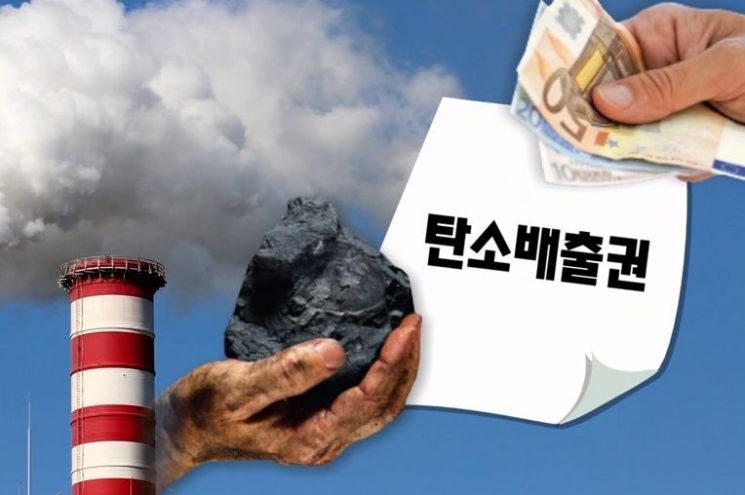
[Asia Economy Reporter Moon Chae-seok] The '3rd National Greenhouse Gas Emission Allowance Allocation Plan (3rd Plan)' to be applied for the next five years starting next year has been finalized. The core of this plan is to increase the proportion of paid emission allowances that companies must purchase and to allocate allowances favorably to companies that emit fewer greenhouse gases relative to their production activities. It aims to strengthen the coal greenhouse gas emission factor and ease the liquefied natural gas (LNG) emission factor, thereby reducing free allowances allocated to coal and increasing those for LNG.
The Ministry of Environment stated that if the Ministry of Trade, Industry and Energy introduces a total coal generation cap and coal price bidding system by the first half of 2023, it will not introduce the integrated emission efficiency standard allocation method (BM) coefficient for the power generation sector. BM is a method of calculating emission allowance allocation based on a company's greenhouse gas emission efficiency, favoring companies with higher emission efficiency. The emission allowance allocation for the power generation sector is calculated by multiplying the past power generation performance of each power plant by the emission factor. The higher the emission factor value, the more free allowances are received; the lower it is, the fewer allowances are received.
Compared to the 2nd plan period (2018?2020), the 3rd plan reduces the coal emission factor and raises the LNG emission factor. Especially, during the second phase of the 3rd period (2024?2025), an integrated BM coefficient plan applying the same emission factor to both coal and LNG power generation was proposed. Although it seems that the integrated BM coefficient will not be applied if the Ministry of Trade, Industry and Energy introduces the total coal generation cap and coal price bidding system by the first half of 2023, coal power producers have opposed, stating that regardless of the introduction of the integrated BM coefficient, the emission factor is being strengthened and the proportion of paid allowances is increasing, which will inevitably increase power generation costs.
◆Ministry of Environment: "If Coal Total Cap and Price Bidding System Are Introduced, Integrated BM Coefficient Will Not Be Applied"
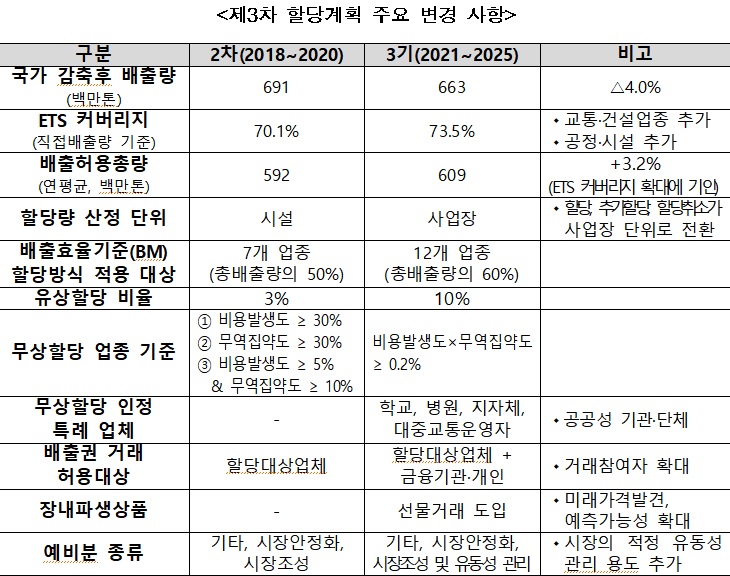
The Ministry of Environment announced that the '3rd National Emission Allowance Allocation Plan' was approved at the Cabinet meeting on the 29th. It plans to complete the designation of companies subject to emission allowance allocation and the allocation itself by the end of the year and to promote the 3rd greenhouse gas emission trading system starting January 1 next year.
The 3rd plan, to be introduced from next year until 2025, features an increase in the total allowable emission allowances compared to the 2nd plan (applied 2018?2020), but expands the proportion of paid allowances that companies must purchase and establishes an evaluation system favorable to companies emitting fewer greenhouse gases. A total of 609.7 million tons of emission allowances will be permitted, with the paid allowance proportion increasing from 3% to 10%. Paid allowances mean that companies subject to emission allowance trading, allocated by the Ministry of Environment, purchase allowances through auctions or other means. The more greenhouse gases a company emits, the greater its burden.
On this day, the Ministry of Environment stated that if the Ministry of Trade, Industry and Energy introduces the total coal generation cap and price bidding system by the first half of 2023, the integrated BM coefficient will not be applied. If the integrated BM coefficient is applied, the greenhouse gas emission factor for coal and LNG power generation will be the same at 0.6821889 during 2024?2025. If the Ministry of Environment does not introduce the integrated BM coefficient, the coal factor for 2024?2025 will be 0.7086734, and the LNG factor will be 0.4545114. Currently, under the 2nd plan, the coal factor is 0.8869770, and LNG is 0.3889024. Regardless of the introduction of the integrated BM coefficient, the coal factor will decrease and the LNG factor will increase, reducing free allowances allocated to coal and increasing those for LNG.
A power generation industry official said, "If the integrated BM coefficient is applied, LNG power plants will receive many free allowances relative to their greenhouse gas emissions, lowering their incentive to reduce emissions," and added, "There is a high possibility of windfall profits from selling surplus allowances."
An official from the Ministry of Environment explained, "If the Ministry of Trade, Industry and Energy introduces the total coal generation cap and price bidding system by the first half of 2023, a single BM coefficient will not be applied," adding, "The Ministry of Trade, Industry and Energy says it could be implemented as early as 2022, but since there are no concrete details on when and how it will be applied, we have informed them of the review of the integrated BM coefficient implementation and set the first half of 2023 as the deadline."
◆Power Generation Industry: "Electricity Rates May Rise Due to Increased Costs" vs Ministry of Environment: "No Factor for Rate Increase"
 Electricity bill. (Image source=Yonhap News)
Regardless of whether the integrated BM coefficient is introduced, if free allowances allocated to coal power generation decrease, the cost burden on the power generation industry is expected to increase. The industry says Korea Electric Power Corporation (KEPCO) will have no choice but to raise electricity rates.
The power generation industry argues that ▲ KEPCO and affiliated power companies' emission allowance trading costs will surge, and ▲ following the government's '9th Basic Plan for Electricity Supply and Demand' to reduce coal and increase LNG, the market entry of new LNG power plants will increase, ultimately leading KEPCO to raise electricity rates.
An industry official said, "Despite the fundamental differences in fuel characteristics between coal and LNG, artificially applying a uniform coefficient at the overall average level will cause excessive emission allowance trading costs for coal power plants, raising concerns about a sharp increase in electricity rates," adding, "If the paid allowance ratio rises from 3% to 10%, it will directly increase costs in the power generation sector, becoming a factor for electricity rate hikes and ultimately imposing economic burdens on all industrial sectors."
The Ministry of Environment drew a line, stating that strengthening the coal power emission factor and increasing paid emission allowances will not lead to electricity rate hikes. KEPCO separately settles greenhouse gas emission allowance costs, and if the environmental premium arising after the implementation of the 3rd plan is reflected in fuel costs, KEPCO's profits will not change.
An official from the Ministry of Environment explained, "Although the cost of purchasing greenhouse gas emission allowances by the coal power industry is expected to rise after the 3rd plan is implemented, it will not lead to electricity rate hikes," adding, "Nationally, as coal power sales costs increase, LNG power sales costs decrease, so the factor for electricity rate increases will not be significant."
In response, a power generation industry official said, "The Ministry of Environment's explanation assumes the introduction of a fuel cost linkage system," adding, "Even if such a linkage system is introduced, the cost burden will inevitably increase due to the strengthened emission factors and increased paid allowance ratio in the 3rd plan, and it cannot be ruled out that this will ultimately act as a factor for electricity rate hikes."
© The Asia Business Daily(www.asiae.co.kr). All rights reserved.


















