August Industrial Production Declines for First Time in 3 Months
Corporate Sentiment Also Drops After Five Months
Bank of Korea Warns of -2% Growth Rate if COVID Resurgence Continues Through Year-End
[Asia Economy Reporters Eunbyeol Kim and Sangdon Joo] Chuseok, one of South Korea's biggest holidays, is expected to become another critical test for this year's economic growth rate. This year, after holidays in May and August, there was a tendency for COVID-19 to spread, making it inevitable to revise growth forecasts downward. Attention is now focused on whether the 'growth rate jinx' will be broken by successfully navigating through Chuseok.
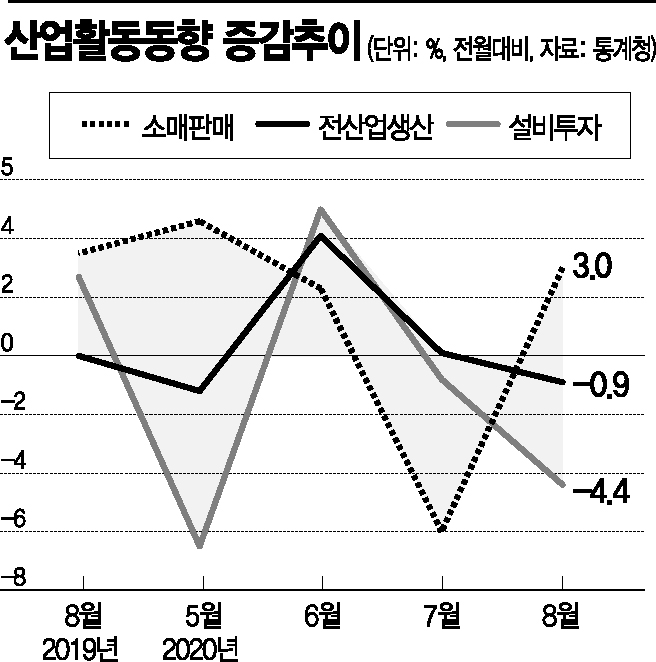
On the 29th, the Statistics Korea and the Bank of Korea each released the 'August 2020 Industrial Activity Trends' and the September Business Survey Index (BSI), which clearly reflected the impact of the COVID-19 resurgence since mid-August. According to the August Industrial Activity Trends, total industrial production (seasonally adjusted, excluding agriculture, forestry, and fisheries) decreased by 0.9% compared to the previous month. This marks the first decline in three months since May (-1.2%). Service sector production, which had increased for four consecutive months, turned to a decrease, and manufacturing production, which had risen for two months, also declined. Service sector production fell by 1.0% month-on-month due to the direct hit from COVID-19 on accommodation and food services (-7.9%) and wholesale and retail trade (-1.5%). Mining and manufacturing decreased, causing overall mining and manufacturing production to drop by 0.7% month-on-month, despite increases in electricity and gas sectors. Particularly, manufacturing production declined by 1.0% month-on-month due to decreases in food products (-7.3%) and automobiles (-4.1%).
Among the 'Industrial Activity Trends' announced by Statistics Korea that day, the coincident and leading index cyclical components showed improvement. The coincident index cyclical component, which indicates the current economic condition, rose by 0.4 points from the previous month to 97.6. The leading index cyclical component, which forecasts future economic conditions, increased by 0.6 points to 100.9. However, the Business Survey Index, which significantly influences the leading index cyclical component, was surveyed before the COVID-19 resurgence, so the impact of COVID-19 was not fully reflected.
The economic sentiment of businesses and the public also showed signs of deterioration again. The Bank of Korea announced that the all-industry Business Survey Index (BSI) for this month was 64, down 2 points from the previous month. After steadily recovering since April (51), the BSI fell for the first time in five months. The non-manufacturing BSI, which has a high proportion of face-to-face industries, was particularly weak at 62, down 4 points. The manufacturing BSI generally showed recovery, but manufacturing small and medium enterprises recorded 58, down 4 points from the previous month (62). The Economic Sentiment Index (ESI), which reflects the comprehensive economic sentiment of businesses and households, fell by 6.5 points from the previous month to 73.2.
The government and the Bank of Korea view the Chuseok holiday as an important turning point for this year's economic growth rate. In the past, COVID-19 spread during holidays, leading to strengthened quarantine measures and economic shocks. Previously, the Bank of Korea revised its growth forecast downward from 2.1% to -0.2% in May and further lowered it to -1.3% in August. The basic scenario of the August economic outlook assumed that the COVID-19 resurgence would begin to subside from October, meaning that whether the spread of COVID-19 calms down after Chuseok is crucial. The Bank of Korea stated in the August forecast that if the COVID-19 resurgence continues through winter, a growth rate in the -2% range cannot be ruled out. The Bank of Korea will revise the growth forecast for the last time this year in November.
A Bank of Korea official said, "To properly assess whether the third quarter is moving as expected, we need to check not only the industrial activity trends but also export indicators. Regarding exports, since the number of working days was affected by the Chuseok holiday in early September last year, comparisons must take this into account. Also, to be confident that the economy is on an improving trend, the improved coincident index should be examined by its components."
© The Asia Business Daily(www.asiae.co.kr). All rights reserved.
![Clutching a Stolen Dior Bag, Saying "I Hate Being Poor but Real"... The Grotesque Con of a "Human Knockoff" [Slate]](https://cwcontent.asiae.co.kr/asiaresize/183/2026021902243444107_1771435474.jpg)
















