3Q Earnings Rebound Across the Board... S-Oil and SK Innovation Expected to Return to Profit
Stock Prices Still Weak... Weak Refining Margins Also a Negative Factor
Energy Business Interest Shifts to Batteries, Investors Ignore
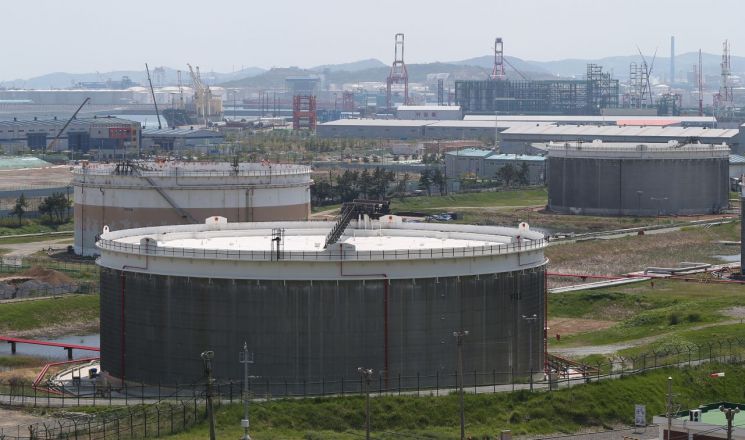
[Asia Economy Reporter Minwoo Lee] Despite the gradual improvement in the performance of oil refining companies such as SK Innovation, GS, and S-Oil, their stock prices have failed to recover. As the energy paradigm rapidly shifts from primary energy sources (hydrocarbons) to secondary energy sources (electricity), and global refining capacity continues to increase, investor interest appears to be waning.
According to financial information provider FnGuide on the 29th, S-Oil's market consensus for Q3 this year forecasts sales of 4.3448 trillion KRW and operating profit of 200.5 billion KRW. Compared to the same period last year, these figures represent declines of 30.31% and 13.09%, respectively, but show a clear recovery from the previous quarter. Sales increased by about 1 trillion KRW, and operating losses turned into profits. GS shows a similar trend. The Q3 consensus for this year is sales of 4.3354 trillion KRW and operating profit of 360.9 billion KRW. Although these are decreases of 4.16% and 34.52% compared to Q3 last year, sales rose by 18.3% and operating profit by 129.4% compared to the previous quarter.
SK Innovation, which recorded its worst performance since its founding due to demand slumps caused by COVID-19 and continued low oil prices, is also showing signs of recovery. Q3 sales are expected to reach 9.3988 trillion KRW with an operating profit of 129.5 billion KRW. Sales, which had fallen to the 7 trillion KRW range in Q2, increased by more than 2 trillion KRW, and operating losses sustained for two consecutive quarters turned into profits.
Although performance has begun to recover, stock prices continue to decline. According to the Korea Exchange, as of 9:41 AM, S-Oil's stock price was 51,800 KRW, up 1.57% from the previous day. However, this is not significantly different from the low 50,000 KRW range during the stock market crash from March 20 to 24 caused by COVID-19. After rising to 79,400 KRW on June 4 following the March crash, the stock price has since been on a downward trend. This contrasts with the KOSPI index, which rose from the 1,400 range to the mid-2,400 range during the same period.
GS is in a similar situation. At the same time, its stock price was 31,300 KRW, up 1.13% from the previous day, but still lower than the lowest price of 32,200 KRW recorded during the COVID-19 crash on March 23. On the 24th, it even dropped to 30,300 KRW, setting a new all-time low. Only SK Innovation, buoyed by expectations for its secondary battery business and its 100% subsidiary SK IE Technology (IET) recently initiating an initial public offering (IPO) process, is holding up relatively well. Its stock price was 141,500 KRW at the same time, up 2.54% from the previous day. Compared to the annual low of 55,100 KRW on March 19, it has nearly tripled.
This is interpreted as a decline in expectations for the refining business itself. Although stock prices have fallen significantly, the momentum for growth is insufficient compared to pure chemical sectors. Jiwoo Son, a researcher at SK Securities, said, "Due to the Fourth Industrial Revolution, the energy paradigm is rapidly shifting from primary energy sources, hydrocarbons, to secondary energy sources, electricity, and this inevitably sustains the trend of a post-oil era. Refining capacity is globally on an increasing trend, and weak demand due to COVID-19 means that refining margins are likely to remain weak for the time being."
© The Asia Business Daily(www.asiae.co.kr). All rights reserved.

















