Azerbaijan-Armenia Clash on Second Day Kills at Least 55
Observed as Largest Since 1994
Experts Say "For Now, Energy Market Impact Is Limited"
[Asia Economy Reporter Naju-seok] As armed clashes continue between Azerbaijan and Armenia, the international energy market is on high alert. Since this region is rich in oil and natural gas and is traversed by oil and gas pipelines, a full-scale war here could impact the energy market.
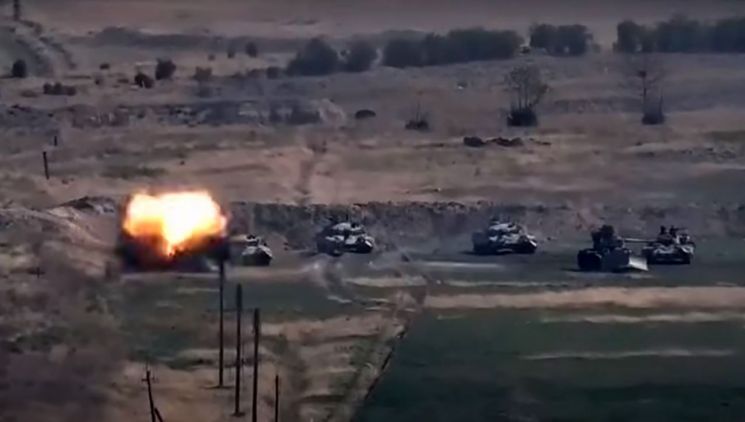 A captured frame from a video showing Azerbaijani military vehicles being destroyed as clashes erupted on the 27th (local time) between Armenian separatists and Azerbaijani forces in the Nagorno-Karabakh region, a disputed area between Azerbaijan and Armenia.
 [Image source=Yonhap News]
On the 28th (local time), Azerbaijan and Armenia engaged in their second day of fighting in Nagorno-Karabakh. Foreign media reported that at least 55 people lost their lives that day. It is known that there were civilian casualties in addition to military personnel, with foreign media estimating the total number of casualties to be in the hundreds. Both sides engaged in artillery and rocket shelling. Although clashes had occurred before, foreign media assessed that the intensity this time is different. One foreign outlet described it as the fiercest fighting since 1994.
The Nagorno-Karabakh region was originally part of Azerbaijan's territory when the Soviet Union dissolved. However, since the area was predominantly inhabited by ethnic Armenians, it became a disputed region. Eventually, fighting broke out between Azerbaijan and Armenia, and after a ceasefire in 1994, the area became a republic supported by the Armenian government. However, since no peace agreement was signed, Azerbaijan and Armenia have engaged in multiple armed conflicts over this area. Moreover, the situation has become more complicated with reports that Syrian armed forces, supported by Turkey, have joined the fighting.
The armed conflict between the two longstanding rivals raises concerns not only about human casualties but also about potential threats to the international energy market. Currently, the Nagorno-Karabakh region and the surrounding areas through which oil and natural gas pipelines pass are separate, so there has been no direct damage to the pipelines yet.
Azerbaijan produces about 1% of the world's crude oil supply. While its daily oil production capacity can reach up to 1.2 million barrels, it currently produces 500,000 barrels per day. About 80% of the oil produced here is exported through pipelines starting from Azerbaijan's capital Baku, passing through Georgia's capital Tbilisi, and ending in Turkey's Ceyhan. Additionally, Azerbaijan exports crude oil via pipelines and railways passing through Russia. Azerbaijan also exports natural gas produced from the Shah Deniz gas field to Europe and Turkey.
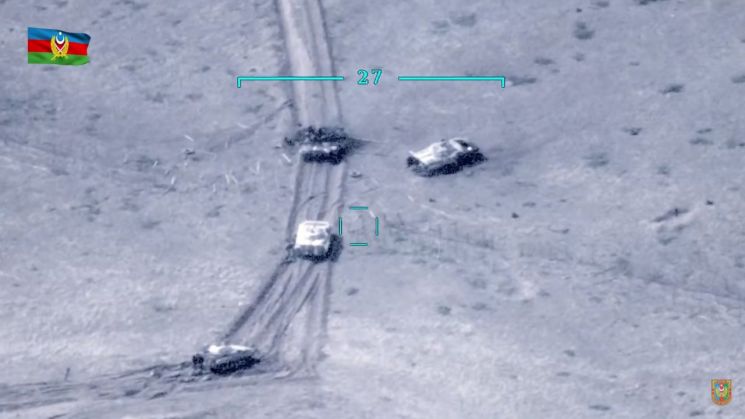 A screenshot from a video showing some Armenian tanks damaged amid armed clashes on the 27th (local time) in Nagorno-Karabakh, a disputed region between Azerbaijan and Armenia.
 [Image source=Yonhap News]
Oil-related information company OilX stated in a report, "This region is where major oil and natural gas pipelines pass," adding, "This is why the international community is concerned about the situation in Nagorno-Karabakh."
Of course, there are opposing views. Although an unexpected variable, it is argued that the energy market is not likely to be shaken to a significant degree.
First, since the fighting between Azerbaijan and Armenia is limited to the disputed Nagorno-Karabakh region rather than a full-scale war, the impact on oil wells or pipelines is expected to be limited. Igor Yushkov, senior analyst at Russia's state-owned Energy Security Fund, said, "For oil or natural gas pipelines to be damaged, a full-scale conflict between the two sides would have to occur," adding, "As long as the fighting remains confined to Nagorno-Karabakh, pipelines will not be damaged."
Edward Bell, senior director at NBD Bank in Dubai, predicted that the energy market can adequately respond to geopolitical crises. Considering the scale of energy production and inventories worldwide, the market can cope with risks such as disruptions to oil production or pipelines in the Azerbaijan area. Due to the reduced global energy demand caused by the COVID-19 pandemic, the energy market is unlikely to be shaken solely by geopolitical variables in the South Caucasus region.
© The Asia Business Daily(www.asiae.co.kr). All rights reserved.


















