COVID-19 Central Disease Control Headquarters Regular Briefing
"Minimize Spread by Adhering to Social Distancing and Hygiene Rules"
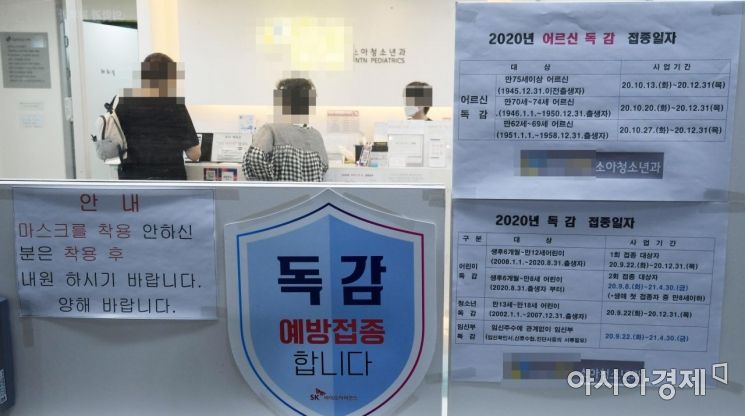 A notice for free flu vaccinations is posted at a hospital in Seoul city. Photo by Kim Hyun-min kimhyun81@
[Asia Economy Reporter Choi Dae-yeol] The health authorities announced on the 28th that there have been three patients in South Korea who were simultaneously infected with the novel coronavirus disease (COVID-19) and influenza (flu). As concerns grow over the so-called 'twindemic,' where two infectious diseases with similar symptoms spread simultaneously, the authorities emphasized the need to minimize the outbreak by properly following vaccination and personal hygiene guidelines.
Jung Eun-kyung, head of the Central Disease Control Headquarters, stated at a briefing on the 28th, "At the end of February this year, when influenza and COVID-19 were both prevalent, there were about three cases of co-infection at a contracted testing institution in the Daegu and Gyeongbuk regions," adding, "The clinical symptoms of those patients were assessed to be not severe."
Although the outward symptoms of COVID-19 and influenza are similar, they are distinctly different viruses, so co-infection is entirely possible, the health authorities have explained. Some cases have also been reported in foreign studies. According to the authorities, among 116 cases in the United States, one was classified as a co-infection case. Cases have also been reported in China (2.7%) and Turkey (2.0%).
Respiratory viruses typically spread during the colder autumn and winter seasons. Generally, in the Northern Hemisphere, including South Korea, the influenza types that circulate in the Southern Hemisphere during its winter are monitored to prepare for the autumn and winter outbreaks, since summer in the Northern Hemisphere corresponds to winter in the Southern Hemisphere.
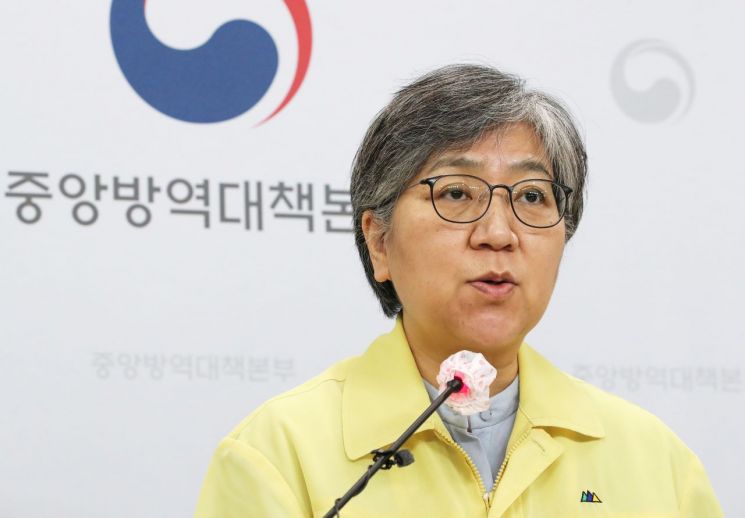 Jung Eun-kyung, Director of the Central Disease Control Headquarters (Director of the Korea Disease Control and Prevention Agency)
 Regarding the possibility of a twindemic this autumn and winter, Director Jung said, "It is still not easy to predict accurately," but added, "The vaccination rate for influenza and the practice of social distancing will likely determine the scale of the simultaneous outbreaks."
He further explained, "Influenza A circulated in February this year, and influenza B usually spreads in March and April, but this year, due to the COVID-19 outbreak in Daegu and Gyeongbuk during March and April, the second influenza wave was maintained at a very low level, leading to an early end of the outbreak." He added, "In the Southern Hemisphere as well, the scale of the outbreak has decreased by about 80% compared to usual years. However, since the Northern Hemisphere, including South Korea, has very high population density and large populations, it is difficult to directly apply the Southern Hemisphere's situation here."
As before, the authorities stressed that as long as individuals adhere well to social distancing and personal hygiene rules, and the authorities conduct thorough epidemiological investigations, the outbreak can be minimized. Director Jung said, "In winter, ventilation becomes difficult, and the environment becomes dry and cold, which can extend the survival time of viruses. Taking this into account, we are preparing responses and establishing medical guidelines and policies on how to distinguish, diagnose, and treat COVID-19 and influenza."
© The Asia Business Daily(www.asiae.co.kr). All rights reserved.
![Clutching a Stolen Dior Bag, Saying "I Hate Being Poor but Real"... The Grotesque Con of a "Human Knockoff" [Slate]](https://cwcontent.asiae.co.kr/asiaresize/183/2026021902243444107_1771435474.jpg)

















