Current Status and Issues of Domestic Waste Paper Recycling, Analysis of Government Policy Limitations and Implications
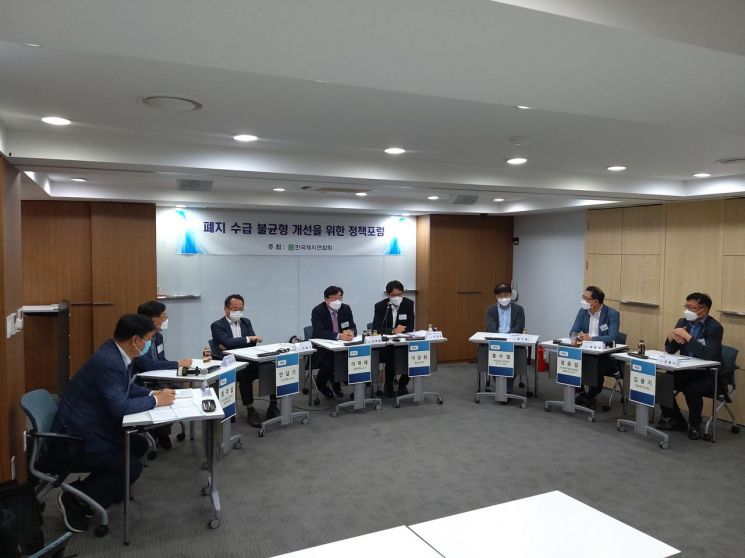 Panelists discussing at the policy forum hosted by the Korea Paper Association.
 [Photo by Korea Paper Association]
[Asia Economy Reporter Kim Jong-hwa] The Korea Paper Association announced on the 28th that it held the "1st Policy Forum for Improving the Supply-Demand Imbalance of Waste Paper" on the 24th, inviting experts from the Ministry of Environment, academia, non-governmental organizations (NGOs), and the paper and waste paper industries to devise measures to improve the supply-demand imbalance in the domestic waste paper recycling market.
This policy forum was organized to seek improvement measures as the domestic waste paper backlog and shortage situations have been recurring periodically, causing difficulties for the paper and raw material industries in responding.
Under the theme "What is the problem with domestic waste paper recycling?", the forum identified the current status and issues of domestic waste paper recycling, analyzed the limitations of government policies, and discussed implications.
Professor Ryu Jeong-yong of Kangwon National University pointed out that to resolve the current issues, "institutional improvements and technological development are needed to expand the use of high-strength lightweight corrugated cardboard in agricultural product packaging, which accounts for the largest share of demand for corrugated boxes," and added, "It is necessary to establish stockpiling complexes to temporarily resolve waste paper backlog and shortage situations, along with government support for this."
Kim Jeong-gu, Head of Eco & Partners, stated, "If the essential import waste paper volume for the domestic paper industry, which records the world's highest waste paper recycling rate, is not secured, it could lead to a decline in product competitiveness and result in a reduction in the use of domestic waste paper," and argued, "There is a need to shift from regulatory policies to private autonomous support policies."
In the subsequent discussion, panelists expressed opinions that "stockpiling of waste paper is necessary as a priority to resolve the domestic waste paper supply instability, and government support to expand stockpiling warehouses is needed." However, some also noted that "private sector investment should be pursued simultaneously to normalize the market structure," and "a multi-purpose stockpiling warehouse considering various recyclable wastes is needed rather than dedicated warehouses."
Regarding this, Lee Jang-won, Team Leader of the Recycling Market Stabilization Promotion Team at the Ministry of Environment, stated, "We will closely monitor China's waste policies and conduct sufficient communication and consultation with the paper and waste paper industries to stabilize the domestic waste paper recycling market."
Kwon Oh-geun, Executive Director of the Korea Paper Association, said, "Through this policy forum, we plan to derive measures to improve the waste paper supply-demand imbalance and minimize industry burdens through policy proposals."
© The Asia Business Daily(www.asiae.co.kr). All rights reserved.
![Clutching a Stolen Dior Bag, Saying "I Hate Being Poor but Real"... The Grotesque Con of a "Human Knockoff" [Slate]](https://cwcontent.asiae.co.kr/asiaresize/183/2026021902243444107_1771435474.jpg)
















