[Feature] Four Keywords Deciding the Presidential Election ③ Electoral Map... President Moon's Votes in the Presidential Election Were More in 2012 When He Lost Than in 2017 When He Won
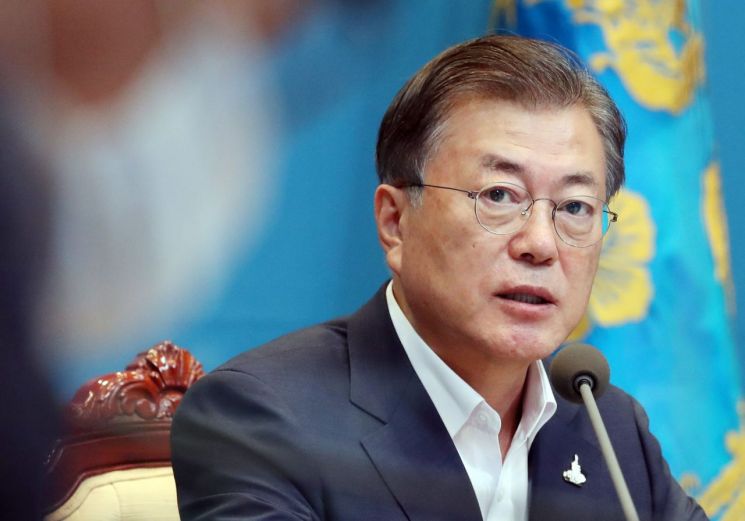
Did President Moon Jae-in receive more votes from the public in the 19th presidential election in 2017 than in the 18th presidential election in 2012? Considering that the 2017 election ended in a landslide victory, one would naturally think so, but the opposite is true. The 2012 election had both a higher number of votes and a higher vote percentage.
President Moon was elected in the 19th presidential election in 2017 with 13,423,800 votes (41.08%). This means that over 13 million voters chose politician Moon Jae-in as president. Considering that the candidates who came in second and third, Hong Joon-pyo of the Liberty Korea Party and Ahn Cheol-soo of the People's Party, received 24.03% and 21.41% of the vote respectively, this result can be considered a landslide victory.
What is interesting is that although President Moon received 14,692,632 votes (48.02%) in the 18th presidential election in 2012, he was not elected president. This was the first time in South Korean politics that a candidate with over 48% of the vote and close to 15 million votes lost a presidential election, and it is a record that will be difficult to see again.
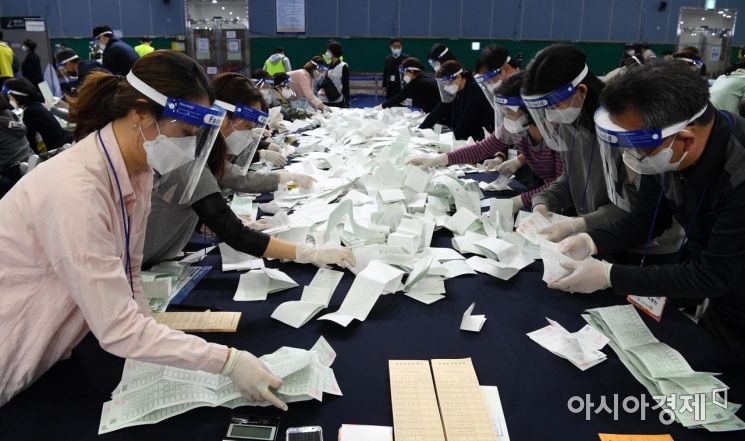 On the 15th, the 21st National Assembly election was held, and officials are conducting vote counting at the counting center set up in the multipurpose badminton gymnasium in Yeongdeungpo-gu, Seoul. Photo by Hyunmin Kim kimhyun81@
From President Moon's perspective, it was a regrettable defeat.
The reason the 2012 election left a historic record was because it was held under a unique electoral dynamic. In the 2012 election, only two parties fielded presidential candidates. Not only minor parties but also major parties gave up running presidential candidates.
The 2012 election was a two-way contest between Park Geun-hye of the Saenuri Party and Moon Jae-in of the Democratic Party.
The simple reason Moon lost despite his high vote count and percentage was that Park Geun-hye received more votes and a higher percentage. Park Geun-hye's vote count reached 15,773,128, and her vote percentage was 51.55%.
At the time, Moon's camp believed that running as the unified candidate of the progressive and reformist camp would secure victory. The fact that progressive parties or other parties based in the Honam region did not field presidential candidates, and that no reformist independent candidates ran, was accepted as a winning scenario for the election.
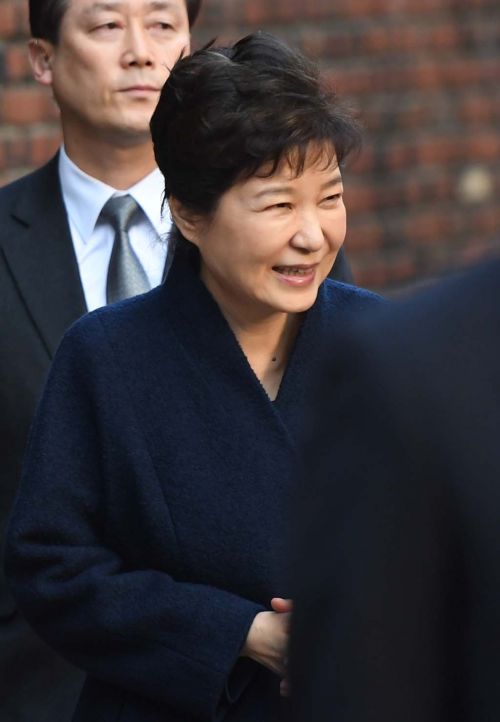
This is also why Moon put effort into unifying with Ahn Cheol-soo. Had Moon and Ahn each run separately in the 2012 election, it might have ended in a one-sided victory for Park Geun-hye.
The reason the electoral dynamic acts as a double-edged sword in presidential elections is due to the law of action and reaction. Although Moon and Ahn unified, this acted as a rallying factor for Park Geun-hye's supporters. Just as Moon's side united, Park's side felt a sense of crisis and also rallied tightly.
The conservative political forces' decision to field only one candidate (Park Geun-hye), unlike usual presidential elections, was a key variable that shaped the 2012 election landscape. This was a negative factor for Moon, as the electoral dynamic was disadvantageous to him.
The unification process with Ahn Cheol-soo was not smooth either. Although unification was eventually achieved in favor of Moon, supporters bore emotional wounds when voting. There were Ahn Cheol-soo supporters who did not readily choose Moon but made a 'different choice,' and this reverse voting affected the outcome of the 2012 presidential election.
© The Asia Business Daily(www.asiae.co.kr). All rights reserved.
![Clutching a Stolen Dior Bag, Saying "I Hate Being Poor but Real"... The Grotesque Con of a "Human Knockoff" [Slate]](https://cwcontent.asiae.co.kr/asiaresize/183/2026021902243444107_1771435474.jpg)













