Among 2,431 Admitted to Residential Treatment Centers, Only 326 Are Severe Patients
"Hospital Beds Should Be Used Efficiently, Focusing on Elderly and Patients with Underlying Conditions"
[Asia Economy Reporter Choi Dae-yeol] It has been found that most young patients infected with the novel coronavirus disease (COVID-19) in South Korea recover fully without receiving special treatment.
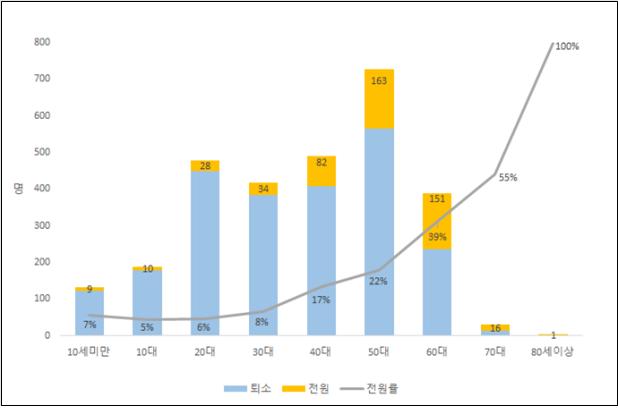
According to data compiled on the 28th by the COVID-19 Response Situation Room at the National Medical Center, among 2,413 patients aged 50 and under admitted to residential treatment centers, 326 patients (13.4%) were transferred to external medical institutions for treatment due to worsening symptoms. The remaining 2,105 patients, accounting for 86.6%, were treated at the residential treatment centers and recovered, subsequently being released from isolation and discharged.
Residential treatment centers are facilities for patients who have no symptoms or only mild symptoms at the time of diagnosis. No specific treatment is provided there; only the presence and severity of symptoms are monitored. If symptoms worsen while isolated in the center, patients are transferred to medical institutions for treatment. Through treating various patients, it has been understood that COVID-19 does not require intensive treatment for patients without underlying diseases or for young patients. The health authorities have established and operated this treatment system to use hospital beds efficiently.
Looking only at patients aged 30 and under admitted to residential treatment centers, the transfer rate was in the single digits. For patients under 10 years old, the transfer rate was 7%, for teenagers it was about 5%. For patients in their 20s, it was 6%, and for those in their 30s, about 8%. However, the transfer rate varied significantly by age group, with 39% for patients in their 60s and 55% for those in their 70s.
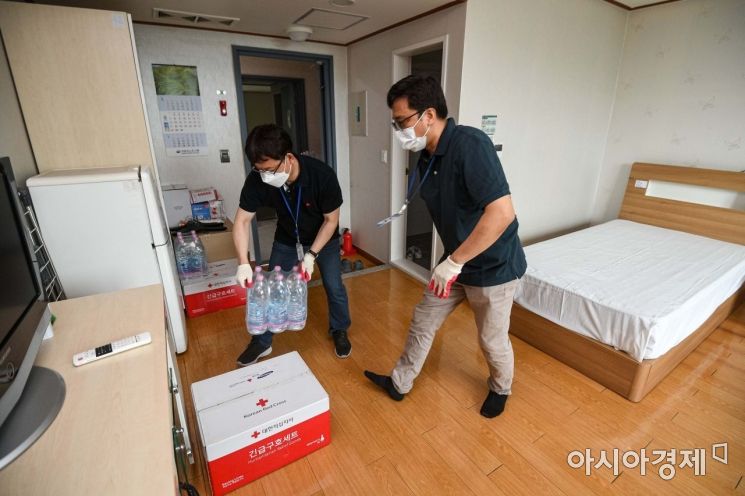 At the 'Seoul Namsan Living Treatment Center' established in June at the Seoul Youth Hostel in Jung-gu, Seoul, for managing mild and asymptomatic COVID-19 patients, center staff are preparing emergency relief supplies for the residents. Photo by Jinhyung Kang aymsdream@
Since August, outbreak centered in the metropolitan area, increase in elderly patients
Young asymptomatic and mild patients should use beds efficiently without undue anxiety
The National Medical Center stated, "Special attention must be paid to infections among the elderly who are at risk of severe illness and death," adding, "Excessive anxiety and hospitalization demands from young asymptomatic and mild patients must be prevented to avoid inefficient use of bed resources and to maintain a stable medical system."
Efficient use of limited medical resources is the most critical concern for health authorities to reduce casualties such as deaths. During the outbreak centered around Daegu and Gyeongbuk in February and March, many patients emerged in a short period without a prepared treatment system, resulting in significant casualties. Some patients died at home because they could not be admitted due to a shortage of hospital beds even after testing positive.
In particular, the health authorities anticipate that the recent second wave centered in the metropolitan area, which involves more elderly patients compared to previous outbreaks, is likely to lead to more casualties. According to fatality rates compared by the COVID-19 Situation Room by period and age group, from January to May, the fatality rate among COVID-19 patients aged 70 and under was higher than that of patients in August, whereas for those aged 80 and above, the fatality rate in the recent outbreak phase was 19.4%, higher than the 14.0% recorded from January to May.
The National Medical Center emphasized, "A sudden increase in new elderly patients leads to a rapid rise in the number of critically ill patients within 5 to 7 days, followed by shortages of intensive care beds and difficulties in patient transfers," warning, "This may result in preventable deaths due to inadequate critical care."
© The Asia Business Daily(www.asiae.co.kr). All rights reserved.


















