[Feature] Four Keywords Defining the Presidential Election ②People... The Political Revolution of Ordinary Citizens Leading the 2002 Political Reversal Drama
[Asia Economy Reporter Ryu Jeong-min]
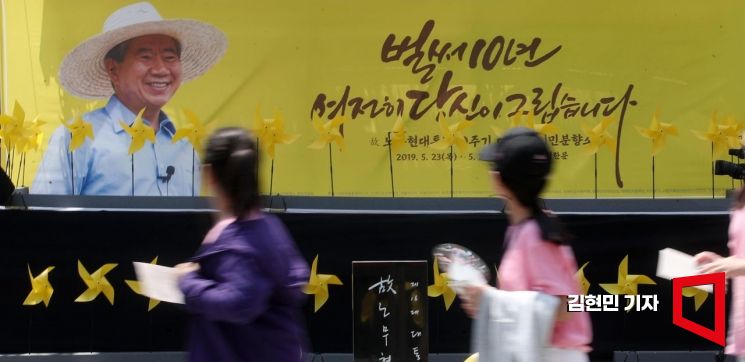 Citizens are passing by the memorial altar installed in front of Daehanmun Gate, Deoksugung Palace, Jung-gu, Seoul, on the 23rd, the 10th anniversary of the late President Roh Moo-hyun's passing. Photo by Kim Hyun-min kimhyun81@
One of the iconic scenes symbolizing the history of South Korean presidential elections is the large-scale rallies. The joy or sorrow depended on how many people gathered and how much support was received. Politicians who succeeded in large rallies had an advantage in momentum battles, while those who failed suffered setbacks in their presidential campaigns.
During the 1987 presidential election, so-called "one million crowds" participated in election rallies. Campaign schedules were set in places capable of hosting large crowds, such as Yeouido Plaza in Seoul, and people flocked like clouds from all over the country. The area around Yeouido Plaza was a spectacular sight with rows of chartered buses from across the nation.
Those who participated witnessed the massive waves of people with their own eyes and shared their experiences upon returning to their regions. This is the power of word of mouth.
It is not easy for one million people from all over the country to gather on a specific day to meet a particular individual. The one million crowd rally was possible because there was an organization and funding necessary for large-scale manpower mobilization.
This is also why politicians with weak funding mobilization and organization found it difficult to dream "big dreams." Money and organization do not just appear. To move someone, interests inevitably intervene, and within that, seeds of corruption grow.
In South Korean presidential elections dominated by politicians with strong funding and organization, a figure emerged who sparked a "non-mainstream rebellion." This was politician Roh Moo-hyun, who pioneered the era of online political revolution. He walked a steadfast path to the extent that he was called "Fool Roh Moo-hyun."
He confronted the walls of real politics to break down regionalism. The 2002 presidential election was one where a single figure, Roh Moo-hyun, shook the landscape. It was a representative election that showed why individuals matter in presidential elections.
Politician Roh Moo-hyun was a protagonist of turmoil from the Democratic Party primaries. He faced off against Lee In-je, a politician who was leading the trend at the time, producing a memorable contest. Most Democratic Party lawmakers supported candidate Lee In-je. Roh Moo-hyun’s greatest supporters were unknown individuals who only participated under "nicknames" on internet bulletin boards?online warriors from across the country.
Although traditional political organizational power was weak, these online supporters were a strong backing for the online election revolution. The "weak" presidential candidate with only 2% support suddenly shook the dynamics of the Democratic Party primaries and became the main character.
Even after becoming a presidential candidate, politician Roh Moo-hyun faced continuous hardships. As his support rate dropped, a group known as "Hoodan-hyup" gained influence within the party, attempting to change the election dynamics. Although it appeared to be a group for candidate unification, it was actually a political move to strip Roh Moo-hyun, who was chosen by party members and the public, of his candidacy.
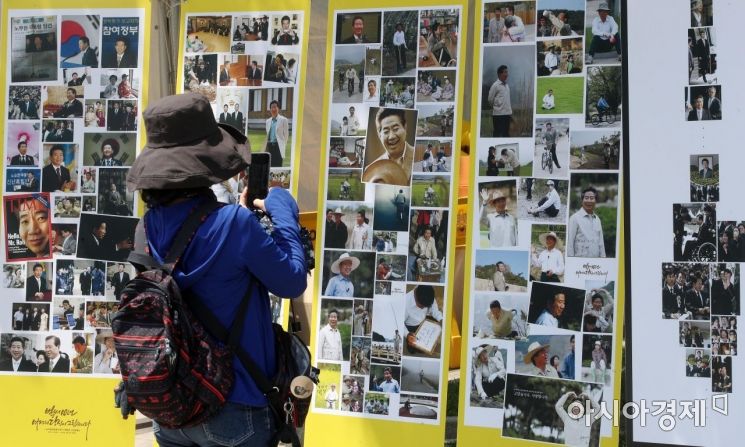 On the 23rd, the 10th anniversary of the late President Roh Moo-hyun's passing, a citizen is looking at the photo exhibition of the deceased at the citizen memorial altar installed in front of Daehanmun Gate, Deoksugung Palace, Jung-gu, Seoul. Photo by Kim Hyun-min kimhyun81@
Politician Roh Moo-hyun overcame the crisis by directly confronting candidate Chung Mong-joon for unification. The main opponent in the general election, Lee Hoi-chang of the Grand National Party, was no pushover. His organization was solid, and his regional base surpassed that of Roh Moo-hyun. Especially, just one day before the presidential election, when Chung Mong-joon declared his withdrawal of support, predictions favored Lee Hoi-chang. However, Roh Moo-hyun had nameless citizens on his side.
Whenever politician Roh Moo-hyun faced a crisis, countless citizens nationwide, based online, formed a defensive line. When Chung Mong-joon withdrew his support, the online community literally ignited. Internet bulletin boards overflowed with messages of support and encouragement for Roh Moo-hyun. They stayed up all night, holding phones and urging their acquaintances to vote.
They called not only friends they rarely contacted but also relatives with whom they had awkward relationships, asking them to participate in voting. As the possibility of Roh Moo-hyun’s defeat grew due to Chung Mong-joon’s withdrawal, nameless citizens across the country voluntarily launched a campaign to encourage voting for Roh Moo-hyun.
The 2002 presidential election was an election that changed the paradigm of Korean politics. It proved that the power to change politics comes not from faction bosses in Yeouido’s political circles but from the citizens. Roh Moo-hyun became the protagonist of the turnaround.
On December 19, 2002, Roh Moo-hyun was elected president in the 16th presidential election with 12,014,277 votes (48.91%). Lee Hoi-chang received 11,443,297 votes (46.58%) but lost. The 2002 presidential election was a continuous drama. It showed that a politician with 2% support could be elected president. The reason this was possible was the power of countless nameless citizens nationwide who led the online political revolution.
© The Asia Business Daily(www.asiae.co.kr). All rights reserved.
![Clutching a Stolen Dior Bag, Saying "I Hate Being Poor but Real"... The Grotesque Con of a "Human Knockoff" [Slate]](https://cwcontent.asiae.co.kr/asiaresize/183/2026021902243444107_1771435474.jpg)


















