Fair Trade Commission Announces Legislative Notice for the "Online Platform Fairness Act" Proposal
[Asia Economy Reporter Joo Sang-don] The Fair Trade Commission announced that it has prepared a bill for the "Act on the Fairness of Online Platform Intermediated Transactions" and will publicly notify the legislation for 40 days from the 28th to November 9th.
Chairman Cho Sung-wook of the Fair Trade Commission stated, "The main players in the digital economy are undoubtedly online platforms. Online platforms, which mediate connections between economic agents online, are the very places where the digital economy is realized," adding, "However, as the influence and transactional position of platforms in the digital economy strengthen, various threat factors that hinder the sustainable development of the industrial ecosystem in diverse transactional relationships connected to platforms are also emerging," explaining the purpose of the legislation.
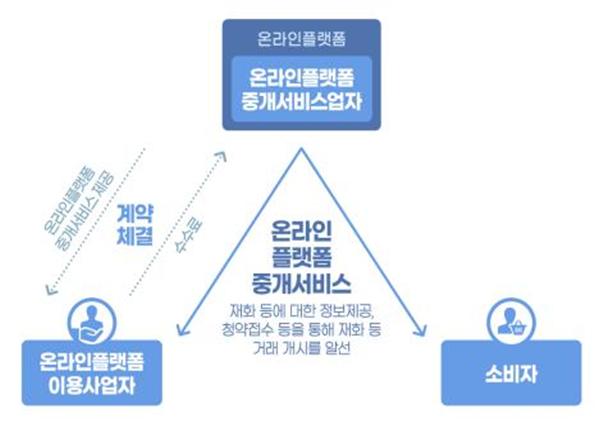
First, the law applies to business operators providing online platform intermediary services who meet all of the following conditions: ▲intermediary service contractual relationships ▲scale requirements ▲extraterritorial application requirements.
The business operator must provide services that mediate the initiation of goods and services transactions between tenant businesses and consumers who have contractual relationships through the online platform by providing information or receiving offers from consumers. Representative examples include open markets, delivery apps, app markets, accommodation apps, ride-hailing apps, price comparison sites, information provision services such as real estate and used cars, and search advertising services.
The law applies only to platform operators whose sales or intermediary transaction amounts exceed certain thresholds. Specifically, sales revenue refers to commission income (sales) from providing online platform intermediary services and value-added services in the previous business year, which must be above an amount prescribed by presidential decree within the range of up to 10 billion KRW. The intermediary transaction amount refers to the total sales value of goods and services sold through online platform intermediary services in the previous business year, which must be above an amount prescribed by presidential decree within the range of up to 100 billion KRW.
Considering that platform transactions occur across borders without boundaries, the law applies regardless of the platform operator’s location or the governing law at establishment when mediating transactions between domestic tenant businesses and domestic consumers.
The bill requires platform operators to enhance transparency and fairness in transactional relationships with tenant businesses by mandating the preparation and delivery of contracts to tenant businesses, who are the contractual counterparties, to prevent disputes in advance by transparently disclosing transaction conditions. Key items must be mandatorily specified in the contract (mandatory entries). These mandatory entries include not only typical major transaction conditions but also items particularly required to protect tenant businesses and prevent disputes, which are directly related to tenant business interests in platform intermediary transactions.
Additionally, platform operators must provide prior notice when changing contract contents or restricting, suspending, or terminating services. When changing contract contents, platform operators are obligated to notify at least 15 days in advance, and contract changes made without following this procedure will not be recognized as valid.
The existing prohibition on abuse of superior bargaining position under the Fair Trade Act is specified and applied in a manner suited to the characteristics of the platform industry. A basis has been introduced to present criteria for recognizing the bargaining position of platform operators, considering the unique nature of the platform industry.
Alongside this, an institutional foundation for voluntary win-win cooperation and prompt dispute resolution has been established. First, the Fair Trade Commission plans to present standard contracts by platform type to allow flexible responses through soft norms tailored to the rapidly changing and diverse characteristics of the platform industry. Furthermore, to promote a culture of mutual growth between platform operators and tenant businesses, provisions encouraging and supporting the conclusion of win-win agreements have been established. A basis for establishing a dispute mediation council specialized in the online platform sector has been created to enable swift and professional dispute resolution.
Chairman Cho said, "We have paid meticulous attention to establishing a balanced regulatory system that allows effective law enforcement without hindering innovation in the new platform industry," adding, "To this end, we have strengthened the imposition of fines while minimizing the introduction of criminal penalties and have introduced a consent decision system."
© The Asia Business Daily(www.asiae.co.kr). All rights reserved.

















