[Asia Economy Reporter Chunhee Lee] The income criteria for 1- and 2-person households wishing to move into public rental housing are expected to be raised again. When reconstructing aging public rental housing, public institutions will be able to promote reconstruction quickly without forming associations.
The Ministry of Land, Infrastructure and Transport announced on the 28th that it held the 6th Regulatory Innovation Committee meeting, which included various private experts, and identified a total of 30 regulatory improvement tasks to promote institutional improvements.
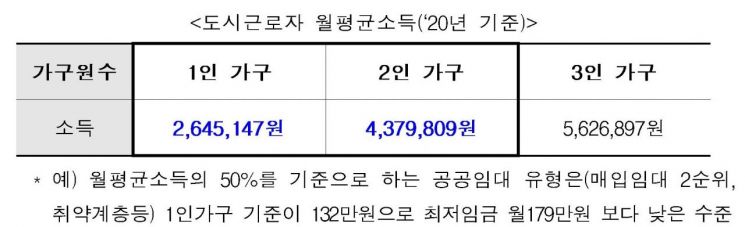
In the housing sector, regulations related to rental housing for 1- and 2-person households and youth have been significantly eased. Last year, the government adjusted the public rental housing admission criteria, which had applied the previous year's average monthly urban worker income standard for 3-person households to 1- and 2-person households as well. This was a measure to prevent a reversal phenomenon where a single-person household earning 5.4 million KRW per month could qualify for rental housing, while a 3-person household with about 1.85 million KRW monthly income per person could not.
However, as a result, the income criteria for 1- and 2-person households became significantly lower, causing the unintended side effect of making it excessively difficult for these households to move into public rental housing again. Based on last year's average monthly urban worker income of 2.65 million KRW for a single-person household, rental types with admission criteria set at 50% of the average monthly income had income standards as low as 1.32 million KRW per month, which is even lower than the minimum wage of 1.79 million KRW per month.
Accordingly, the Ministry of Land, Infrastructure and Transport announced that it will revise the related enforcement regulations in December to raise the income criteria for 1- and 2-person households. Earlier, Seoul City, considering these points, announced on the 23rd that it would raise the first-priority income criteria for special supply of public and private rental housing in station areas from 50% to 100% of the average monthly urban worker income.
Improvements considering the hardships of actual demanders will also be made regarding Happy Housing. Currently, if one has to move to the same or adjacent area due to job changes, re-entry into Happy Housing is not possible. However, with the revision of enforcement regulations in December, re-entry will be possible if the place of residence changes within the same or adjacent area and the income base changes. For Happy Housing aimed at industrial complex workers, where many vacancies occur due to asset criteria such as being homeless, the asset criteria will be excluded to increase usability.
Regulations related to reconstruction and redevelopment will also be innovated. As aging public rental housing increases, currently, even to reconstruct permanent rental housing owned by Korea Land and Housing Corporation (LH), associations must be formed and projects promoted under the 'Urban and Residential Environment Improvement Act,' which has been challenging. From December, with the revision of the 'Public Housing Special Act,' public institutions such as LH will be able to promptly promote reconstruction. Regarding the obligation to install parks above a certain scale during maintenance projects, the law will be amended to simplify procedures by deeming the park creation plan decision as approved once the project implementation permit is granted.
Measures to activate private investment related to the Green New Deal will also be promoted. Currently, electric vehicle charging facilities installed as ancillary facilities in off-street parking lots are regulated to be installed within 20% of the total facility area, but to increase the spread of eco-friendly vehicles, installations exceeding this standard will be allowed. Additionally, three-dimensional high-precision road maps used for autonomous vehicle research, which have been provided only in limited forms after security reviews, will be made available online to facilitate smooth utilization. Incentives such as relaxed building coverage ratios will also be provided to activate private participation in zero-energy buildings.
Other various regulations will also be improved, including ▲expansion of urban shared home delivery centers ▲simplification of application documents for pro-rata calculation of traffic inducement charges ▲allowing lifts during vehicle inspections ▲improvements in estimate periods for disaster recovery construction projects.
Yang Jong-ho, the Ministry of Land, Infrastructure and Transport’s Regulatory Reform Legal Officer, said, "We have reviewed tasks with high demands for improvement from a zero-base perspective based on the government's burden of proof system and will promptly revise related laws and regulations." He added, "We will continue to discover innovative tasks with high tangible effects to improve the business investment environment and enhance public convenience."
© The Asia Business Daily(www.asiae.co.kr). All rights reserved.

















