Ministry of Environment-K-water Collect 105,000 Tons... Twice Last Year's Amount
Massive Inflow of Floating Waste Due to Prolonged Heavy Rain and Typhoons
Local Governments' Budgets Exceeded... 7.7 Billion Won National Subsidy and 4 Billion Won Watershed Fund Support
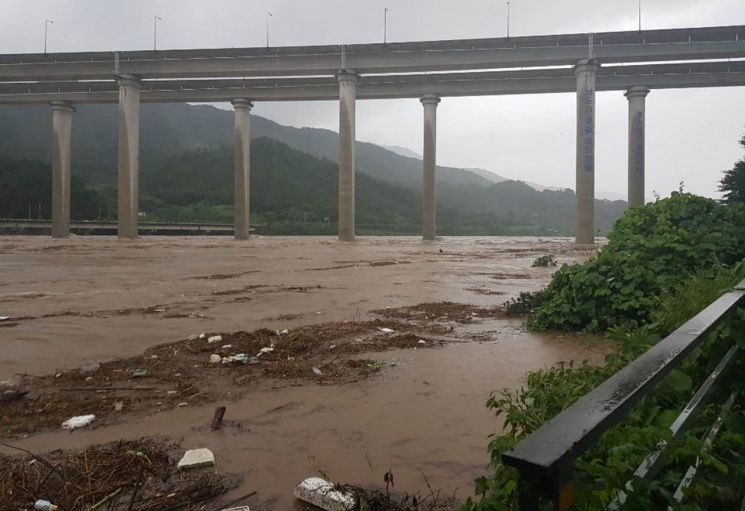
[Asia Economy Reporter Kim Bo-kyung] The Ministry of Environment announced that it has collected more than 90% (105,000 tons) of floating debris that flowed into dams and rivers due to heavy rains and typhoons. The amount of floating debris collected nationwide this year was more than double that of last year. Including all the debris yet to be collected, the total reaches 114,000 tons, the largest amount in the past 10 years.
The Ministry of Environment and Korea Water Resources Corporation announced on the 27th that they have collected 105,000 tons of floating debris that flowed into rivers, estuaries, and dams nationwide due to this year’s heavy rains and typhoons, and are currently finishing up the cleanup work.
The amount of floating debris nationwide this year increased significantly due to the rainy season from June to August and typhoons Bavi, Maysak, and Haishen.
More than 80% of the collected floating debris consists of trees, grass, and other vegetation, while the remainder is household waste. The Ministry of Environment plans to recycle as much as possible through sorting, and incinerate or landfill the rest.
First, all floating debris in major water sources by watershed that flowed into dams such as Soyanggang Dam (11,000 tons), Chungju Dam (13,000 tons), Daecheong Dam (11,000 tons), Yongdam Dam (3,000 tons), Juam Dam (2,000 tons), and Paldang Dam (1,000 tons) has been collected.
Out of approximately 70,000 tons of debris that flowed into 34 water supply and multipurpose dams and 16 weir sections managed by Korea Water Resources Corporation, about 62,000 tons (90%) have been collected so far, with plans to complete collection before Chuseok.
Regarding rivers, out of 45,000 tons of floating debris that flowed into major rivers and estuaries nationwide, 42,000 tons (94%) have been collected.
The 105,000 tons of floating debris collected nationwide this year is more than double compared to last year (48,000 tons). Including the debris yet to be collected (10,000 tons), the total reaches 114,000 tons, the largest amount in the past 10 years.
The Ministry of Environment believes that the amount of floating debris exceeded the collection and disposal budgets of local governments and plans to provide an additional 7.7 billion KRW in national subsidies and 4 billion KRW from watershed funds beyond the existing support amounts.
For seven special disaster declaration areas including Yesan in Chungnam and local governments in the lower Yeongsan River (Mokpo, Muan, Yeongam) with equivalent status, the Ministry will fully support collection and disposal costs of 5 billion KRW and 2 billion KRW respectively, and will also provide 70% (700 million KRW) of national funding for additional costs requested by other local governments.
Meanwhile, the Ministry of Environment expects repeated large-scale waste generation due to climate change such as heavy rains and plans to cooperate with related organizations to inspect and improve blind spots in the collection system.
© The Asia Business Daily(www.asiae.co.kr). All rights reserved.

















