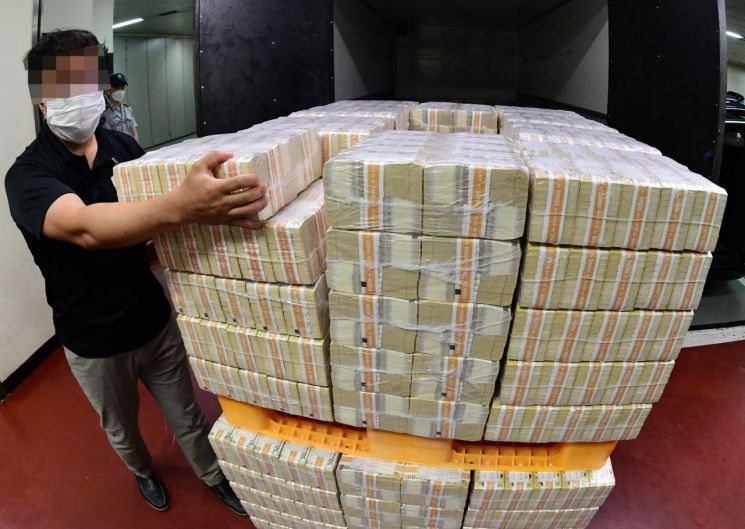
 On the 24th, ahead of the Chuseok holiday, cash transportation personnel were conducting Chuseok fund disbursement operations at the Bank of Korea's Issuance Department located in Gangnam-gu, Seoul. [Image source=Yonhap News]
[Asia Economy Reporter Kim Eunbyeol] As the spread of the novel coronavirus infection (COVID-19) continues, the Bank of Korea decided on the 24th to increase the limit of the Financial Intermediation Support Loan (FISL) from the existing 35 trillion won to 43 trillion won. The FISL is a system where the Bank of Korea lends funds to commercial banks at a low interest rate to promote loans to small and medium-sized enterprises (SMEs). Commercial banks first execute loans to eligible companies and report to the Bank of Korea, which then supports more than half of the loan amount.
Among the 8 trillion won supported by the Bank of Korea this time, 6 trillion won (3 trillion won for SMEs and 3 trillion won for small business owners) is allocated to support SMEs and small business owners affected by COVID-19. The remaining 2 trillion won is for facility fund loans for startup companies, job-creating companies, and material, parts, and equipment companies.
While it is good to induce funds to flow to companies affected by COVID-19, there is also an intention to support companies with high growth potential and productivity, as well as companies capable of creating jobs. Including the previously supported 3 trillion won, a total of 5 trillion won in funds will be supported.
So, which companies can receive funds from the Bank of Korea when commercial banks provide loans? First, the 'startup companies' supported by the Bank of Korea are divided into technology-based startups and general startups. These are SMEs certified under the 'Small and Medium Enterprise Startup Support Act' within 7 years of establishment, possessing advanced technology or having a high ratio of research and development expenses to sales. A patent certificate, utility model registration certificate, or guarantees from the Korea Technology Finance Corporation or Korea Credit Guarantee Fund are required. In some cases, the guarantee must specify a technology evaluation result of 'average' or higher as determined by the Director of the Bank of Korea's Monetary Policy Department to be certified.
For general startups, the condition of being an SME within 7 years of establishment is the same, but certain industries are excluded. These include finance, insurance, real estate, rental, accommodation and food services, dance hall operations, golf and ski resort operations, gambling facility management and operations, legal services, patent attorney services, certified public accountant services, tax services, hospitals, clinics, and other personal services.
Job-creating companies are defined as those receiving tax credits for employment creation investment, youth employment increase, or conversion to regular workers under the Restriction of Special Taxation Act. The excluded industries are the same as those for general startups. For material, parts, and equipment companies, the target is SMEs under the Special Measures Act on Fostering Material, Parts, and Equipment Specialized Companies, including companies related to Japan's export regulation items.
A Bank of Korea official stated, "It also means supporting companies that can contribute to the growth engine of our economy and job expansion," adding, "If the limit is fully utilized this time as well, we will decide on extension based on the situation."
© The Asia Business Daily(www.asiae.co.kr). All rights reserved.

















