National Dementia Management Committee Finalizes Comprehensive Plan by 2025
Expanding Prevention and Screening Opportunities, Establishing Treatment and Care Infrastructure
Developing Measures from the User Perspective... Strengthening the 'Dementia National Responsibility System'
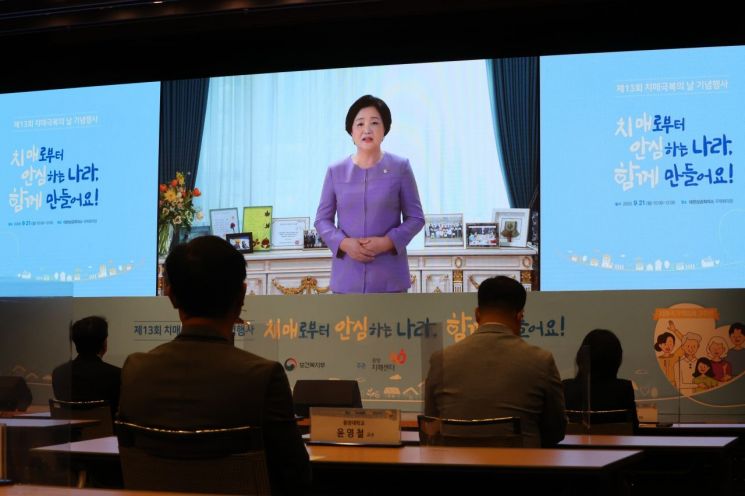 On the 21st, at the 13th Dementia Overcoming Day event held at the Korea Chamber of Commerce and Industry International Conference Hall in Jung-gu, Seoul, a congratulatory message video from First Lady Kim Jung-sook is being screened.
 [Asia Economy Reporter Choi Dae-yeol] Starting as early as next year, a dementia screening tool tailored to domestic circumstances will be introduced. While reducing out-of-pocket expenses for dementia differential diagnosis, care support for dementia patients will also be increased. Measures to provide mental health counseling for families with dementia patients will be promoted, and dementia family leave will be roughly doubled from the current level. The development of digital medical devices for dementia treatment will also be actively pursued.
The Ministry of Health and Welfare announced on the 25th that the 4th Comprehensive Dementia Management Plan, which includes these details, was reviewed and approved at the National Dementia Management Committee meeting. This plan is a mid- to long-term plan formulated every five years, showing the direction of how the state will manage dementia going forward. Following the previous three comprehensive plans, the basic goal is to expand infrastructure related to dementia and reduce the burden on patients and families through the dementia national responsibility system announced after the current government took office.
First, infrastructure for treatment and care will be expanded. The number of dementia-specialized long-term care institutions will increase by 100 to 310 by 2025, and the number of dementia-specialized rooms in these institutions will rise from 264 to 388. Currently, there are four dementia relief hospitals, which will increase to 22 by 2025. By 2025, dementia-specialized wards will be installed in 70 public nursing hospitals, and for regions without public nursing hospitals, plans will be made to support fees.
To make it easier for dementia patients to use services, local branches will be established at the 256 dementia relief centers nationwide by utilizing existing public health clinics and others. Through this, the registration and management rate of dementia patients at dementia relief centers will be raised from 60% in 2021 to 80% by 2025. The dementia relief center’s integrated dementia management system will be linked with other health and welfare systems such as the National Health Insurance Corporation and Happy e-um, allowing reference to dementia patients’ medical information and long-term care service usage.
Since early detection and suppression of symptom progression are important, this plan also includes support measures for dementia diagnosis. Currently, the dementia differential diagnosis fee can be up to 110,000 KRW per person, but the government plans to gradually raise the support ceiling to 150,000 KRW. Starting next year, the results of cognitive impairment tests from the national health screening will be notified to dementia relief centers so that centers can quickly identify individuals in need of dementia testing in their regions.
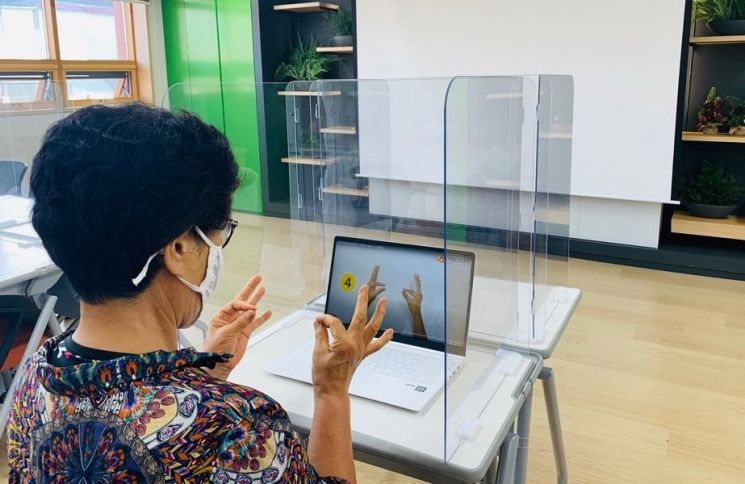 An elderly person at the Dementia Safety Center in Yangcheon-gu, Seoul, is watching and following a dementia prevention finger exercise class conducted via YouTube.
 [Image source=Yonhap News]
A 'Korean-type dementia screening tool' that can be used as a primary screening tool at dementia relief centers nationwide will also be developed. The currently used 'Mini-Mental State Examination' (MMSE) has been used for over 10 years and requires payment of copyright fees, so this test will be developed independently.
Additionally, to provide professional care services to mild dementia patients, the shelter program, which was only available to cognitive support grade recipients among long-term care beneficiaries, will be opened to those with long-term care grade 5. Along with this, the criteria for the long-term care grading system, currently composed of six grades (grades 1 to 5 and cognitive support grade), will be reorganized to measure the care needs of elderly dementia patients. A related pilot project will be conducted next year, with implementation planned from 2023.
To reduce the caregiving stress on patient families, the government will promote a plan to calculate mental health professional treatment for dementia patient families as a health insurance fee starting in 2023. The annual usage limit of the dementia family leave system will also be increased from the current 6 days to 12 days. The application of the reduced working hours system for those caring for dementia patients among family members will be expanded from 'businesses with 300 or more employees and public institutions' to 'businesses with fewer than 30 employees.'
The number of institutions providing short-term care services that look after dementia patients for a few days will increase from 88 to 350 by 2025. In addition to individuals, corporations with expertise related to guardianship will be allowed to act as public guardians, and conditions will be prepared to supply guardianship support trusts so that elderly people, including dementia patients, can receive professional asset management services.
The government plans to review the development of a communal living model for nine mild dementia patients together, combined with long-term care services linked to the elderly welfare housing system by next year. Programs that dementia patients and their families can enjoy outdoors will be diversified to include forest experiences and gardening. Starting in 2022, development of 'digital therapeutic devices' to enhance cognitive abilities and manage mental health of dementia patients will begin. Non-face-to-face technologies enabling dementia patients to undergo dementia tests and receive management at home will also be introduced. The Ministry of Health and Welfare expects that about 1.3 trillion KRW will be spent over five years to implement this plan.
Kim Kang-rip, Chairperson of the National Dementia Management Committee (1st Vice Minister of Health and Welfare), said, "Through this comprehensive plan, we will steadily carry out tasks to support the home life of dementia patients from a 'demand-centered' perspective, including dementia prevention, treatment, and care," adding, "We will create an environment where dementia patients can enjoy a dignified life and families can rest."
© The Asia Business Daily(www.asiae.co.kr). All rights reserved.
![Clutching a Stolen Dior Bag, Saying "I Hate Being Poor but Real"... The Grotesque Con of a "Human Knockoff" [Slate]](https://cwcontent.asiae.co.kr/asiaresize/183/2026021902243444107_1771435474.jpg)

















