Rent Delay Allowed for 6 More Months Without Contract Termination
Intended to Protect Low-Income Tenants but Forces One-Sided Sacrifice
Experts and Parties Oppose Forced Implementation Without Adequate Discussion
Conflicts Escalate Among Landlords, Tenants, Brokers, and Residents
Housing Prices Remain Uncontrolled... Jeonse Prices Soar
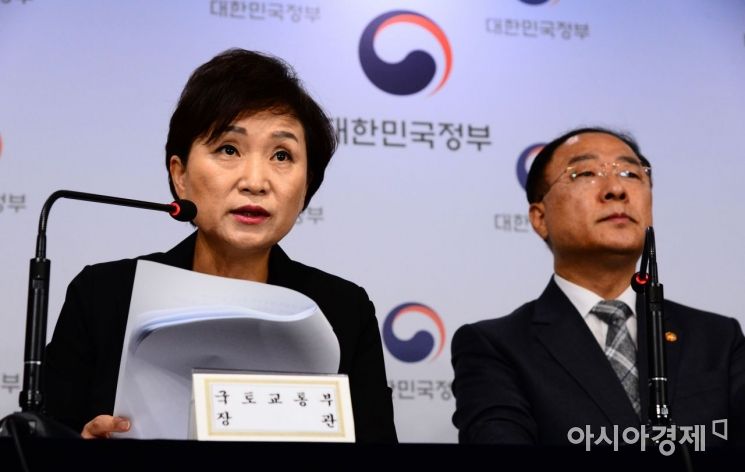 Minister of Land, Infrastructure and Transport Kim Hyun-mi is briefing on the plan to expand housing supply in the Seoul metropolitan area, including the Seoul region, at the Government Seoul Office in Jongno-gu, Seoul, on the 4th of last month. Photo by Kang Jin-hyung aymsdream@
[Asia Economy Reporters Moon Jae-won, Lee Chun-hee] The confusion in the market is worsening due to the government's real estate policies that seem to be implemented with a "just do it first" approach.
Under the pretext of "stabilizing the housing market," the government has been pushing measures without sufficient discussion with experts or stakeholders, resulting only in growing side effects. Conflicts surrounding real estate measures continue to increase, housing prices remain uncontrolled, and the government keeps repeating that "stability will come soon."
'Protecting the Common People' Claimed, but Government Emphasizes Sacrifice of Specific Groups
According to the real estate industry on the 25th, since the inauguration of the Moon Jae-in administration, the government has been pushing for a major overhaul of the real estate market, which has amplified side effects and conflicts among stakeholders.
A representative example is the amendment to the Commercial Building Lease Protection Act, which passed the National Assembly plenary session the day before. Through the amendment, the government made it so that for six months after the enforcement date, tenants cannot have their contracts terminated even if they are late on rent payments. Additionally, tenants affected by quarantine measures for first-class legal infectious diseases, including COVID-19, can request rent reductions from landlords.
Although the intention is to protect tenants hit hard by the "COVID-19 direct impact," criticism is spreading that it unilaterally demands sacrifices only from landlords. Many landlords argue, "We still have to pay building loan interest and taxes, but not being able to collect monthly rent for six months and being unable to exercise property rights is forcing one-sided sacrifice."
The industry also views the rent reduction claim right as ineffective since if landlords refuse, there is no proper solution other than litigation. Ultimately, it only fuels disputes between landlords and tenants.
The "two lease laws"?the right to request contract renewal and the cap on monthly rent?that the government implemented from the end of July are no different. As landlords' opposition grows, the number of jeonse (long-term deposit lease) listings decreases and deposit prices soar, causing side effects. The clear landlord-tenant confrontation has led to an increase in cases where issues that were previously resolved through dialogue are now taken to dispute committees or lawsuits.
A representative from a law firm in Seocho-dong explained, "As real estate-related disputes increase, more landlords and tenants are visiting Seocho-dong," adding, "Law firms are also expanding their related practice areas."
Repeated Enforcement Without Sufficient Discussion... Could They Not Anticipate Backlash?
Experts explain that the reason conflicts related to real estate are growing is because the government pushed policies without discussing their effects or side effects. Especially recently, as the initiative for real estate policies has effectively shifted from the government to the political sphere, rushed legislation and delayed supplementary measures have only increased confusion.
Lee Eun-hyung, a research fellow at the Korea Institute of Construction Policy, said, "If it were an issue everyone agrees is urgent, laws could be made quickly, but recent bills are hard to see as such," adding, "At least one or two months of public opinion gathering is necessary, but the government and political circles are pushing these through without any."
The recent backlash among frontline real estate agents regarding the brokerage system reform is in the same context. On the 1st, the Ministry of Economy and Finance announced plans to invest 800 billion won in the AI government construction project, one of the ten Korean New Deal tasks, and to promote a real estate transaction system without brokers. Since then, a sense of crisis that "we could lose our jobs" has spread among brokers, leading to a survival rights struggle at the Korea Association of Realtors level.
Related ministries such as the Ministry of Land, Infrastructure and Transport and the Ministry of Economy and Finance distanced themselves by saying they "do not know the details" as the controversy grew, but the industry's response remains cold. There are criticisms that the government is adjusting the pace because the industry's backlash was greater than expected when trying to push such policies.
Despite Repeated Measures, Housing Prices Soar... Repeated Failures
Due to policies pushed without sufficient discussion, dissatisfaction is also rising in local areas. Through the August 4 housing supply plan, the government announced plans to build large apartment complexes on the Taereung Golf Course in Nowon-gu, Seoul, and on idle land at the Gwacheon Government Complex in Gyeonggi Province, but this has triggered opposition not only from local residents but also from frontline local governments. As a result, even within the ruling party, opinions have emerged that "government decisions without prior discussion are regrettable."
The problem is that despite these real estate measures, sales and jeonse prices in Seoul and the metropolitan area continue to rise. According to the weekly apartment price trend by the Korea Real Estate Board, apartment sales prices in Seoul have risen 0.01% for five consecutive weeks, showing no signs of turning downward.
In the metropolitan area, prices rose 0.07% this week, an increase from 0.06% the previous week. Jeonse prices are similar; although the rate of increase has somewhat slowed, the upward trend has continued for 65 weeks.
Kwon Dae-jung, a professor in the Department of Real Estate at Myongji University, analyzed, "Whenever the government introduces a policy, it should hold public hearings to hear expert opinions, run simulations to comprehensively assess validity, pros and cons, and implementation effects, but this government mostly does not follow such procedures," adding, "Even when side effects occur, they justify them under the pretext of protecting tenants, which only increases market confusion."
© The Asia Business Daily(www.asiae.co.kr). All rights reserved.

















