Emergency in the Auto Industry Following California's Ban on Internal Combustion Engine Vehicle Sales
Nihon Keizai Warns of Backlash Against Gasoline Phase-Out
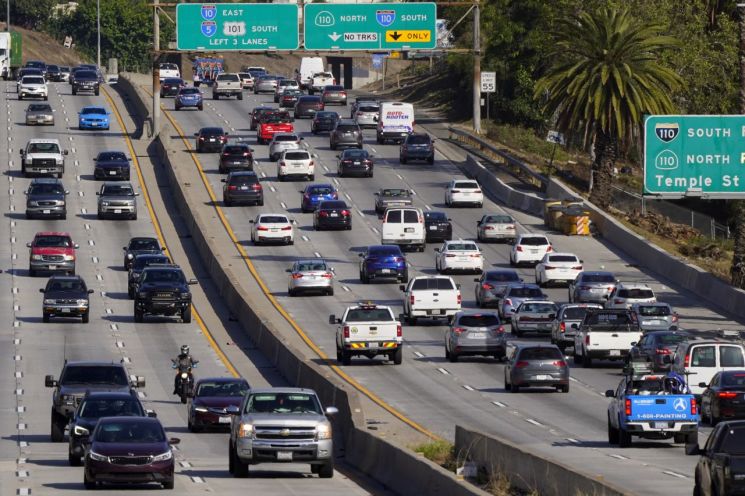
[Asia Economy Reporter Kwon Jae-hee] California has become the first state in the United States to ban the sale of new internal combustion engine vehicles, sending shockwaves through the global automotive industry. Following the European Union (EU)'s announcement of a major carbon dioxide emission regulation, this move in the world's largest automobile market, the U.S., could spread to other states. The automotive industry is expected to revise its strategies to focus more on eco-friendly vehicles.
The Wall Street Journal (WSJ) reported on the 24th (local time) regarding California's announcement to ban the sale of new internal combustion engine vehicles starting in 2035, calling it "a signal that the era of internal combustion engine vehicles is coming to an end" and stating that "this is not just a California issue." The report emphasized the possibility of eco-friendly initiatives expanding to other regions.
The Japanese automakers are particularly tense due to this strengthened regulation. On the 25th, the Nihon Keizai Shimbun published an article titled "The move away from gasoline will be a headwind for Japanese cars," reporting that companies are struggling to devise countermeasures. According to the newspaper, the U.S. is the largest market for Japanese automakers, with a market share of 47% as of 2019. Toyota, which has been selling eco-friendly vehicles mainly hybrids in North America, plans to revise its strategy. According to California's environmental regulations, hybrid vehicles that use both fuel and electricity as power sources are not considered zero-emission. Last year, 11.5% of Toyota's new car sales in the U.S. were eco-friendly vehicles, but most of these were hybrids rather than EVs.
General Motors (GM) and other major U.S. automakers issued a statement through the American Automotive Innovation Association (AAI) opposing the sudden regulatory tightening, saying, "Market creation through regulation cannot succeed."
The problem is that eco-friendly regulations are being strengthened worldwide. The EU is implementing stringent regulations to reduce the allowable carbon dioxide emissions per vehicle from 130g/km to 95g this year and further down to 10g by 2050. Vehicles that fail to meet these standards must pay a fine of 95 euros per vehicle based on the excess carbon dioxide emissions and sales volume. Separately, Germany has been offering an exemption from ownership tax for vehicles emitting 95g/km or less of carbon dioxide since this year.
The pace of the automotive industry's transition to electric vehicles is expected to accelerate further. Morgan Stanley forecasts that by 2035, when California's ban takes effect, electric vehicles will account for half of global new car sales and will increase to over 80% by 2050.
Arndt Ellinghorst, an automotive analyst at Bernstein Research, said, "Europe and China have already realized that internal combustion engine vehicles are dead," adding, "It seems the U.S. is just beginning to realize this now."
© The Asia Business Daily(www.asiae.co.kr). All rights reserved.
![From Bar Hostess to Organ Seller to High Society... The Grotesque Con of a "Human Counterfeit" [Slate]](https://cwcontent.asiae.co.kr/asiaresize/183/2026021902243444107_1771435474.jpg)
















