Announcement on the 13th of next month... Emphasis on first upward revision since the COVID-19 crisis
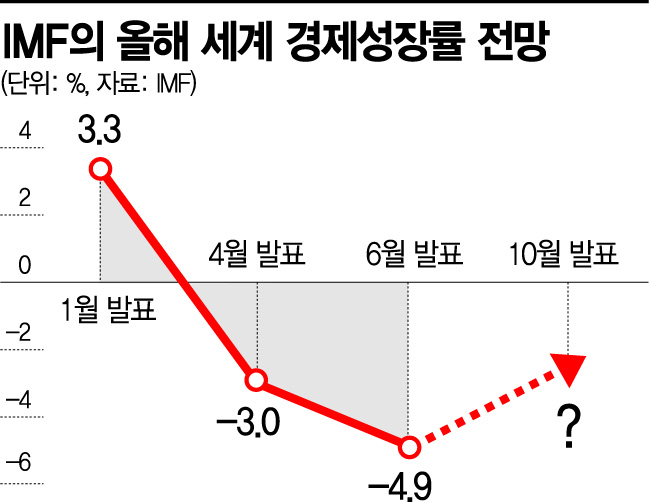
This year's forecast: January 3.3% → April -3.0% → June -4.9%
Moody's upgrades manufacturing outlook from 'Negative' to 'Stable' after four quarters
Too early to judge full recovery... "Emerging markets and developing countries still in crisis"
[Asia Economy Reporter Jeong Hyunjin] The International Monetary Fund (IMF) has hinted at the possibility of revising upward its growth forecast in the World Economic Outlook next month. This is based on the assessment that the economic situation has deteriorated less than initially expected as economies hit by the COVID-19 pandemic, mainly China and advanced countries, have shown some improvement. If the IMF raises its forecast next month, it will be the first time since the COVID-19 crisis began.
However, since discussions on additional stimulus measures are still ongoing in the United States and the situations in emerging and developing countries remain challenging, it is still considered premature to talk about a full-scale global economic recovery.
According to foreign media on the 24th (local time), Gary Rice, IMF spokesperson, said at a regular briefing held that day, "Recent incoming data suggest that parts of the global economy have started to overcome the critical phase," adding, "The outlook is somewhat less severe than during the World Economic Outlook update on June 24."
He noted that China and some other advanced economies performed better than expected in the second quarter of this year, partly due to the easing of lockdown measures after economic activities were almost completely shut down earlier this year. He added, "We are also seeing signs that global trade is gradually beginning to recover following widespread lockdowns to contain the virus spread."
This assessment implies that the IMF's global economic outlook may be revised upward. The IMF is scheduled to release the World Economic Outlook on the 13th of next month. Before the COVID-19 outbreak, the IMF forecasted global economic growth at 3.3% for this year in January, but lowered it to -3.0% in April, and then further downgraded it to -4.9% in June, citing worsening economic conditions due to lockdowns in various countries.
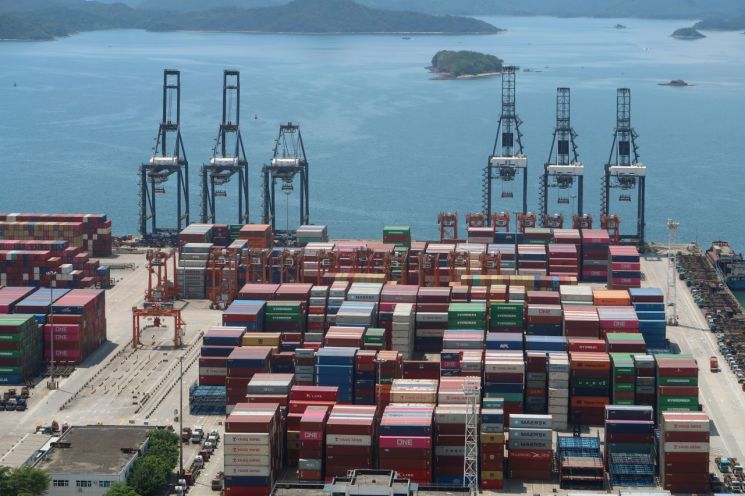
The IMF's outlook is also reflected in some figures. According to IHS Markit, the number of countries with a new export orders index above 50 in August was 14 out of 38 countries, a significant increase from 4 in June. This index indicates whether the volume of manufacturing export orders increased compared to the previous month, with a value above 50 meaning an increase. Global freight volumes have also normalized in the US, Asia, and Europe, and exporters in various countries are reportedly increasing employment, according to the Wall Street Journal (WSJ).
Credit rating agency Moody's recently reported that the global manufacturing Purchasing Managers' Index (PMI) has surpassed 50, revising its quarterly manufacturing outlook from 'negative' to 'stable' and expecting economic recovery in 2021. This is the first time in four quarters since September last year that Moody's has revised the manufacturing outlook to stable. In the US, new home sales increased by 4.8% year-on-year last month, marking the highest level in 14 years.
However, it remains uncertain whether the recovery trend will continue. The resurgence of COVID-19 could have an impact, and the need for large-scale fiscal support remains a variable. Jerome Powell, Chair of the US Federal Reserve (Fed), emphasized the necessity of additional fiscal support, warning that "(without support) Americans may have to reduce their income and possibly lose their homes." On the same day, foreign media reported that the US Democratic Party is preparing a $2.2 trillion stimulus package, smaller than initially planned, to increase the likelihood of agreement.
Above all, the capacity of emerging markets and developing countries is insufficient. These countries face persistent domestic demand weakness, reduced export demand, decreased remittances, and fewer tourists. IMF spokesperson Gary Rice stressed, "We are not out of trouble yet, and especially the outlook for many emerging markets and developing countries, excluding China, is very poor. Their situation remains precarious."
© The Asia Business Daily(www.asiae.co.kr). All rights reserved.
![Clutching a Stolen Dior Bag, Saying "I Hate Being Poor but Real"... The Grotesque Con of a "Human Knockoff" [Slate]](https://cwcontent.asiae.co.kr/asiaresize/183/2026021902243444107_1771435474.jpg)

















