Korea Federation of SMEs and Ministry of Environment Discuss On-Site Difficulties
Propose 18 Field Tasks Related to Environmental Regulations Including the Chemical Control Act
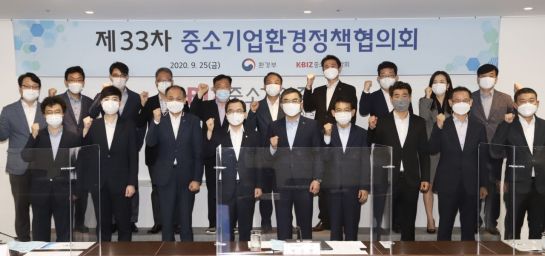 Seungwon Seo, Senior Vice President of the Korea Federation of Small and Medium Business (fifth from the left in the front row), and Junggi Hong, Vice Minister of Environment (fourth from the left in the front row), are attending the 33rd Small and Medium Business Environmental Policy Council held on the 25th at the Korea Federation of Small and Medium Business in Yeouido, Seoul, posing for a commemorative photo with representatives of small and medium enterprises and other related personnel.
[Asia Economy Reporter Kim Daeseop] "Please take a close look at the situation faced by the organic fertilizer industry. The reporting period for the commencement of operation of emission facilities by organic fertilizer manufacturers should be postponed for one year."
No Hak-jin, Chairman of the Korea Organic Fertilizer Industry Cooperative, made this request on the 25th while attending the '33rd Small and Medium Enterprise Environmental Policy Council' held at the Korea Federation of SMEs in Yeouido, Seoul. He lamented, "Most organic fertilizer manufacturers are small businesses, and it is difficult to install pollution control facilities costing several hundred million won by the end of this year."
The Environmental Policy Council was convened to discuss and propose solutions to various difficulties faced by SMEs in relation to environmental regulations. The Korea Federation of SMEs has been holding the Environmental Policy Council twice a year, in cooperation with the Ministry of Environment, since 2004.
Organic fertilizer manufacturers collect livestock manure from livestock farms to produce compost. Due to the expansion of the management scope of air emission facilities under the Ministry of Environment's 'Enforcement Rules of the Air Quality Preservation Act,' these manufacturers must report the commencement of operation of emission facilities by December 31 of this year.
Chairman No stated, "Because organic fertilizer manufacturing sites are large, installing emission or pollution control facilities under the Air Quality Preservation Act requires an investment of about 200 to 300 million won, which is difficult given the management conditions of small businesses. It is understood that out of 400 organic fertilizer manufacturers, more than half, about 270, have not yet submitted their reports."
Organic fertilizer operates on a system where products are produced and stockpiled from October each year and sold from January to April of the following year. It is difficult to carry out product production and facility improvements simultaneously, raising concerns that the application of current laws may disrupt product production next year. The industry demands that pollution control facilities be installed during the off-season from May to September next year, after collecting sales proceeds.
Chairman No added, "The annual electricity bill for organic fertilizer manufacturing sites exceeds 36 million won, and including other costs, fixed expenses exceed 50 million won annually. The business environment has worsened due to COVID-19 and other factors. It is difficult to invest several hundred million won to install air pollution control facilities by the end of this year."
At this Environmental Policy Council, representatives from SME cooperatives related to resource circulation, chemical safety, and air quality raised 18 field issues. The SME sector requested realistic alternatives to enhance the applicability of environmental policies on the ground and appropriate regulation speed adjustments.
Lee Sang-oh, Executive Director of the Korea Surface Treatment Industry Cooperative, said, "We have actively invested in improving handling facilities and complying with the Chemical Substances Control Act (Chemicals Control Act). However, the detailed standards for handling facilities are very difficult for SMEs to understand and apply, and due to the prolonged COVID-19 pandemic and decreased sales, there is no capacity to respond to the Chemicals Control Act this year."
Executive Director Lee requested the Ministry of Environment to provide a one-year postponement of regular inspections for hazardous chemical handling facilities, amend laws, expand consulting support, differentiate handling facility standards by industry, and provide subsidies for facility improvements related to the Chemicals Control Act.
Discussions were also held on raising the exemption and reduction criteria for SME waste disposal charges. Cho Nam-su, Executive Director of the Korea Leather Industry Cooperative, said, "The introduction of the waste disposal charge system under the Resource Circulation Basic Act has become a new burden for small SMEs. According to the Resource Circulation Basic Act, SMEs under the SME Basic Act can receive charge reductions, but the enforcement decree limits reductions to small enterprises, excluding medium-sized enterprises."
Currently, manufacturing SMEs with sales under 1 billion won receive a 100% exemption from waste disposal charges, and those with sales between 1 billion and 12 billion won receive a 50% reduction. Executive Director Cho emphasized, "The 100% exemption sales threshold should be raised from under 1 billion won to under 3 billion won, and the 50% reduction threshold from under 12 billion won to under 40 billion won."
Other proposals at the Environmental Policy Council included ▲adjustment of toxic substance notifications for existing biocidal products ▲improvement of procedures and subsidy increases for eco-friendly freight vehicles ▲strengthening of the standard container system for reusable empty containers and improvement of distribution industry regulations ▲improvement of environmental liability insurance rates ▲and enhancement of the Korea Environment Corporation's environmental guarantee system operation.
Seo Seung-won, Senior Vice Chairman of the Korea Federation of SMEs and co-chair of the Environmental Policy Council, said, "SMEs lack personnel specialized in environmental laws, and the laws themselves are numerous and complicated with detailed notifications, making them difficult to understand. The government needs to prepare practical alternatives suited to the field and expand on-site consulting support with sufficient time for SMEs to comply with the laws."
In response, Hong Jeong-gi, Vice Minister of the Ministry of Environment and co-chair of the Environmental Policy Council, said, "We are striving to provide practical assistance to SMEs struggling due to COVID-19. Since SME growth is a crucial national task, we will continue to listen to field voices and work closely to communicate and cooperate."
© The Asia Business Daily(www.asiae.co.kr). All rights reserved.
![Clutching a Stolen Dior Bag, Saying "I Hate Being Poor but Real"... The Grotesque Con of a "Human Knockoff" [Slate]](https://cwcontent.asiae.co.kr/asiaresize/183/2026021902243444107_1771435474.jpg)
















