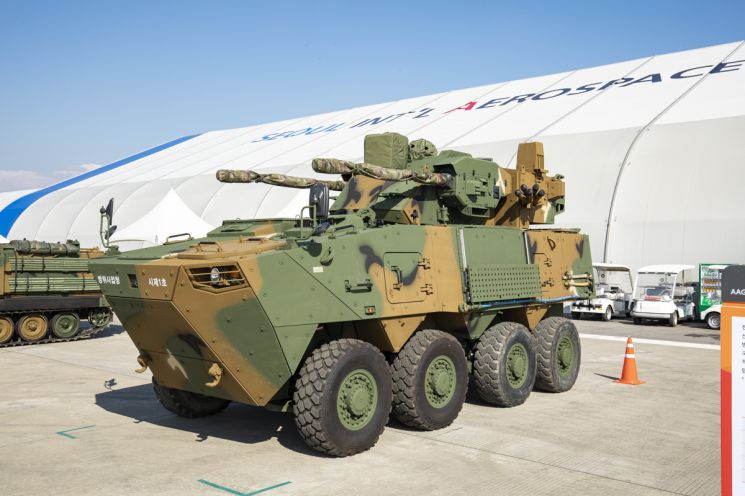
[Monthly Defense Times Editor-in-Chief An Seung-beom] The 30mm wheeled anti-aircraft gun is a next-generation low-altitude air defense weapon system introduced to the Army since the mid-1970s to replace the 20mm Vulcan cannon, capable of countering threats from enemy aircraft and small unmanned aerial vehicles.
Developed with a wheeled chassis and two cannons that exceed the range of the 20mm Vulcan cannon, it can also support air defense operations for mobile units. It is scheduled to be deployed in the 2020s to the Army, Marine Corps, and Air Force low-altitude air defense artillery units, replacing the 20mm Vulcan cannon.
The 20mm ground Vulcan cannon, which forms an anti-aircraft fire net with a firing rate of 1,000 rounds per minute and a maximum of 3,000 rounds, began deployment in the U.S. Army in 1967. Our military first introduced the M167 towed Vulcan cannon in 1973.
Although efforts were made to domestically produce the M167 towed Vulcan cannon, difficulties arose in developing key equipment such as radar and fire control systems. Subsequently, it was produced through a Korea-U.S. joint production method, and the M167 towed Vulcan cannons introduced by 1975 were used for air defense of critical national facilities. Later, the improved domestic KM167A1 towed Vulcan cannon was deployed and operated in the field.
In the mid-1980s, Hanwha Defense developed the K263 20mm self-propelled Vulcan cannon mounted on the K200 armored vehicle.
The 30mm wheeled anti-aircraft gun was developed as a government-invested, company-led project over 48 months from June 2015 to May 2019. Hanwha Defense served as the system integrator responsible for development, with Hanwha Corporation, Hanwha Systems, LIG Nex1, Hyundai Rotem, and S&T Dynamics participating as cooperating companies.
Operational testing and evaluation were conducted for 12 months starting January 2018. Meeting the military's requirements, the initial mass production plan was confirmed by the Defense Acquisition Program Administration's Promotion Committee in January 2020, and the first mass production contract worth 250 billion KRW was signed on June 24. The 30mm wheeled anti-aircraft gun was able to meet development timelines and military performance requirements through experience and technology gained from the tracked K-30 Biho/Biho Combined development. The domestic development of the turret-mounted electro-optical tracking device also achieved a system localization rate exceeding 95%, which is a significant advantage.
As a system suitable for responding to new air defense threats such as drones, it can engage not only aerial targets but also ground and maritime targets in emergencies. Without radar, it can detect and track aircraft up to 7 km away using the electro-optical tracking device, and small drones can be detected and tracked up to 3 km. It is capable of performing missions day and night under all weather conditions.
It can be linked with the C2A system, which is a core component of the recently established low-altitude air defense network, and the airbase fire control system. If linkage is not possible, it can detect and track targets independently.
Interoperable with the Army and Air Force air defense radar networks for operational use, it differentiates itself from existing Vulcan cannon systems. When linkage is unavailable, it performs low-altitude air defense missions by detecting and tracking targets using its own electro-optical target tracking device.
Compared to the 20mm Vulcan cannon, its range is 1.6 times longer and accuracy has improved. Developed as a self-propelled anti-aircraft gun, it moves alongside next-generation mobile units.
While the Biho is mounted on a tracked vehicle with a top speed of 60 km/h, the 30mm wheeled anti-aircraft gun can move at a maximum speed of 90 km/h, demonstrating superior mobility.
It includes a 'fire stabilization' function for precise target engagement, and the first round loading is automatic. Equipped with an electro-optical tracker along with thermal/TV camera-type optical sights, it enables continuous night operation.
The chassis for the 30mm wheeled anti-aircraft gun being mass-produced this time uses the K808 wheeled armored vehicle deployed in the Army, and the turret is equipped with two 30mm cannons and tracking and aiming devices.
© The Asia Business Daily(www.asiae.co.kr). All rights reserved.

















