The Statue Erection Has Been Discussed Since 2017... Various Opinion Gathering Processes
Suncheon, a City of Peace and Patriotism, Started with the Reexamination of the History of the Jeongyujaeran War
[Asia Economy Honam Reporting Headquarters Reporter Lee Hyung-kwon] The 2014 film Immortal Admiral Yi Sun-sin, directed by Kim Han-min from Suncheon, attracted 17 million viewers and ranked first in the all-time box office, raising interest in the Imjin War and Admiral Yi Sun-sin more than anywhere else in Suncheon.
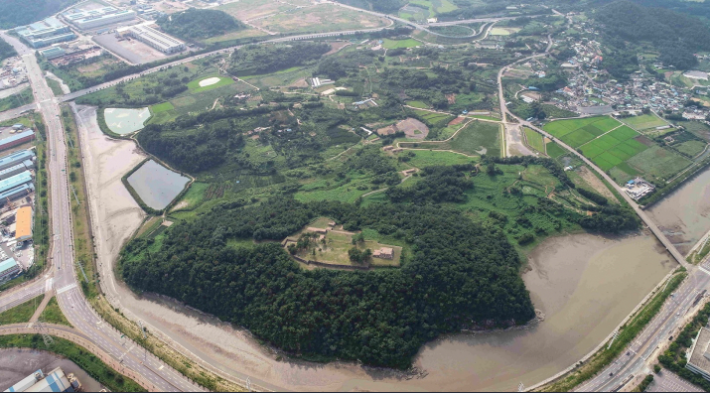
Along with this, in Suncheon, the Jeongyujaeran (the second Japanese invasion of Korea) battlefield site development project began with the perspective that the historical awareness of Suncheon Waeseong, the largest battlefield site at the end of Jeongyujaeran, should be reexamined.
The project planned to develop battlefield sites centered on Waeseong to excavate local patriotic relics related to Jeongyujaeran, enhance local residents’ pride through the history of the seven-year Imjin War victory, and develop them as tourism resources.
In February 2017, then Mayor Cho Chung-hoon of Suncheon established a plan to promote Suncheon as a Northeast Asian historical and cultural hub city, including the Jeongyujaeran battlefield site historical park project.
This project aims to establish the history of Jeongyujaeran, which embodies the sacrifices of Suncheon citizens who led the nation to victory during a national crisis, and to create a space for future peaceful coexistence among Korea, China, and Japan by utilizing historical and cultural resources to develop an international tourist destination.
This is the first time the terms “Korea-China-Japan” and “future peaceful coexistence space” appear.
Meanwhile, the Jeongyujaeran battlefield site development project consists of a total budget of 90 billion KRW, divided into the Suncheon Waeseong restoration project (33 billion KRW), Geomdansanseong restoration project (22 billion KRW), and Jeongyujaeran tourism resource development project (35 billion KRW).
Among these, the Jeongyujaeran tourism resource development project includes the construction of an exhibition experience center, an education center, and the promotion of building a patriotic peace statue (war participation statue).
This is the first mention of the statue. In other words, the statue construction plan was established in 2017.
In April 2017, four local organizations including the Historical and Cultural Research Institute Maru, Jeonnam Eastern Regional Community Research Institute, Jeongyujaeran History Research Association, and Haeryong-myeon signed a business agreement to reexamine the history of Jeongyujaeran, and the battlefield site development project proceeded smoothly.
In November, the Suncheon City Council (Chairman Lim Jong-gi) held a forum titled “Reexamining Jeongyujaeran and Admiral Yi Sun-sin’s Spirit of Righteous Army.”
At the forum, Professor Lee Wook of Suncheon University’s Department of History said, “Making Suncheon a sacred place to educate the importance of ‘peace’ is a meaningful reexamination project,” and argued, “It is necessary to focus budget and personnel on discovering and highlighting the local people who cooperated with Admiral Yi Sun-sin, rather than Admiral Yi himself.”
He also claimed that the prosperity of the three countries Korea, China, and Japan was due to “200 years of sustained peace among the three countries,” and that Suncheon Waeseong should be reestablished as a place symbolizing “the importance of peace.”
The Jeongyujaeran battlefield site project centered on Suncheon Waeseong began to actively promote the Korea-China-Japan three-country and “peace” and “peace park” development projects.
Meanwhile, Suncheon City signed a sister city agreement and held a 20th anniversary cultural and artistic exchange exhibition with Ningbo City, a friendly exchange city in China, and Ningbo City donated a peace monument to Suncheon.
In April 2018, Jeonnam Province and Jiangxi Province agreed to strengthen friendly exchanges in seven fields, including holding high-level talks and tourism promotion events.
In September, Mao Weiming, Vice Governor of Jiangxi Province, and his delegation signed an agreement to donate a statue of General Deng Zilong (鄧子龍), a native of Jiangxi Province who died alongside Admiral Yi Sun-sin in the Battle of Noryang, in commemoration of the 20th anniversary of exchanges with Jeonnam Province. The statue arrived last year.
After receiving the statue of General Deng Zilong last year, Suncheon City faced a dilemma. They could not just erect the statue of General Deng Zilong alone.
Accordingly, in July last year, Suncheon City set a direction to negotiate the donation of a statue of Konishi Yukinaga (So Seohaengjang) with Uto City, Kumamoto Prefecture, Japan, and a statue of General Jin Lin with Guangzhou City, Guangdong Province.
In March this year, related to the East Asian Cultural Cities, they planned to visit Kitakyushu and Tokyo to meet former Japanese Prime Minister Hatoyama and descendants of Konishi Yukinaga to discuss the statue donation.
In April, after visiting Yangzhou City, an East Asian Cultural City, they finalized a schedule to meet descendants of Generals Deng Zilong and Jin Lin in Jiangxi Province to invite them to the statue donation and peace forum.
However, the COVID-19 situation changed everything. Business trips to China and Japan, East Asian Cultural Cities events, and the Suncheon Peace Forum could not proceed under the COVID-19 circumstances.
In January this year, during a dialogue with citizens, Mayor Heo Seok explained the three-country statue construction plan via PPT and announced plans to travel to Japan and other countries in March.
In March, the plan to acquire shared property for the Jeongyujaeran battlefield site development, including the three-country statue construction plan, was reported to the Administrative and Safety Committee and approved as originally proposed at the plenary session of the Suncheon City Council.
Due to the COVID-19 situation, visits to China and Japan became difficult, and the donations could not be received, so the city reported to the council and obtained approval for statue construction. This was also reported during the council’s second half-year work report.
This shows that the Suncheon City Council was aware of the three generals’ statue construction. Suncheon did not suddenly engage in pro-Japanese acts but planned a park development project themed on “peace.”
In August, a Blue House (Cheong Wa Dae) national petition opposing the Konishi Yukinaga statue construction plan began, and Mayor Heo Seok ordered the cancellation of the Konishi Yukinaga statue construction plan.
In September, the Suncheon City Culture and Arts Division conducted a public opinion survey, stating, “There are differing opinions regarding the construction of the Konishi Yukinaga statue among the three generals, and we would like to hear valuable opinions.”
It is argued that a “justification” was needed to cancel a project approved by the city council.
Despite planning to build a statue of a Japanese general, Suncheon is being stigmatized as a pro-Japanese city and criticized by various media outlets.
Suncheon is not a pro-Japanese city. Suncheon is a “city of peace” hosting the “Suncheon Peace Forum” and a “cultural city” selected as an “East Asian Cultural City.”
It is a city of patriotic martyrs standing at the center of peace among Korea, China, and Japan.
It is argued that calling Suncheon a pro-Japanese city because of the three generals’ statue construction plan in the Korea-China-Japan Peace Park project is inappropriate.
The park development project at Suncheon Waeseong, which carries the pain of Japanese plundering and atrocities during Jeongyujaeran, and the killing of Koreans sacrificed to exaggerate the merits of the Ming army, aims to convey the importance of peace.
© The Asia Business Daily(www.asiae.co.kr). All rights reserved.

















