COVID-19 Spread
Government Tightens Grip on Businesses
Despite Corporate Survival Crisis
[Asia Economy Reporters Jonghwa Kim, Daeseop Kim, Chulhyun Kim, Hyewon Moon] "Due to the impact of the novel coronavirus infection (COVID-19), many companies are on the brink of closing down any day now, yet the government is pushing forward with corporate regulations. Companies need some breathing room, but this is excessive."
Seobyungmoon, Senior Vice Chairman of the Korea Federation of SMEs, criticized the government's successive legislative moves on corporate regulations on the 24th. The day before, Seobyungmoon also met with economic organization heads including Sohn Kyung-shik, Chairman of the Korea Employers Federation, and opposition party leaders to convey concerns from the corporate sector.
Seobyungmoon said, "Expanding the class action system to all sectors will affect large corporations more than SMEs, but since the management of large corporations needs to be revitalized and successful for SMEs to ultimately do well, the government is tightening regulations on companies when they are struggling. I am seriously concerned about why they keep introducing corporate regulatory laws in such a hurry."
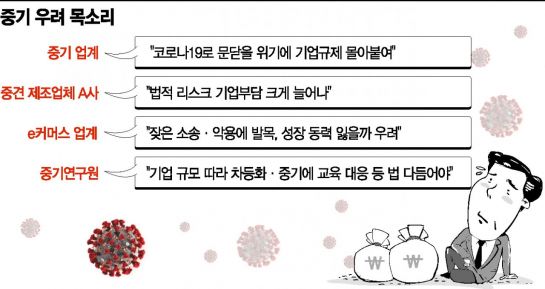
The mid-sized and small business sectors are in a state of confusion due to the surge in corporate regulations. A mid-sized B2C (business-to-consumer) company official, who requested anonymity, said, "If the class action law, which currently applies only to securities-related industries, is applied across all areas of corporate activity, considerable confusion is expected," adding, "Corporate activities will inevitably shrink."
Concerns were also expressed about the proposed amendment to include punitive damages, currently stipulated in individual laws, into the Commercial Act. The official said, "Legal risks and other burdens on companies will increase, and for mid-sized and small companies lacking internal coping capabilities, this means higher cost burdens and management risks."
Another mid-sized company official said, "While I agree with the government's intention to introduce the class action system, issues can be raised based solely on claims from 50 consumers or franchisees, potentially causing serious image damage and economic losses to companies before the factual basis of the claims is legally clarified," adding, "Punitive damages could also stifle business activities."
Emergency signals have also been triggered in the e-commerce industry. Companies providing platforms to sellers, including e-commerce firms like Coupang, Wemakeprice, Tmon, and Naver, are concerned that if the class action law is abused by some sellers, they may miss growth opportunities. At a time when non-face-to-face (untact) consumption is increasing and preparations for the post-COVID era are needed, frequent lawsuits could hinder economic growth momentum.
An industry insider pointed out, "There are existing mechanisms such as the Fair Trade Commission for platform operations, but if lawsuits from sellers continue, it amounts to double regulation," adding, "Abuse cases could arise, which would negatively affect corporate growth and industrial development."
Lee Dong-joo, Deputy Director of the Korea Institute for Small and Medium Enterprises, said, "SMEs often lack legal response capabilities, and there is a risk that innovation activities could be stifled due to black consumers and malicious accusers," adding, "It is necessary to refine the law by differentiating according to company size, and establishing response systems such as legal support, damage insurance enrollment, and education for SMEs."
The SME sector refers to the government's Fair Economy 3 Laws, promoted amid the COVID-19 crisis, as the "Corporate Strangulation 3 Laws." They pointed out that unlike advanced overseas countries that are lowering corporate taxes and freezing or reducing minimum wages to secure corporate competitiveness amid economic contraction due to COVID-19, the government is implementing policies without proper opinion-gathering procedures.
The SME sector plans to meet with the ruling party leader soon. Choo Moon-gap, Head of Economic Policy at the Korea Federation of SMEs, expressed concern, saying, "Four out of ten SMEs rely on large corporations for supply, and 80% of these companies' sales come from large corporations. If large companies lose their investment direction and falter, partner SMEs will suffer, leading to damage for numerous cooperating SMEs."
© The Asia Business Daily(www.asiae.co.kr). All rights reserved.
![Clutching a Stolen Dior Bag, Saying "I Hate Being Poor but Real"... The Grotesque Con of a "Human Knockoff" [Slate]](https://cwcontent.asiae.co.kr/asiaresize/183/2026021902243444107_1771435474.jpg)
















