Press Briefing on 'Financial Stability Situation' on the 24th
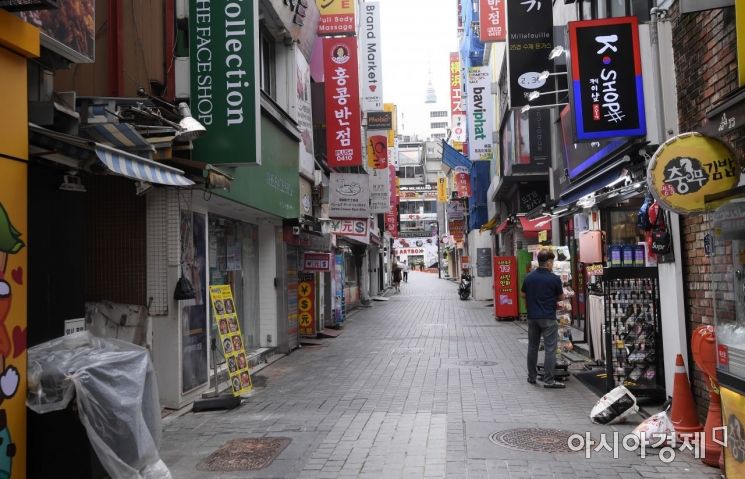 With the resurgence of COVID-19, government quarantine measures have been strengthened, and citizens' consumption activities have even contracted, intensifying the suffering of self-employed business owners. On the 31st, the streets of Myeongdong, Jung-gu, Seoul, where restaurants and various shops are concentrated, appeared quiet. Photo by Kim Hyun-min kimhyun81@
[Asia Economy Reporter Jang Sehee] The Bank of Korea announced that if the sales shock immediately following the spread of the novel coronavirus infection (COVID-19) persists throughout the year, the number of marginal firms this year is expected to reach 5,033.
On the 24th, Min Jwahong, Director of the Financial Stability Bureau at the Bank of Korea, said at a press briefing on the 'Financial Stability Situation,' "Assuming a severe stress scenario among this year's COVID-19 sales shocks, the number of marginal firms is estimated to reach 5,033." This means that among all externally audited companies, the proportion of firms unable to cover interest expenses with operating profit for three consecutive years will increase to 21.4%.
Regarding the trend of the expected default rate of marginal firms, he said, "The probability of expected default has significantly increased this year," adding, "It rose from 3.1% in December 2018 to 4.1% as of June this year." The expected default rate of marginal firms is estimated based on stock price trends.
In response to criticism that the long-term COVID-19 situation and the deferment of interest payments are distorting financial soundness indicators, he stated, "Financial support measures have aspects that do not properly reflect the actual debt repayment ability of borrowers."
He continued, "The interest payment deferment measure is intended to support borrowers facing temporary debt repayment difficulties due to COVID-19," emphasizing, "However, it can be a factor that prevents the fundamental weakening of debt repayment ability from surfacing, and adjustments should be made while monitoring the duration of this effect."
Jeong Gyu-il, Deputy Governor of the Bank of Korea, analyzed the ratio of private credit to nominal Gross Domestic Product (GDP), saying, "Since 2017 and 2018, delinquency rates have been rising," and "This year, private credit growth has explosively increased due to COVID-19." He added, "The trend of private credit growth seems likely to continue increasing for the time being," and "Leverage will likely be determined by support measures or developments such as COVID-19 treatments and vaccine development, which will influence the real economy trend."
Meanwhile, according to the report released that day, as of the end of the second quarter this year, the ratio of private credit to GDP was recorded at 206.2%, up 14.3 percentage points compared to the same period last year. The increase (+12 percentage points) was even greater compared to the first quarter.
© The Asia Business Daily(www.asiae.co.kr). All rights reserved.
![Clutching a Stolen Dior Bag, Saying "I Hate Being Poor but Real"... The Grotesque Con of a "Human Knockoff" [Slate]](https://cwcontent.asiae.co.kr/asiaresize/183/2026021902243444107_1771435474.jpg)
















