[Asia Economy Reporter Changhwan Lee] The global drone market is rapidly expanding, but South Korea's drone industry is reportedly struggling to grow properly due to regulations. Analysts warn that if regulations are not eased, the domestic market could be dominated by foreign products, similar to what happened in the past with the LED (Light Emitting Diode) industry.
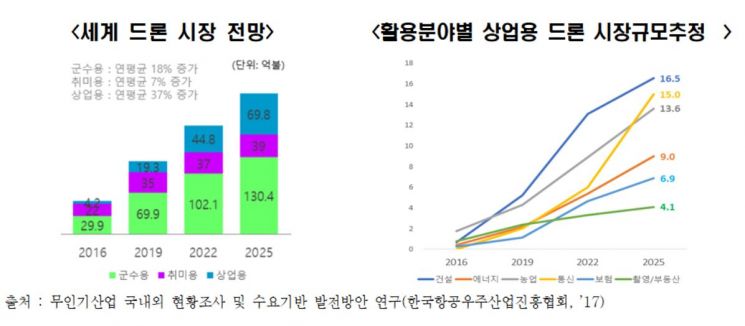
According to the Federation of Korean Industries on the 24th, the global drone market size, which was $5.6 billion in 2016, is expected to increase more than fourfold to $23.9 billion by 2025.
Drones are experiencing explosive market growth due to their diverse applications beyond military and hobby uses, including safety inspections, surveillance, surveying, transportation, delivery of goods, and as transport vehicles.
Despite the rapid growth of the global drone market, the market share of domestically produced drones is minimal. As of 2016, South Korean drones accounted for only 1% of the global market. Additionally, 51.9% of domestic drone companies are small-scale businesses with sales under 1 billion KRW.
South Korea's share of global drone-related patents is 7%, lower than major countries such as the United States at 28%, and its core component technology does not yet reach the world’s highest standards.
As a result, the domestic market has long been dominated by imported drones. As of the end of August 2019, among the 10,021 drones registered with the Regional Aviation Administration, less than 10% were domestically produced. The Regional Aviation Administration requires registration of large drones weighing 12kg or more for commercial use.
◆Global Drone Market Dominated by China and the U.S. Backed by Government Support
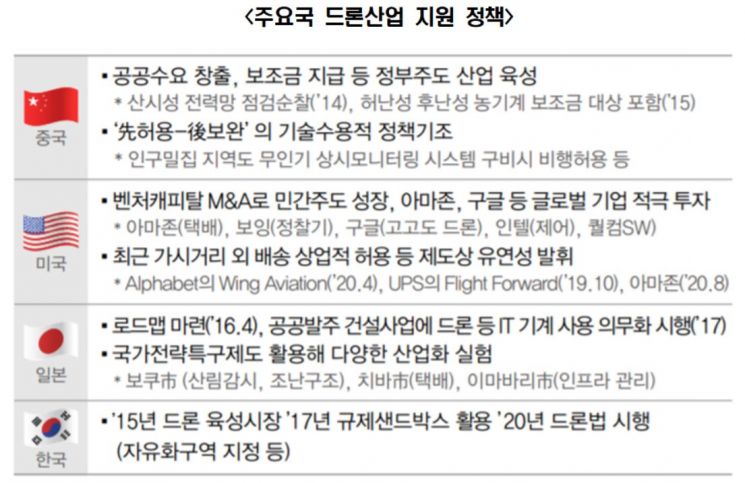
The global drone market is dominated by China and the United States, supported by strong government-level backing. China has rapidly developed its industry through a technology-accepting policy of 'allow first, regulate later,' along with strong public demand creation and government-led subsidies.
Thanks to the success of drone companies like DJI and Ehang, China has established itself as the world's largest small drone production base. Recently, it has also focused on research and development (R&D) investments, creating a virtuous cycle to secure technological capabilities.
The United States has grown its market through private-sector-led growth based on technological prowess, venture capital, and mergers and acquisitions (M&A). Recently, global companies such as Amazon, Google, and Qualcomm have been investing, and authorities are flexibly applying strict regulations to prevent losing leadership in industrialization.
For example, they have swiftly promoted commercialization in delivery by allowing commercial deliveries beyond visual line of sight for companies like UPS, Alphabet, and Amazon.
In contrast, South Korea has aligned its drone operation regulations with major countries but is still criticized for focusing on protecting small and medium-sized enterprises (SMEs) in the drone industry, such as designating drones as 'competitive products among SMEs' in public procurement since 2017.
By limiting public sector projects that should create challenging demand to SMEs and restricting participation from mid-sized and large companies, opportunities to enhance competitiveness in the fiercely competitive drone industry may be reduced.
The Federation of Korean Industries warned that South Korea’s drone industry could repeat the failure experienced by the LED industry. In the early 2010s, domestic large corporations participated in the LED market, but they withdrew after LEDs were designated as an SME-suitable industry in 2011. Subsequently, foreign companies like Philips and Osram increased their domestic market share, and Chinese companies’ low-price competition led to the domestic market being taken over by foreign firms. Even after LEDs were removed from the SME-suitable industry list in 2015, recovery did not occur.
Yoo Hwan-ik, head of corporate policy at the Federation of Korean Industries, said, "Policies focused on protecting SMEs could actually hinder synergy and competitiveness among SMEs, mid-sized, and large companies in the drone industry, raising concerns about repeating the LED failure."
He emphasized, "Support should be directed toward the 'capabilities' needed to survive in the global market rather than protectionist domestic policies," adding, "It is urgent to ease regulations and shift to support-focused policies so that South Korea’s global companies can apply their already secured competitive technologies to the drone sector."
© The Asia Business Daily(www.asiae.co.kr). All rights reserved.


















