Secondary Financial Sector Credit Loans Surge
High-Interest Card Loans Also Attract Attention
Financial Supervisory Service Requests Loan Data
[Asia Economy Reporters Oh Hyung-gil and Kim Min-young] "Despite the novel coronavirus infection (COVID-19), bank interest rates have been extremely low, and due to the impact of COVID-19 support policy loans, loans did not expand as much as expected. However, from the second half of the year, loans centered on unsecured credit increased, and this month, loan inquiries have noticeably surged." (An executive in charge of loans at A Savings Bank)
Unsecured loans in the secondary financial sector, such as insurance and savings banks, are rapidly increasing. This is interpreted as a balloon effect caused by tightening loans at commercial banks, which had surged due to debt-financed investment (debt investment) and pulling together all resources (Yeongkkeul).
The market views that, given the high interest rates characteristic of the secondary financial sector and that loans are mainly taken by low-income and low-credit borrowers, it is unlikely that these funds flowed into stock or real estate investments. However, financial authorities are preparing to manage loans in the secondary financial sector, keeping the possibility of a balloon effect in mind.
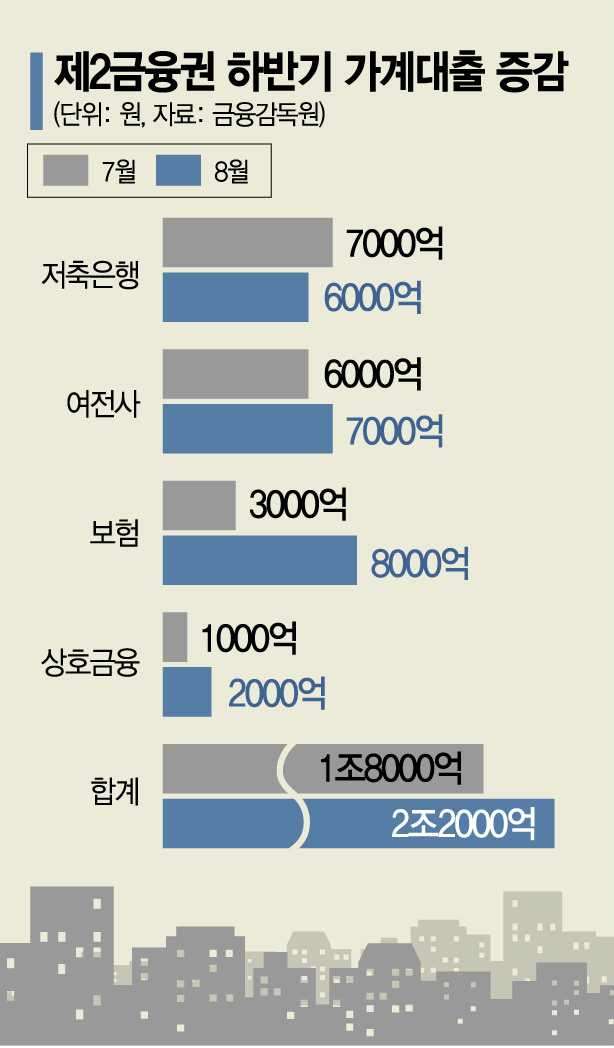
According to the Financial Supervisory Service and the financial industry on the 23rd, household loans in the secondary financial sector increased by about 4 trillion won in the second half of the year alone. After increasing by 1.8 trillion won in July, an additional 2.2 trillion won was added last month. The total increase in unsecured loans across the entire financial sector, including banks, was 6.2 trillion won, which is 2.8 trillion won more than the same month last year (3.4 trillion won).
Among the secondary financial sectors, household loans increased by 1.3 trillion won each in savings banks and capital/card companies (credit finance companies), and insurance also increased by 1.1 trillion won.
Unsecured loans increased significantly more than mortgage loans. Of the 3.5 trillion won increase in other loans in July and August, unsecured loans accounted for 1.7 trillion won, or half, while mortgage loans increased by only 200 billion won.
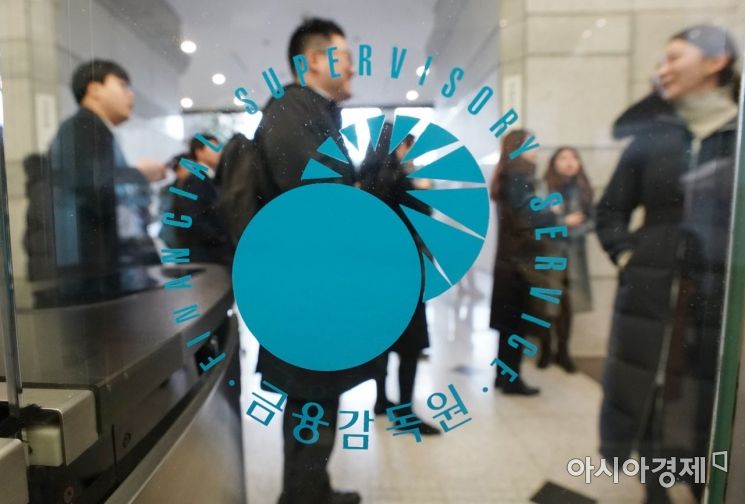 DLF Disciplinary Hearing Attendees Awaited by Reporters
 (Seoul=Yonhap News) Reporter Kim Do-hoon = On the 30th, the third disciplinary committee meeting related to the overseas interest rate-linked derivative-linked fund (DLF) incident was held at the Financial Supervisory Service in Yeouido, Seoul, where reporters were waiting for the attendees of the disciplinary hearing.
At this disciplinary hearing, the level of disciplinary action against Woori Bank and Hana Bank, which sold the DLF, as well as Sohn Tae-seung, Chairman of Woori Financial Group and CEO of Woori Bank, and Ham Young-joo, Vice Chairman of Hana Financial Group (then CEO of Hana Bank during the DLF sales), is expected to be decided. 2020.1.30
superdoo82@yna.co.kr
(End)
Financial Authorities Begin Checking Balloon Effect of Loans in Secondary Financial Sector
Household loans in the secondary financial sector had been on a declining trend until May. Due to the COVID-19 pandemic and low interest rates, the scale of household loans decreased by 5 trillion won compared to the end of last year from January to May. However, from June (500 billion won), the loan scale turned to an increase.
Demand also surged for card loans with an average high interest rate of around 15%. Card loans, which have relatively lenient loan screening and long repayment periods and are mainly used by small business owners, also turned to an increasing trend from the second half of the year. As of July, the balance of card loans at seven domestic specialized card companies was 30.0802 trillion won, an increase of 291 billion won from the previous month (29.7892 trillion won). Usage also increased by 74.6 billion won from 3.9145 trillion won to 3.9891 trillion won.
Typically, the secondary financial sector has more low-income and low-credit borrowers than banks, and the proportion of real demand rather than investment is higher, so demand is concentrated on living expenses or business funds. However, there is analysis that as financial authorities tightened bank loans to curb debt-financed investment and Yeongkkeul, loan demand increased in the secondary financial sector.
It is also expected that demand, which had flowed to insurance companies due to strengthened bank mortgage loan regulations, will continue for a while.
In the first half of the year, the loan balance of 24 domestic life insurance companies was 144.5 trillion won, an increase of 2.4 trillion won from 142.1 trillion won at the beginning of this year. Among these, mortgage loans were 45.5 trillion won, up 2.3 trillion won from 43.2 trillion won at the beginning of the year. On the other hand, the balance of policy loans was 45.6 trillion won, down 1.4 trillion won from 47 trillion won at the beginning of the year.
Accordingly, the Financial Supervisory Service plans to examine whether there is a balloon effect in loans in the secondary financial sector. The FSS recently requested credit loan-related data from the Korea Federation of Savings Banks and is working to grasp the current status of loans in the secondary financial sector.
The authorities have recently requested commercial banks to consider reducing loan limits for high-income and high-credit borrowers regarding the rapidly increasing unsecured loans. Along with this, since they requested submission of household loan management plans by the 25th, it is expected that a comprehensive management guideline will be issued after the Chuseok holiday based on the inspection results.
An official from a savings bank said, "If high-credit borrowers or professionals are blocked from getting loans at banks, they might look for mutual finance companies with relatively lower interest rates next," but added, "However, since the interest rate on savings bank unsecured loans is at least in the 5% range annually, the demand to replace banks is not expected to be high."
© The Asia Business Daily(www.asiae.co.kr). All rights reserved.


















