[Asia Economy Reporter Woo Su-yeon] On the 22nd (local time), Tesla announced plans to launch a 'half-price electric vehicle' through its Battery Day event, causing the domestic automobile industry to become highly alert. Tesla, the world's number one electric vehicle market share company, poses a threat to Hyundai Kia Motors with its aggressive cost reduction plans, but at the same time, there is growing anticipation that it could accelerate the popularization of the electric vehicle era.
So far, governments around the world have been increasing subsidies for electric vehicles as part of policies to expand eco-friendly cars. However, due to limited resources, it is essential in the long term to supply electric vehicles at prices accessible to the public without subsidies. Therefore, reducing battery costs, which account for a significant portion of the electric vehicle price, remains the biggest challenge for automakers.
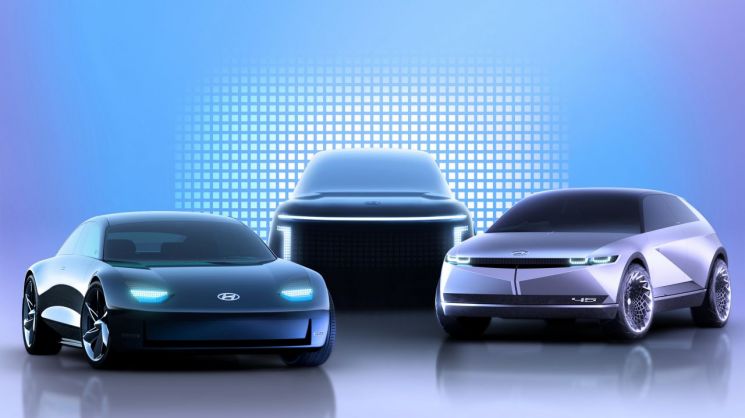 Rendering images of the Ioniq brand lineup equipped with Hyundai's dedicated electric vehicle platform (from left: Ioniq 6, Ioniq 7, Ioniq 5) / Photo by Hyundai Motor Group
Tesla's 'Half-Price Electric Vehicle' Declaration... Expectation for Accelerated Popularization of Electric Vehicles
Industry experts predict that if Tesla's specific plans are realized, Tesla's market share will expand in the short term, but in the long term, the price decline of electric vehicles will accelerate, expanding the overall market size. According to Bloomberg, electric vehicles are expected to account for 58% of global new car sales (passenger cars) by 2040, and Hyundai Motor Group has set a goal of selling 1 million electric vehicles and achieving a 10% global market share by 2025.
According to market research firm SNE Research, from January to July this year, Hyundai ranked 4th and Kia ranked 8th in electric vehicle sales across 77 countries worldwide. Hyundai's sales increased by 12.3% compared to the same period last year to about 36,000 units, marking its first-ever entry into 4th place. This is a rise of more than six ranks compared to the same period last year, showing Hyundai's aggressive expansion of market share in the electric vehicle market.
Im Eun-young, a researcher at Samsung Securities, said, "As new technologies spread throughout the industry, the cost reduction speed of electric vehicles is expected to be faster than anticipated," adding, "Hyundai Kia Motors will consider ways to reduce costs across the entire electric vehicle value chain rather than internalizing batteries."
Hyundai Kia Motors to Face Tesla Head-On by Strengthening Collaboration on Dedicated Platforms and Battery Suppliers
First, Hyundai Kia Motors will respond to Tesla's aggressive moves by launching new electric vehicles next year equipped with the dedicated electric vehicle platform (E-GMP). The first new cars equipped with dedicated electric vehicle platforms, such as Hyundai's Ioniq 5 (NE) and Kia's CV, will enter full-scale production next year. Dedicated electric vehicle platforms are directly linked to cost. Applying the same platform increases production efficiency and reduces costs through parts standardization. As of next year, the only automakers capable of producing vehicles using dedicated electric vehicle platforms are Volkswagen and Hyundai Motor Group.
Moreover, Hyundai Kia Motors has strong allies competing for the number one position in the global battery industry. Through collaboration with LG Chem, SK Innovation, and Samsung SDI, Hyundai Kia Motors is pursuing stable and price-competitive battery supply. Earlier this month, it was reported that the heads of the four major groups, including Chung Eui-sun, Vice Chairman of Hyundai Motor Group, gathered in one place for a sudden meeting aimed at strengthening such battery collaboration.
In addition, Hyundai Motor Group is planning to introduce a battery rental system to reduce electric vehicle costs. In July, Hyundai Motor and SK Innovation signed a memorandum of understanding (MOU) in the Battery as a Service (BaaS) field, covering the entire process from battery production and supply to rental, exchange, repair, charging, reuse, and recycling. The electric vehicle popularization model envisioned by the two companies involves the rental company owning the battery, while the buyer only pays for the vehicle. This is attracting attention as a revolutionary solution because it can reduce the cost of the battery, the most expensive component in electric vehicles.
© The Asia Business Daily(www.asiae.co.kr). All rights reserved.
![Clutching a Stolen Dior Bag, Saying "I Hate Being Poor but Real"... The Grotesque Con of a "Human Knockoff" [Slate]](https://cwcontent.asiae.co.kr/asiaresize/183/2026021902243444107_1771435474.jpg)











