Shutdown Crisis During November Presidential Election Averted
Cross-Party Agreement Amid Concerns Over Aftermath of COVID-19 Crisis
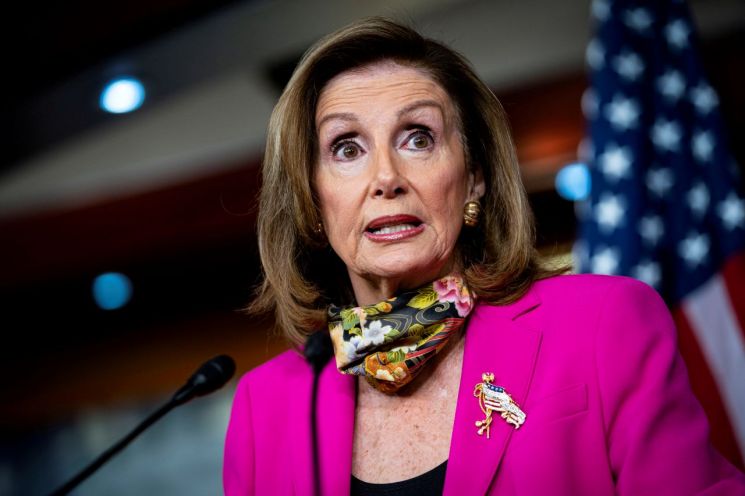
[Asia Economy Reporter Hyunwoo Lee] The U.S. House of Representatives has agreed on a temporary federal budget. The Trump administration, which faced the threat of a federal government shutdown at the beginning of next month as the fiscal year changed, has breathed a sigh of relief. The bipartisan cooperation is interpreted as a result of both the Republican and Democratic parties, who failed to agree on the 2021 fiscal year budget, feeling a sense of crisis that their approval ratings could suffer a fatal blow amid the COVID-19 pandemic and the upcoming November election.
According to foreign media including CNN, on the 22nd (local time), the U.S. House passed a "Continuing Resolution (CR)" allowing the use of the federal government's temporary budget until December 11. House Speaker Nancy Pelosi stated in a press release that day, "Through the short-term spending bill CR, we will fund the government until December 11," and added, "The Democrats have secured emergency funds to ensure that students from extremely poor backgrounds can receive school meals even amid the COVID-19 crisis."
According to ABC News, late that evening, Speaker Pelosi and U.S. Treasury Secretary Steven Mnuchin reached a negotiation that allowed the CR bill to pass. Pelosi and Mnuchin had been working throughout the previous week to reach an agreement but repeatedly failed. Pelosi insisted that the CR bill must include an $8 billion support package for extremely poor students and their families proposed by the Democrats, while Mnuchin argued that the $19 billion in farmer aid emphasized by President Trump should be reflected first, leading to a standoff. Ultimately, ABC News reported that the two parties were able to reach an agreement after Mnuchin withdrew his demand to include the farmer aid.
Previously, the dominant expectation was that the U.S. federal government would shut down starting from the first day of the new fiscal year next month due to the failure of the Democratic and Republican parties to agree on the 2021 fiscal year budget. In the U.S., if Congress fails to pass the new fiscal year budget bill by September 30, the last day of the fiscal year, the federal government has repeatedly been unable to pay salaries to public employees.
The CR bill passed this time is a temporary measure to prevent a shutdown caused by a budget gap. If a budget bill or a new CR bill extending the short-term spending deadline is not passed before the expiration of the short-term spending period specified in the CR bill, the federal government will face another shutdown crisis. The U.S. federal government previously experienced the longest shutdown in its history, lasting 35 days from December 22, 2018, to January 25, 2019.
The bipartisan agreement is interpreted as a judgment that the political fallout would be significant if the federal government were to shut down ahead of the election. The Washington Post (WP) recently reported that even within the U.S. Democratic Party, moderate lawmakers expressed concerns that Speaker Pelosi's prolonged political battle with the Trump administration over the budget and additional stimulus package could backfire in the election.
© The Asia Business Daily(www.asiae.co.kr). All rights reserved.

















