Government Plans to Amend Standing Committee Law Within This Month
Tenants Can Now Request Rent Reduction in Disaster Situations
Hong Nam-ki: "Recent Trend of Stabilization in the Housing Market"
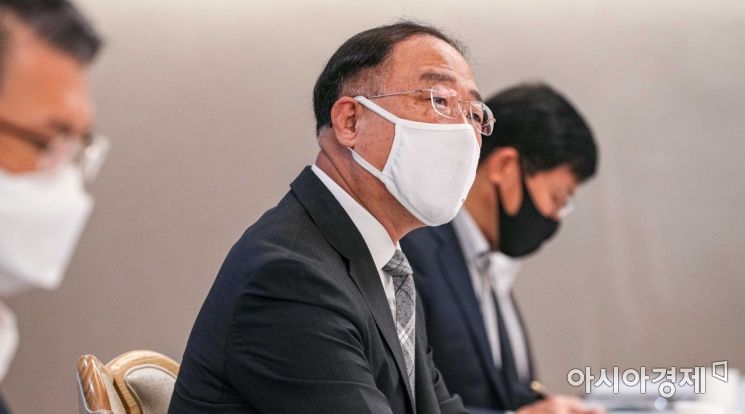 Hong Nam-ki, Deputy Prime Minister and Minister of Economy and Finance, is delivering opening remarks at the 'Real Estate Market Inspection Meeting of Related Ministers' held at the Government Seoul Office in Jongno-gu, Seoul, on the 23rd. Photo by Kang Jin-hyung aymsdream@
[Asia Economy Reporters Joo Sang-don, Moon Je-won] In the future, tenants of commercial properties who suffer damage in disaster situations such as the novel coronavirus infection (COVID-19) will be able to request a rent reduction. Additionally, a plan is being considered to exclude the first six months after the enforcement of the amended Commercial Building Lease Protection Act (CBLPA), which is about to pass the National Assembly, from the rent arrears period.
On the 23rd, Hong Nam-ki, Deputy Prime Minister and Minister of Economy and Finance, presided over the '7th Real Estate Market Inspection Meeting' held at the Government Seoul Office and stated, "Currently, tenants can request a rent reduction if there are changes in economic circumstances, but we will clarify that disaster situations such as COVID-19 are also included." This means that the amendment to the CBLPA being discussed in the National Assembly will include such provisions. The amendment passed the subcommittee on the 22nd, and is scheduled to be reviewed by the Legislation and Judiciary Committee on the same day and submitted to the plenary session on the 24th.
If this amendment to the CBLPA passes the National Assembly, tenants will be able to request a rent reduction from landlords. However, if the landlord refuses the reduction, the tenant must apply for mediation through the 'Commercial Building Lease Dispute Mediation Committee,' and if mediation fails, a civil lawsuit must be filed.
Furthermore, the government is exploring measures to reduce concerns about forced eviction of commercial tenants who have inevitably fallen behind on rent due to the COVID-19 crisis. According to the current CBLPA, landlords can terminate contracts if the tenant's rent arrears reach three months' rent.
Because of this, many tenants whose sales sharply declined due to COVID-19 were worried that they might be evicted without even recovering their key money. In response, the government decided not to include the first six months after the enforcement of the amended CBLPA in the arrears period. If the amendment passes the plenary session on the 24th and is immediately enforced, rent arrears will not be counted in the arrears period until March 23 of next year.
However, arrears before enforcement will not disappear. For example, if a tenant who has already failed to pay one month's rent falls behind on an additional two months' rent after March 23, the landlord can terminate the contract. While tenants may avoid immediate contract termination even if they fail to pay rent, which is expected to help protect small business owners, landlords will not be able to exercise their property rights even if they do not receive rent for the next six months. A Ministry of Land, Infrastructure and Transport official said, "This is intended to protect tenants who could face immediate disadvantages if they fall behind on three months' rent. Since the overdue rent is not waived, landlords will not suffer unilateral losses."
Deputy Prime Minister Hong assessed the recent housing market as showing a "stabilization trend." As of the second week of September, the Seoul apartment sales price increase rate has recorded 0.01% for four consecutive weeks, and in the Gangnam 4 districts (Gangnam, Seocho, Songpa, Gangdong), it has remained flat at 0.0% for six consecutive weeks, effectively halting the upward trend. Seoul's jeonse (long-term lease) prices have been rising for three consecutive weeks since the fifth week of August (0.09%). Hong said, "Notably, the Korea Real Estate Agency's supply-demand index is 102.9, gradually approaching the balance point of 100, and KB Real Estate's sales dominance index is 92.1, indicating a seller's market for two consecutive weeks, reflecting a recent calming trend in sales sentiment that precedes housing market prices." He added, "This is also reflected in the demand side, such as a decrease in the number and proportion of Seoul apartment purchases from outside Seoul."
© The Asia Business Daily(www.asiae.co.kr). All rights reserved.
![Clutching a Stolen Dior Bag, Saying "I Hate Being Poor but Real"... The Grotesque Con of a "Human Knockoff" [Slate]](https://cwcontent.asiae.co.kr/asiaresize/183/2026021902243444107_1771435474.jpg)
















