Park Beom-gye "The Most Certain Way to Realize Democracy as a Corporation"
Lee Yong-woo "Will Raise the Issue as Several Lawmakers Point Out the Need"
[Asia Economy Reporter Park Cheol-eung] Voices within the ruling party are growing louder, calling for the passage of a mandatory cumulative voting system bill that was not included in the government-proposed Commercial Act amendment. This issue, which significantly strengthens minority shareholders' rights to appoint directors, is particularly opposed by the business community. In addition, various economic democratization bills, such as the expansion of class action lawsuits where some victims represent the whole group, are being proposed alongside the 'Fair Economy 3 Acts.' Business leaders are visiting the National Assembly daily to appeal for relief from corporate burdens.
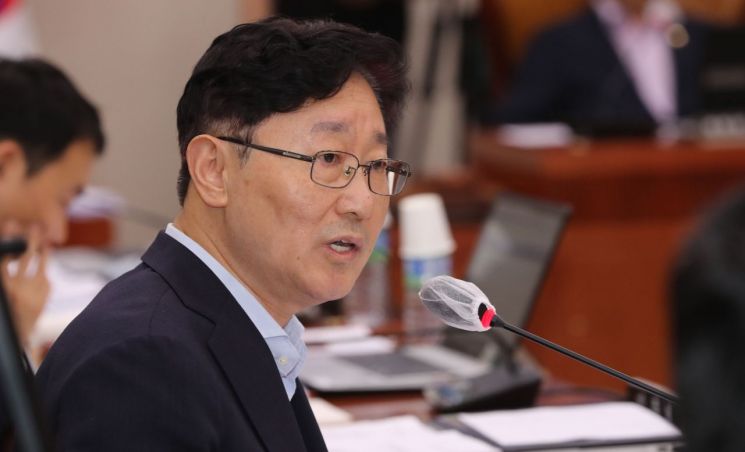
Park Beom-gye, a member of the National Assembly's Legislation and Judiciary Committee from the Democratic Party of Korea, said in a phone interview with Asia Economy on the 23rd, "The cumulative voting system is not included in the government's proposal but is included in the bill proposed by Representative Park Yong-jin," adding, "Implementing cumulative voting would eliminate undemocratic elements in corporate decision-making processes and truly introduce democracy in stock companies."
He continued, "This will definitely be discussed in the current National Assembly session, and I am in favor of it. It is the most certain way to change the decision-making method at shareholders' meetings," he added.
The cumulative voting system grants voting rights not on a one-share-one-vote basis but according to the number of directors to be appointed. Minority shareholders can concentrate their votes on their preferred directors. Although introduced in 1998 to check the unilateral management by major shareholders, it has been considered ineffective because it can be excluded by the articles of incorporation. Representative Park Yong-jin's bill proposes making it mandatory.
Lee Yong-woo, a former CEO of KakaoBank and an economic expert within the Democratic Party, told Asia Economy, "The cumulative voting system was promoted during the Park Geun-hye administration and was also proposed by the Democratic Party, but the government’s approach seems somewhat lax," adding, "Several Democratic Party lawmakers are raising the need and will push for it. We are preparing many bills that we think are necessary beyond the 'Fair Economy 3 Acts,' not just following the government’s proposal." He had introduced a special law for protecting minority shareholders in listed companies last month.
Kim Jong-in, the emergency committee chairman of the People Power Party, included the cumulative voting system as a core part of the Commercial Act amendment he proposed in 2016 when he was with the Democratic Party. Even earlier, it was part of the election pledges presented by Kim during former President Park Geun-hye’s campaign. At a meeting with Park Yong-man, chairman of the Korea Chamber of Commerce and Industry, the day before, Kim said, "The pledge we made back then was even stronger than the current bill," which was interpreted as referring to the cumulative voting system.
The government’s exclusion of the cumulative voting system from the 'Fair Economy 3 Acts' appears to reflect the burden it entails. Park Cheol-ho, a specialist at the Legislation and Judiciary Committee, stated in a review report on Representative Park Yong-jin’s Commercial Act amendment, "The Ministry of Justice sympathizes with the purpose of the cumulative voting system, considering its positive aspects such as enhancing minority shareholders’ rights to appoint directors and contributing to management transparency."
He added, "However, applying it to all listed companies or all companies is too broad, so it is reasonable to limit it to listed companies of a certain size where there is a strong social demand for improving management soundness. Also, there are concerns that if the cumulative voting system is implemented together with the separated election system for audit committee members, the effectiveness of each system may be diminished, so supplementary review is necessary."
Meanwhile, Baek Hye-ryun, the ruling party’s floor leader on the Legislation and Judiciary Committee, introduced a bill the day before to expand class action lawsuits to all fields. This would allow the effect of a judgment in a lawsuit filed by a representative party to extend to all victims, whereas currently it is only applied in the securities field. The proposal aims to enable this for cases involving so-called 'gap-jil' (power abuse) relationships, consumer disputes, environmental and pollution disputes, among others.
Following Chairman Park Yong-man’s visit the day before, Chairman Sohn Kyung-shik of the Korea Employers Federation and Chairman Jung Gu-yong of the Korea Listed Companies Association are scheduled to meet with Chairman Kim Jong-in and others to convey the business community’s concerns.
© The Asia Business Daily(www.asiae.co.kr). All rights reserved.

















