Development of Early Infection Diagnosis Technology Mimicking Human Blood Vessels
Rapid Detection of Various Infectious Agents
Capable of Identifying Cancer as Well as Infectious Diseases like COVID-19
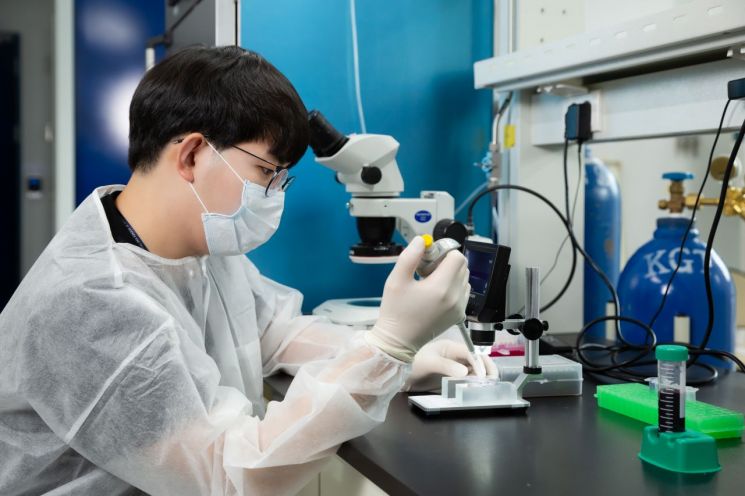
[Asia Economy Reporter Junho Hwang] An artificial vascular chip (microfluidic chip) that mimics the human immune response has been developed. This chip can instantly diagnose the presence of viral or bacterial infections by dropping a single drop of blood. The research team that developed this chip expects it to revolutionize the screening method for patients with the novel coronavirus infection (COVID-19), which currently relies on medical interviews or temperature checks.
On the 23rd, the research team led by Professor Jooheon Kang of the Department of Biomedical Engineering at Ulsan National Institute of Science and Technology (UNIST) announced that they have developed a microfluidic chip capable of early detection of pathogen (bacteria, virus, etc.) infections. The related research results are scheduled to be published in the latest issue of the international journal Biosensors and Bioelectronics.
Instant Confirmation of Infection Status
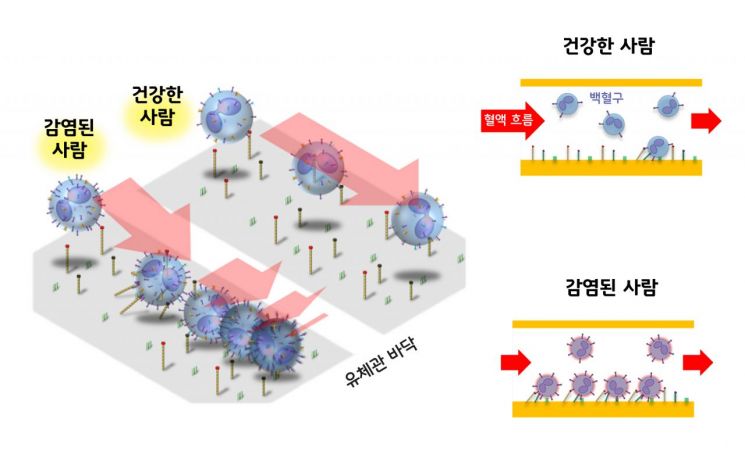
The research team developed this chip by mimicking the phenomenon where immune cells (white blood cells) adhere to the vascular endothelium during the process of extravasation, which is when they pass through the blood vessel walls to reach the site of infection. The chip’s microfluidic channel walls are coated with proteins expressed by vascular endothelial cells during infection, capturing white blood cells in the blood.
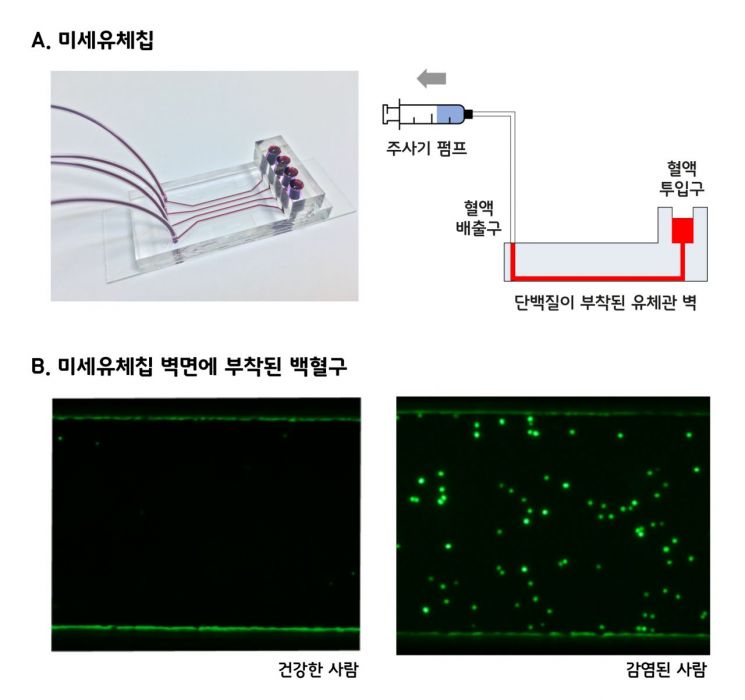
In infected individuals, the number of white blood cells adhering to the walls is noticeably higher than in healthy individuals, allowing easy determination of infection status using only a low-magnification optical microscope. The test takes about 10 minutes. It can detect infection even at the very early stage (within 1 hour of infection).
The research team tested the performance of the microfluidic chip using mice infected with antibiotic-resistant bacteria. When a single drop (50 microliters) of blood from infected mice was flowed through the microfluidic device, more white blood cells were found adhering to the channel walls compared to uninfected mice. Furthermore, even at just 1 hour post-infection, more white blood cells adhered compared to normal mice. The team analyzed this as evidence that early screening of infected patients is possible.
Clinical Study Planned to Differentiate Infected Patients
Se-yong Kwon, the first author and research professor at UNIST’s Department of Biomedical Engineering, stated, "It is well known that the expression of certain proteins in vascular endothelial cells increases during infection, but the increase in protein expression on the surface of white blood cells and the proportion of white blood cells expressing those proteins are newly revealed findings from this study."
Co-first author Amanzol Kermashev explained, "Because the immune response occurs similarly regardless of the causative pathogen, this can be used to diagnose all types of bacterial and viral infections, and it can also be applied to early diagnosis of cancer as well as infectious diseases."
Professor Jooheon Kang said, "Since the human body has the same immune system and human white blood cells respond thousands of times more sensitively than the mice used in the experiments, commercialization potential is high," adding, "We are planning clinical studies to screen patients through joint research with hospitals."
© The Asia Business Daily(www.asiae.co.kr). All rights reserved.
![Clutching a Stolen Dior Bag, Saying "I Hate Being Poor but Real"... The Grotesque Con of a "Human Knockoff" [Slate]](https://cwcontent.asiae.co.kr/asiaresize/183/2026021902243444107_1771435474.jpg)













