Free Flu Vaccinations Only for Vulnerable Groups... Increased Budget for COVID-19 Vaccines
Support Also Planned for Corporate Taxi Drivers
20 Million Won Disaster Relief Includes Entertainment Bars and Colateks
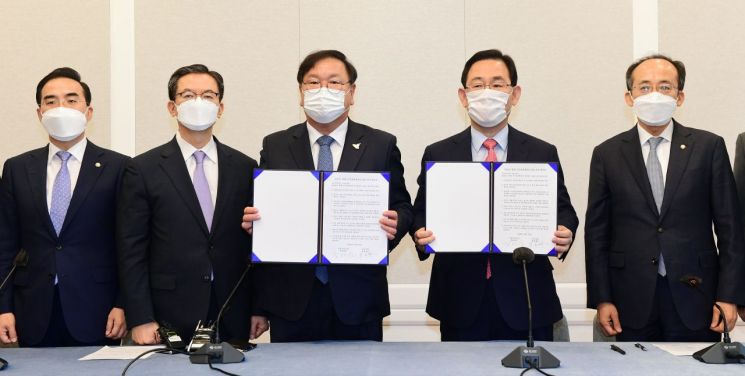
[Asia Economy Reporters Kim Hyemin and Jeon Jinyoung] The ruling and opposition parties have reached a sudden agreement on the key issues of the 4th supplementary budget (추경) bill. The telecommunications fee will be selectively supported, focusing on youth and the elderly, and the care expenses support target has been expanded to include middle school students. The National Assembly will hold a plenary session on the afternoon of the 22nd to process the supplementary budget bill.
Democratic Party floor leader Kim Tae-nyeon and People Power Party floor leader Joo Ho-young held a meeting at the National Assembly on the same day and announced this agreement. Present at the meeting were Park Hong-geun, the Democratic Party budget and accounts committee secretary responsible for coordinating the supplementary budget, and Choo Kyung-ho, the People Power Party secretary.
The key issue of telecommunications fees shifted from universal payment to selective payment. The government and ruling party initially proposed providing support to all citizens aged 13 and above nationwide, but finally decided to limit the recipients to those aged 16 to 34 and those aged 65 and above, providing 20,000 KRW each. Considering that middle school students were included in the child-rearing support project to avoid overlapping support, and that those aged 65 and above generally have low personal income, this decision was made. The related budget is expected to be reduced by about 520.6 billion KRW.
Democratic Party lawmaker Park Hong-geun said, "It was not easy for the ruling party to accept cuts to telecommunications fee support, but considering that the supplementary budget must be executed before Chuseok and the opposition's strong stance, we had no choice but to agree to the reduction."
The care expenses support target, initially applied up to elementary school students, will be expanded to middle school students. The People Power Party had demanded support up to high school students. Accordingly, the ruling and opposition parties reached a compromise to provide 150,000 KRW as a non-face-to-face learning support fund to children aged 13 to 15, corresponding to middle school age.
The opposition's proposal for free nationwide influenza vaccinations was compromised to support 1.05 million vulnerable people, including 700,000 medical aid recipients and 350,000 recipients of disability pensions and allowances. Lawmaker Park explained, "Previously, the free vaccination target included 19 million people, covering high school students, soldiers, and pregnant women, so this is an expansion of the target."
Lawmaker Chu said, "We wanted to expand free vaccinations to more people, but the final decision was made by accepting the opinions of medical staff and infectious disease experts." Floor leader Joo had a technical discussion with Jeong Eun-kyung, director of the Korea Disease Control and Prevention Agency, the previous night and actively reflected her advice, Chu added.
The ruling and opposition parties also agreed to increase the budget proposed by the Democratic Party to secure COVID-19 vaccine supplies (20% of the population nationwide, 10.37 million doses).
They also decided to increase the budget for special support projects such as COVID-19 regional employment response to support individual taxi drivers and corporate taxi drivers whose income has decreased due to COVID-19. Additionally, they agreed to provide 2 million KRW in new hope funds for small business owners in business sectors subject to gathering bans, including entertainment bars and colatecs, who actively cooperated with government quarantine policies.
Besides these, the ruling and opposition parties agreed to include budgets for ▲ compensation and recovery support for medical personnel who sacrificed greatly in COVID-19 response, including counseling therapy and training costs ▲ strengthening protection for at-risk children in blind spots by reinforcing counseling facilities, expanding psychological treatment infrastructure, and early deployment of dedicated child protection personnel.
Until the day before, the ruling and opposition parties had not reached an agreement, but they found a compromise by each party making concessions on their proposals. Lawmaker Park said, "Compared to previous supplementary budget submissions, this is the shortest approval in 11 days, and it also set a record for processing on the day of agreement. This result reflects the shared commitment to prioritize people’s livelihood and implement bipartisan cooperation." Lawmaker Chu added, "Initially, the positions of the two parties were strong, but during negotiations, both sides recognized the need to be more flexible. I thank the Democratic Party for listening to the opposition and accepting many issues."
The ruling and opposition parties plan to hold sequential meetings to finalize the bill as soon as the Ministry of Economy and Finance prepares the budget statement reflecting the agreement (sheet work). It is highly likely that the plenary session will be held at 10 p.m. that day to process the bill.
Floor leader Kim said, "It is very fortunate that the supplementary budget bill can be processed through bipartisan agreement," and urged, "The government should do its best to ensure swift execution so that the funds can be delivered before Chuseok."
© The Asia Business Daily(www.asiae.co.kr). All rights reserved.
![Clutching a Stolen Dior Bag, Saying "I Hate Being Poor but Real"... The Grotesque Con of a "Human Knockoff" [Slate]](https://cwcontent.asiae.co.kr/asiaresize/183/2026021902243444107_1771435474.jpg)
















