Reduced Outdoor Activities Due to Remote Work
Increased Consumption of High-Calorie Delivery Food
Efforts Needed to Manage Weight by Counting Calories
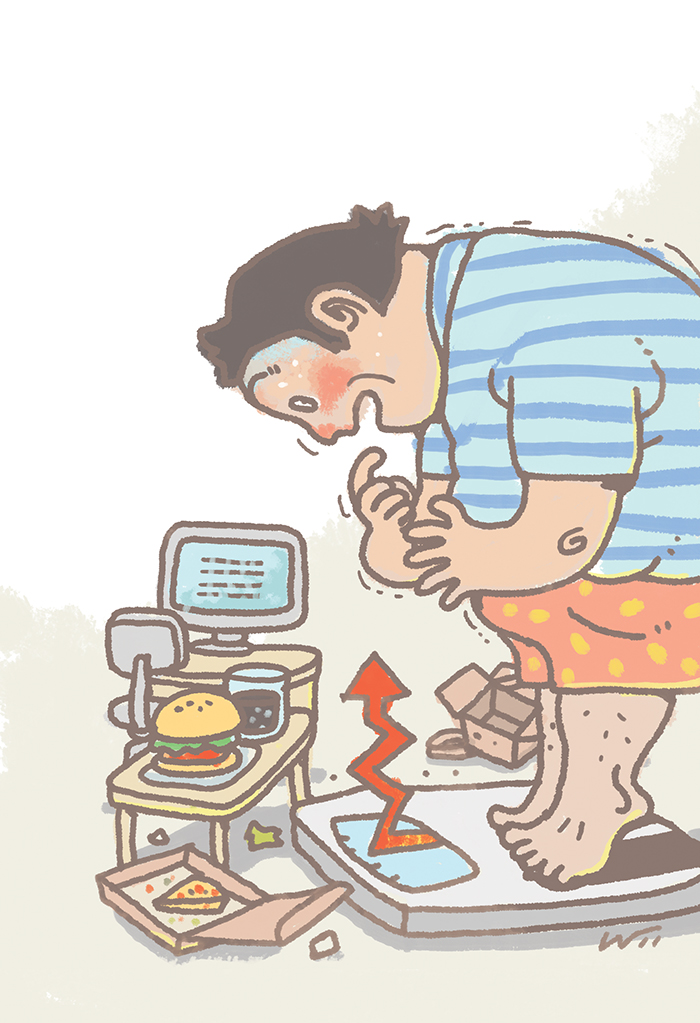
[Asia Economy Reporter Lee Jung-yoon] Office worker Park Mo (30) is worried about his increasing weight since the outbreak of the novel coronavirus disease (COVID-19). Outdoor activities have decreased, and he has become less frequent at the gym he had been attending for over a year because exercising while wearing a mask is uncomfortable. Also, with three weeks of working from home, he resolves almost every meal with delivery food. His weight, which usually stayed in the low 70 kg range, has increased to 75 kg. He said, "I am worried that my health might deteriorate because I spend the whole day only inside the house."
As outdoor activities decrease and the intake of delivery food increases, the number of so-called 'Hwakjjinja' is rising day by day. 'Hwakjjinja' is a newly coined term likening people who have gained a lot of weight due to a sharp decrease in physical activity while staying at home to avoid COVID-19 infection to confirmed patients. According to a survey conducted on 824 individual members by Alba Heaven, a job and part-time job portal, on the 22nd, 52.1%?one in two people?answered that their weight increased compared to the beginning of this year, with an average weight gain of 4.9 kg. Especially, job seekers showed the highest weight gain at 5.9 kg.
The most cited reason for weight gain was an increase in the consumption of high-calorie and high-fat delivery food (52.2%, multiple responses allowed). This was followed by a decrease in outdoor activities due to online classes and working from home (49.1%), irregular sleeping hours (34.8%), and reduced exercise due to refraining from using exercise facilities (31%).
In particular, single-person households, who find it difficult to cook at home because they live alone, say that managing weight has become even more challenging since COVID-19. Job seeker Kim Young-ho (27) said, "I often order delivery food because my one-room apartment lacks proper cooking utensils, and the frequency has increased since COVID-19. Especially, delivery food has a minimum order amount, so I end up ordering more than I usually eat." University student Hwang Mo (27) also lamented, "Since I mainly eat high-calorie foods like delivery food or convenience store ramen, my weight naturally increases."
According to the report titled 'Analysis of Disposable Plastic Waste Emissions Due to the Increase in Single-Person Households' released by the Seoul Digital Foundation on the 20th, the amount of disposable items emitted by single-person households was about 2.3 times higher than that emitted by one person living in multi-person households. Professor Kim Yang-hyun of the Department of Family Medicine at Korea University Anam Hospital advised, "When exercising in places with little contact with others, such as at home or building staircases, or when eating delivery food, it is necessary to make efforts to manage weight by calculating calories."
© The Asia Business Daily(www.asiae.co.kr). All rights reserved.

















