Increase in Noise Complaints Between Floors as Outings Decrease Due to COVID-19
Threats with Weapons Over Noise Between Floors
Experts: "Mutual Consideration Among Neighbors Is the Best"
 Conflicts over noise between floors have intensified as people spend more time at home due to the novel coronavirus infection (COVID-19) pandemic. Photo is unrelated to specific expressions in the article. [Image source=Yonhap News]
[Asia Economy Reporter Heo Midam] "'Thumping' sounds make it impossible to concentrate on work," "I wish they would at least wear slippers..."
As the COVID-19 pandemic has increased the amount of time people spend at home, more individuals are suffering from noise complaints between floors. In particular, office workers doing remote work are experiencing various stresses, including disruptions to their work caused by noise from neighbors above.
However, with no proper solutions to regulate inter-floor noise, some victims have resorted to retaliatory actions such as installing 'revenge speakers' aimed at the upstairs neighbors. Experts suggest that emotional reactions should be avoided and that issues should be resolved through dialogue with neighbors.
Office worker Kim (27) said, "I have been very stressed by the constant 'thumping' from the upstairs neighbors. But recently, since I have been working from home all day, the stress has increased," adding, "I even went upstairs once to ask them to be a little quieter, but they barely acknowledged me."
He continued, "There are three children living upstairs. I wish families with kids would at least use inter-floor noise mats or wear slippers. Isn't that common courtesy?" He lamented, "Because of the noise from upstairs, I can't focus on my work at all."
As citizens have refrained from going out due to COVID-19, the number of people suffering from inter-floor noise has also increased. According to recent statistics released by the 'Inter-floor Noise Neighbor Center,' the number of complaints received via call centers and online from February to May this year, during the spread of COVID-19, totaled 11,655 cases, about 1.3 times higher than the 9,000 cases during the same period last year.
The problem is that conflicts caused by inter-floor noise can escalate into direct threats and violence against neighbors.
In May, in Gwangsan-gu, Gwangju, a man in his 40s who could no longer tolerate the noise from upstairs was caught by the police after going to his neighbor with a weapon, and in January, in Nam-gu, Gwangju, residents exchanged punches and threatened each other with weapons over a year-long inter-floor noise conflict.
Such conflicts are also easily found in online communities. Recently, a post titled "My fianc? was assaulted over inter-floor noise" sparked social outrage on an online community.
The author, who identified herself as a woman in early pregnancy, claimed, "After hearing noise from upstairs past 10 p.m., I filed a complaint with the security office," adding, "Then three men from upstairs shouted curses and yelled, 'Do you live so quietly?'"
According to the post, the men who came downstairs from upstairs not only assaulted the fianc? with punches but also slapped the author, who was in early pregnancy. The fianc? underwent surgery due to orbital fractures and finger fractures caused by the assault.
There are also people who do not complain about inter-floor noise for fear of possible retaliation. University student Kim (25) said, "I can't sleep because I hear thumping noises from upstairs every night," adding, "I want to move immediately, but since I found this place cheaply, moving is not easy."
He continued, "I was too scared to complain alone, so I complained through the landlord, but the loud noise continues," adding, "I can't even trust if the landlord really spoke to them. I want to go upstairs and complain directly, but these days the world is dangerous, so honestly, I'm afraid."
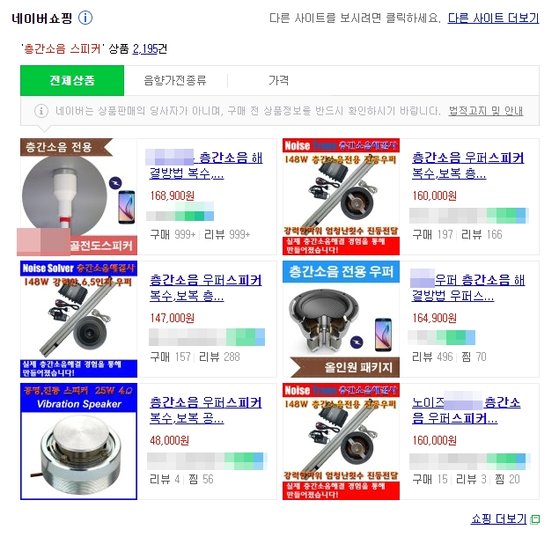 'Revenge Woofer Speaker for Interfloor Noise' registered on the portal site Naver Shopping Mall. Photo by Naver screen capture
Under current law, inter-floor noise is regulated by the 'Apartment Housing Management Act' and the 'Noise and Vibration Control Act.' Accordingly, victims of inter-floor noise can report offenders to the police station under the Minor Offenses Act for causing a public disturbance. However, since it is difficult to accurately measure the volume and duration of the noise, it is often challenging to apply punishment standards.
As a result, some victims who can no longer endure the noise purchase 'revenge speakers' to retaliate. Revenge speakers are woofers attached to the ceiling that transmit sound to the upstairs neighbors. Types of revenge speaker sounds include 'baby crying,' 'hammering,' and 'washing machine noise.'
There have also been cases where victims retaliated through criminal acts. In July, in Buk-gu, Gwangju, a man in his 20s, harboring resentment over inter-floor noise, used an anonymous chat app to reveal the address of a woman living upstairs, encouraging attempts at trespassing. The victim, a woman with elementary school-aged daughters, was reportedly anxious due to men ringing the doorbell repeatedly from early morning.
Experts urge that mutual consideration is necessary rather than emotional reactions when inter-floor noise occurs. A representative from the Korea Environment Corporation said, "Usually, in winter, because of the cold weather, people spend more time indoors, leading to more inter-floor noise disputes compared to other seasons," adding, "With COVID-19 causing more indoor living, neighbors should be considerate and cautious as the best approach."
Meanwhile, other countries have stronger measures compared to South Korea. In New York, USA, when complaints or reports of inter-floor noise are received, the apartment management office issues up to two warnings to the noise offenders. If there are three or more violations, forced eviction can be enforced.
Australia's 'Environmental Protection Act' specifies noise standards within residential spaces as 40 dB during the day and 30 dB at night. Furthermore, apartment lease agreements precisely regulate what noise is allowed and during which hours, and impose fines on noise offenders. Germany also regulates noise offenders under civil law, the Federal Order Act, and the Pollution Control Act.
© The Asia Business Daily(www.asiae.co.kr). All rights reserved.
![Clutching a Stolen Dior Bag, Saying "I Hate Being Poor but Real"... The Grotesque Con of a "Human Knockoff" [Slate]](https://cwcontent.asiae.co.kr/asiaresize/183/2026021902243444107_1771435474.jpg)

















