[Report] Visiting Welcron Technology Research Institute
Localization of Artificial Blood Vessels Fully Dependent on Imports... Penetrated 130 Billion KRW Market
Manufacturing Cost 60% Lower Than Imported Products, "Will Strive for Localization of Medical Materials Through Development of Various Fibers"
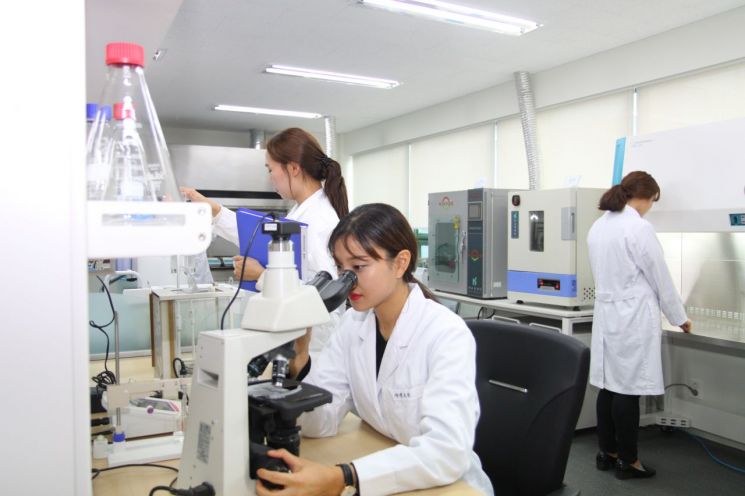 Wellcron, known as a functional fiber company, succeeded in developing the first domestic PTFE artificial blood vessel tube in 2016 and has been making strides in the medical materials field by commercializing it. Photo by Wellcron Technology Research Institute.
[Asia Economy Reporter Kim Heeyoon] "Because it was a stable material that did not deform even at temperatures exceeding 300 degrees, it could be used as a material for artificial blood vessels."
On the 21st, at the Wellcron headquarters' technology research center in Guro-gu, Seoul, Director Kwon Eunhee personally explained how PTFE (polytetrafluoroethylene, fluororesin) could become a material for artificial blood vessels. PTFE, which only deforms above 325 degrees, is a new material used for finely filtering mixtures and is applied in various fields such as outdoor clothing, water treatment filters, electric vehicle motors, and semiconductor components. Although the American company Gore first developed it in 1965 and its patent expired in 1997, only a handful of companies in Korea have developed it due to the high level of technology required. Wellcron, which succeeded in developing a PTFE hollow fiber (a fiber with a hollow center) membrane filter in 2011, challenged the artificial blood vessel market based on its proven technological capabilities.
Throughout the research center, there were devices to test the performance of artificial blood vessel tubes. Director Kwon explained, "The core technology of PTFE artificial blood vessels is obtaining uniform micro air pores with diameters ranging from 0.1 μm (micrometers) to 1 μm," adding, "The key is producing uniform products tailored to various blood vessel sizes."
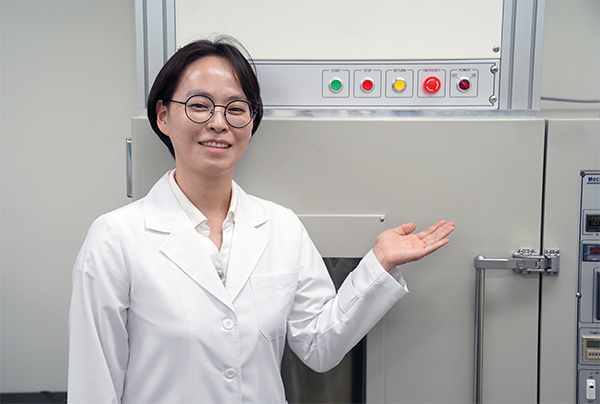 Eunhee Kwon, head of Welcron Technology Research Institute, stated, "We will strive for the localization of medical materials through the development of various medical textile products, including artificial blood vessels."
Artificial Blood Vessels Fully Dependent on Imports, Successful Localization
Before technological development, PTFE materials had difficulty generating pores of uniform size during spinning, so both filters and blood vessels were entirely dependent on imports. In particular, only Gore's products were approved domestically for artificial blood vessel tubes larger than 10mm. In 2017, Gore withdrew from the domestic market citing low insurance reimbursement rates and low demand, which led to a shortage of artificial blood vessel stock for pediatric heart disease surgeries in Korea. This prompted government officials to urgently visit Gore in the United States to request support. PTFE artificial blood vessels require high technological expertise depending on size, and some sizes are produced in small quantities with many varieties, making it difficult to generate significant profits, which led to this precarious situation.
Wellcron succeeded in developing PTFE artificial blood vessel tubes domestically for the first time in 2016 and began commercialization the following year. Director Kwon stated, "Since these products are applied to peripheral vascular diseases with increasing procedural demand, the localization effect and price competitiveness make it possible to enter the global market." Artificial blood vessel tubes are mainly used in surgeries for peripheral vascular diseases such as diabetes and hypertension, serving to replace, expand, or correct blood vessels.
Director Kwon explained, "PTFE is recognized for its chemically stable structure and excellent chemical resistance, while also being flexible and soft, allowing free expansion and contraction," adding, "Noting that it is already commercialized abroad as the most suitable material for vascular substitutes, we began full-scale development in areas where our technology could be applied." In fact, PTFE artificial blood vessels do not cause blood clotting upon contact with blood, have strong durability against high pressure, resist bacterial adhesion, and have excellent elasticity, displacing polyester to become the most widely used material for artificial blood vessel surgeries worldwide.
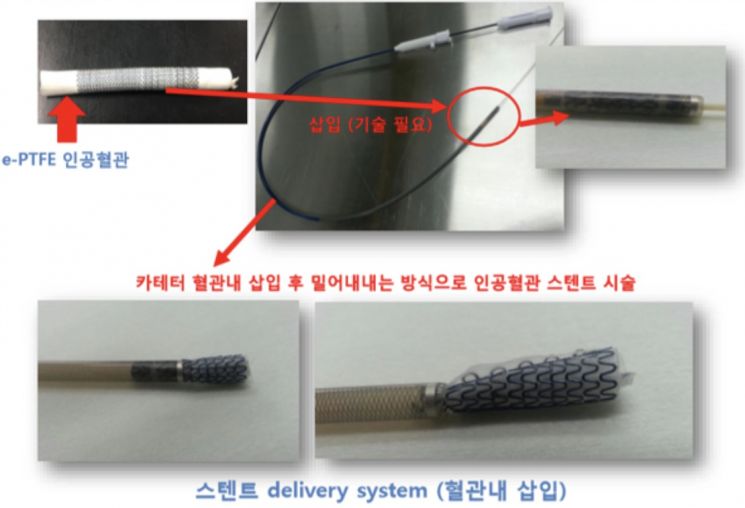 Welcron obtained a patent for "Artificial Blood Vessel Using Heat Shrink Tube and Manufacturing Method" last February and has started supplying stent artificial blood vessels that minimize blood leakage. Photo by Welcron
Patent Acquired for Heat-Shrink Tube Preventing Blood Leakage
In February this year, Wellcron obtained a patent for the "Artificial Blood Vessel and Manufacturing Method Using Heat-Shrink Tube." Director Kwon explained, "When manufacturing artificial blood vessels used in stent procedures, a mesh support structure functioning as a stent is placed on the outside, followed by an anti-detachment member, and then the interior is manufactured using a heat-shrink tube to create the artificial blood vessel," emphasizing, "Existing artificial blood vessels were sewn together at the junction between the blood vessel body and the mesh support structure, which posed a risk of blood leakage at the connection site. This technology improves stability by addressing that issue." She further explained that by producing entirely domestically, supply stability was secured, and applying proprietary technology reduced manufacturing costs by nearly 60% compared to imported artificial blood vessels.
The global artificial blood vessel market is predicted to grow from $2.67 billion (approximately 3.1 trillion KRW) in 2017 to $3.8 billion (4.4 trillion KRW) in 2022. The Korea Health Industry Development Institute estimates the domestic artificial blood vessel market to be worth around 130 billion KRW. Director Kwon said, "Although we are a company based on textile products, we are developing specialized healthcare products based on our technological capabilities," adding, "We will strive for localization of medical materials through the development of various medical textile products such as pleated artificial blood vessels and cell culture filters for burn treatment."
© The Asia Business Daily(www.asiae.co.kr). All rights reserved.
![Clutching a Stolen Dior Bag, Saying "I Hate Being Poor but Real"... The Grotesque Con of a "Human Knockoff" [Slate]](https://cwcontent.asiae.co.kr/asiaresize/183/2026021902243444107_1771435474.jpg)


















