Federation of Korean Industries Conducts Survey Targeting 50 Small and Medium Enterprises
[Asia Economy Reporter Dongwoo Lee] A survey revealed that if the spread of the novel coronavirus infection (COVID-19) continues for a prolonged period as it is now, one out of three small and medium-sized enterprises (SMEs) will find it difficult to sustain their business for more than a year.
The Federation of Korean Industries (FKI) announced on the 22nd that, based on a survey conducted on 50 SMEs nationwide, 34% of SMEs predicted that if the current economic crisis persists, it would be difficult to maintain their business for more than a year.
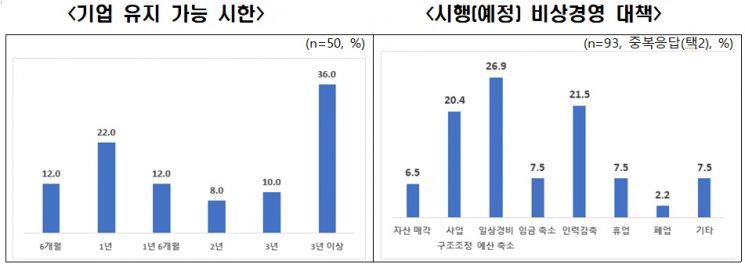
Among the respondents, 12.0% said they could sustain their business for 6 months, and 22.0% said for 1 year. Others responded that they could maintain their business for 1 year and 6 months (12.0%), 2 years (8.0%), 3 years (10.0%), and more than 3 years (36.0%). This indicates that even with emergency management measures such as workforce reduction, the business environment has deteriorated to the extent that one in three companies would find it difficult to sustain their business for more than a year if the economic crisis continues.
In response to the prolonged COVID-19 situation, the most prioritized or planned emergency management measure was reducing the daily expense budget (26.9%). This was followed by workforce reduction (21.5%), business restructuring (20.4%), wage reduction (7.5%), temporary closure (7.5%), and asset sales (6.5%).
Among SMEs, 68.7% responded that their sales in the first half of this year decreased compared to the same period last year. SMEs expecting a decrease in sales in the second half compared to the same period last year accounted for 64.6%. The proportion of SMEs whose first-half sales decreased by more than 30% compared to the same period last year was 39.6%, and those expecting a decrease of more than 30% in sales in the second half compared to the same period last year reached 37.5%.
The FKI judged that the poor sales performance and outlook of SMEs are due to a combination of factors including sluggish domestic sales caused by the prolonged COVID-19, disruption of domestic and international supply chains, and delayed economic normalization in major export countries.
When asked how long the economic crisis caused by COVID-19 would last, the most common response was 1 year (42.0%). This was followed by 2 years (30.0%), 1 year and 6 months (16.0%), 6 months (4.0%), 3 years (4.0%), and more than 3 years (4.0%). Most SMEs expect the economic crisis caused by the spread of COVID-19 to continue for more than a year.
Regarding management difficulties due to the prolonged COVID-19, respondents cited sluggish domestic sales (27.9%), lack of operating funds (23.3%), labor cost burdens (22.1%), poor overseas exports (9.3%), and excessive competition among companies (4.7%) in that order.
Regarding government support measures for SMEs related to the spread of COVID-19, dissatisfaction (42.0%) or strong dissatisfaction (16.0%) was about six times higher than satisfaction (10.0%). Among 29 companies that expressed dissatisfaction (including strong dissatisfaction) with government support measures, the main reason was narrow support conditions and targets (30.8%). This was followed by insufficient support scale (25.0%), complicated support procedures (15.4%), and unclear criteria (13.5%).
To minimize damage to SMEs, the support measures that the government should prioritize were operating fund support (33.3%), expanded tax reductions (26.9%), improvement of employment retention support systems (15.1%), promotion of voluntary restructuring (9.7%), and measures to increase consumption of SME products (8.6%) in that order.
Yoo Hwan-ik, head of the Corporate Policy Office at the Federation of Korean Industries, said, “As COVID-19 continues for a long time, SMEs, which are relatively vulnerable to economic crises, are suffering serious damage. Government support should be implemented in a way that SMEs can feel, focusing on finance, taxation, and employment, and measures to improve the structure of SMEs, such as support for consumption and export of SME products and voluntary restructuring support, should be pursued simultaneously.”
© The Asia Business Daily(www.asiae.co.kr). All rights reserved.
![Clutching a Stolen Dior Bag, Saying "I Hate Being Poor but Real"... The Grotesque Con of a "Human Knockoff" [Slate]](https://cwcontent.asiae.co.kr/asiaresize/183/2026021902243444107_1771435474.jpg)
















