[Asia Economy Reporter Bu Aeri] As the government and ruling party show a stance to expand the use of national spatial information, there are expectations that Google will once again attempt to secure domestic precision map data. The domestic IT industry points out that it is unreasonable for Google, which does not properly pay taxes, to take national spatial information funded by taxpayers' money. There is also a 'security risk controversy' over the exposure of information on key national facilities such as military bases to foreign companies.
Is Google Eyeing 5 Trillion Won Worth of Taxpayer-Funded Data?
According to related industries on the 22nd, the domestic precision maps that Google is trying to acquire are data built annually by the National Geographic Information Institute. Specifically, these include 2D and 3D coordinates, aerial photographs, and satellite images. A map service industry official said, "To provide services like navigation, precise data held by the government is necessary," adding, "It is essential data for providing precise map services."
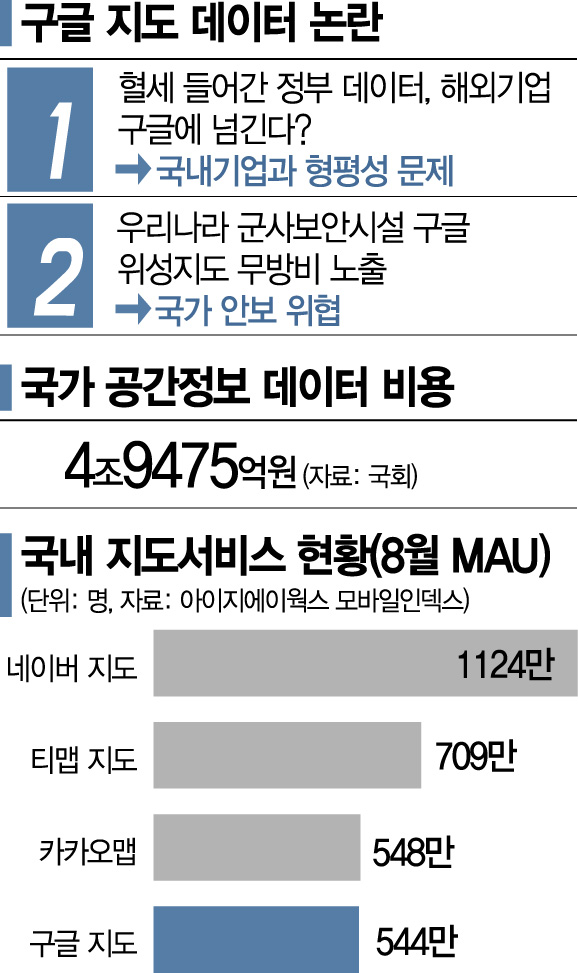
Previously, in 2016, Google requested map data with a scale of 1:5000 from our government and attempted to export it overseas but was rejected. This was due to public opinion rising that taking national data abroad poses a threat to national security. Since then, Google has been providing map services by purchasing only some data from SK Telecom, but its competitiveness is lacking. According to Mobile Index by big data platform company IGAWorks, Google's map monthly active users (MAU) on domestic Android in August were 5.44 million, significantly behind Naver Map (11.24 million), T Map (7.09 million), and Kakao Map (5.48 million).
In this situation, a favorable circumstance for Google unfolded when Lee Kwang-jae, a member of the Democratic Party of Korea, proposed an amendment to the National Spatial Information Basic Act. The amendment aims to make it easier for private companies to utilize national spatial information. The intention is to increase data utilization in the era of the Fourth Industrial Revolution. The problem is whether it is right for Google to use spatial information built with enormous taxpayer money for free. According to the National Assembly and the National Geographic Information Institute, the government’s budget for spatial information collection from 1995 to 2017 reached 4.9475 trillion won. A domestic portal industry official said, "Google does not properly pay taxes in Korea, so if it receives the data, it effectively obtains it for 'free,'" adding, "It is an unfair situation from the perspective of domestic companies that comply with various taxes and regulations."
Google recently filed an objection procedure with the Tax Tribunal against about 600 billion won in corporate tax imposed by the National Tax Service. Because of this, voices are rising that Google must have servers in Korea and pay taxes first to use national spatial information. Professor Choi Kyung-jin of Gachon University said, "If Google wants to use spatial information, it must comply with the same conditions as domestic operators," adding, "Otherwise, there could be issues of discrimination against domestic companies."
Security Risk Controversy Unlike Domestic Companies
There are also concerns that transferring precise spatial information to Google could threaten national security. The Blue House and military bases could be fully exposed on Google satellite images. An industry official said, "In 2016, our government requested Google to apply 'security processing' to major domestic facilities, but Google refused," pointing out, "Allowing Google to use spatial data under such circumstances could be very dangerous for our security." In fact, according to Democratic Party lawmaker Park Kwang-on, 40% of South Korea’s military security facilities are exposed without protection on Google satellite maps.
Domestic companies with servers in Korea undergo prior 'security reviews' to prevent military secrets from being exposed, but Google, which has servers overseas, cannot be sanctioned even if it violates this. Kim In-hyun, CEO of Korea Spatial Information & Communication, raised opposition, saying, "It is difficult to regulate after data export on a case-by-case basis. Once security is exposed, it cannot be recovered." Regarding this, Google Korea stated, "Currently, there are no plans to request spatial information from the Korean government."
© The Asia Business Daily(www.asiae.co.kr). All rights reserved.
![Clutching a Stolen Dior Bag, Saying "I Hate Being Poor but Real"... The Grotesque Con of a "Human Knockoff" [Slate]](https://cwcontent.asiae.co.kr/asiaresize/183/2026021902243444107_1771435474.jpg)
















