Suggestions on Commercial Act and Fair Trade Act
Request for Prompt Legislation on New Industries
[Asia Economy Reporter Dongwoo Lee] The Korea Chamber of Commerce and Industry (KCCI) has urged the National Assembly to carefully deliberate on legislation that significantly impacts corporate management, such as the Commercial Act and the Fair Trade Act.
On the 21st, KCCI submitted a report titled "Opinions on Major Legislative Issues" to the National Assembly, stating that it hopes the Assembly will consider the impact on businesses and the alternatives proposed by the economic sector while discussing bills that impose burdens on companies.
According to KCCI, during the three months since the 21st National Assembly convened, a total of 284 bills imposing burdens on companies were proposed, representing about a 40% increase compared to the 20th National Assembly.
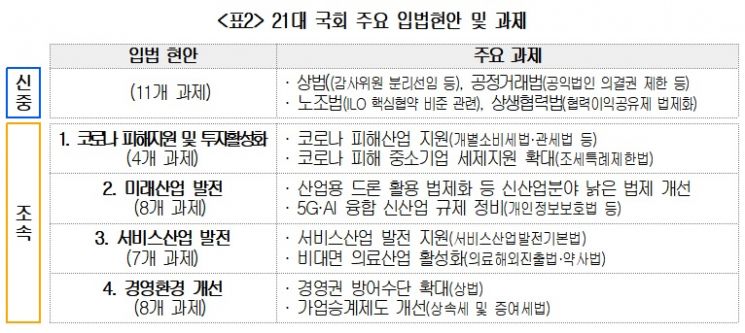
In the report submitted to the National Assembly, KCCI selected 11 tasks (13 bills) and presented its opinions. Additionally, it conveyed opinions on 27 urgent legislative tasks (41 bills) across four major areas: COVID-19 damage support and investment activation, future industry development, service industry development, and improvement of the corporate management environment.
Regarding the amendment to the Commercial Act, KCCI demanded supplementary measures for the separate election of audit committee members. KCCI argued, "The separate election of audit committee members severely restricts the defense rights of management, effectively opening the door wide for foreign speculative funds to propose audit committee candidates and enter the board of directors with the government's and National Assembly's approval."
If the separate election system must be introduced, KCCI proposed an alternative to relax the 3% voting rights rule for major shareholders only when speculative funds attempt to enter the board through shareholder proposals.
Regarding the amendment to the Fair Trade Act that expands the scope of internal transaction regulations, KCCI stated that transactions between companies belonging to a holding company should be exempted.
KCCI argued, "If the scope of internal transaction regulations is uniformly expanded, most companies belonging to holding companies, whose average subsidiary shareholding ratio is 72.7%, will be suspected of internal transactions. This contradicts government policies encouraging the introduction of holding companies and may lead to policy distrust."
Concerning the limitation of voting rights on affiliate stocks held by public interest corporations to within 15%, KCCI also expressed concerns that this could weaken the positive function of returning corporate profits to society. As alternatives, it proposed excluding retroactive application to stocks already contributed and exempting public interest corporations actively engaged in social contribution activities.
Regarding the amendment to the Labor Union Act for the core ratification of the International Labour Organization (ILO), KCCI emphasized the need to supplement the defense rights of management, warning that focusing solely on strengthening labor rights could deepen the imbalance between labor and management. It demanded a general ban on workplace access for dismissed and unemployed workers, prohibition of all forms of workplace sit-in strikes, deletion of the provision banning payment of salaries to union officials while maintaining the 'working hours exemption system,' and deletion of the prohibition on replacement labor during strikes.
In this legislative report, KCCI also shared opinions on the four major areas of COVID-19 damage support and investment activation, future and service industry development, and improvement of the corporate management environment.
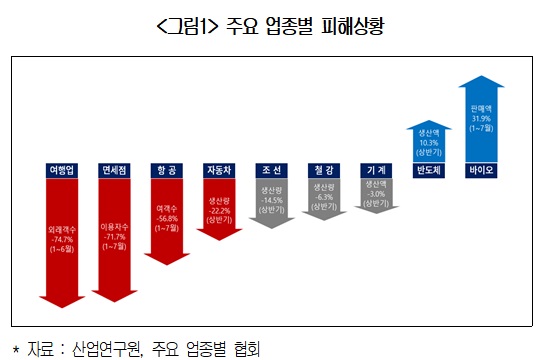
As measures to support COVID-19 damage and activate corporate investment, KCCI proposed extending a 70% reduction in individual consumption tax, temporarily reducing duty fees for duty-free shops, and exempting acquisition and property taxes on aircraft.
It also requested improvements to laws and systems that restrict the development of future new industries such as autonomous driving and non-face-to-face services. KCCI reiterated its request for the enactment of the Service Industry Development Act, which has been pending in the National Assembly for nine years.
KCCI suggested, "Since both ruling and opposition parties agree on the enactment of the law, it should be legislated promptly in a negative list format without enumerating individual industries such as the medical field, and the applicability to the medical sector should be discussed separately at the policy formulation stage."
Jung Young-seok, head of the Corporate Policy Team at KCCI, said, "At least in the 21st National Assembly, a legislative culture should be fostered where the impact on business sites is reviewed and reasonable alternatives are seriously discussed when establishing or strengthening regulations related to companies."
© The Asia Business Daily(www.asiae.co.kr). All rights reserved.


















