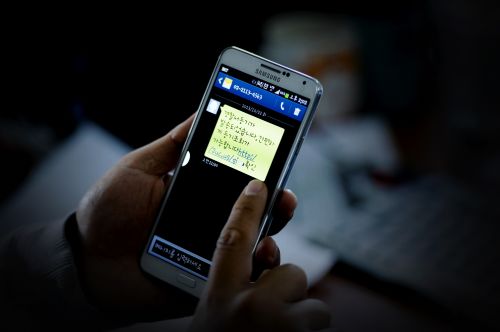
[Asia Economy Reporter Koo Chae-eun] "You have won a Chuseok event and we are sending you a gift. Please check the URL below." "This is an announcement regarding the 2nd round of COVID-19 emergency disaster relief funds. Please click the URL."
Even if you receive such text messages, it is best not to click if the address is unverified.
On the 21st, the Korea Communications Commission warned that smishing is expected to increase ahead of the Chuseok holiday, impersonating Chuseok delivery confirmations, COVID-related emergency disaster relief, and payment notifications, urging users to be cautious.
Smishing is a combination of SMS (Short Message Service) and phishing. It is a method where malicious app URLs are sent in bulk via mobile text messages, inducing users to install malicious apps or make calls to steal financial information.
The government provided precautions to prevent smishing fraud damage.
The Korea Communications Commission first advised not to click on internet addresses (URLs) in texts related to delivery tracking, holiday greetings, mobile gift certificates, transportation tickets, or performance tickets if the source is unverified. Also, to prevent unknown apps from being installed carelessly, users should strengthen their smartphone security settings and download apps only from authorized app markets rather than from URLs of unclear origin.
Furthermore, users should install antivirus programs provided by mobile carriers and keep them updated with real-time monitoring. If personal or financial information is requested under the pretext of security enhancement or updates, users should never enter or disclose such information. Especially, emergency disaster relief fund notification texts do not include URL links, so users should not click on any internet addresses in the message and delete them immediately.
If you receive suspicious smishing texts or suspect malicious app infections during the holiday, you can contact the 118 Counseling Center without an area code for free 24-hour consultation.
As of August this year, the number of detected smishing cases has exceeded 700,000, a 378% increase compared to the same period last year. In particular, over 10,000 smishing cases impersonating COVID-related emergency disaster relief funds have been detected.
© The Asia Business Daily(www.asiae.co.kr). All rights reserved.
![Clutching a Stolen Dior Bag, Saying "I Hate Being Poor but Real"... The Grotesque Con of a "Human Knockoff" [Slate]](https://cwcontent.asiae.co.kr/asiaresize/183/2026021902243444107_1771435474.jpg)











