[Asia Economy Reporter Oh Hyung-gil] The government has warned that smishing scams impersonating parcel delivery services, emergency disaster relief payments related to COVID-19, and payment requests are expected to increase ahead of the Chuseok holiday.
On the 21st, the Ministry of Science and ICT, the Korea Communications Commission, the Financial Services Commission, the Financial Supervisory Service, and the National Police Agency announced that smishing is expected to rise during the Chuseok holiday.
As of August, the number of detected smishing cases reached 700,783, a 378% surge compared to the same period last year. In particular, 100,753 smishing cases impersonating COVID-19 emergency disaster relief funds were discovered, urging users to exercise special caution.
The government plans to promote preventive activities to protect against telecommunication financial fraud such as smishing and voice phishing through cooperation among related ministries ahead of Chuseok.
The Korea Internet & Security Agency (KISA), under the Ministry of Science and ICT, will conduct 24-hour monitoring during the Chuseok holiday period to respond swiftly to smishing distribution and will analyze reported smishing information shared with related organizations to block malicious app distribution sites and minimize user damage.
The Korea Communications Commission will collaborate with the Korea Association for ICT Promotion (KAIT) and the three major telecom operators (SKT, KT, LGU+) to sequentially send "Smishing Damage Prevention Messages" under each telecom company's name starting from the 22nd.
The Financial Services Commission and the Financial Supervisory Service urged parents to verify directly before responding to the recent increase in smishing scams impersonating children or involving false payment messages, and asked children to inform their parents by phone in advance to prevent them from falling for smishing texts impersonating their children. Chuseok holiday voice phishing prevention guides will also be distributed as public awareness materials with support from the Ministry of the Interior and Safety and the Financial Supervisory Service.
The National Police Agency will provide prevention guidelines and damage alerts through its website and the cybercrime prevention app "CyberCop," and plans to conduct cybercrime prevention publicity activities in collaboration with major portal sites and used goods trading companies before and after the Chuseok holiday period.
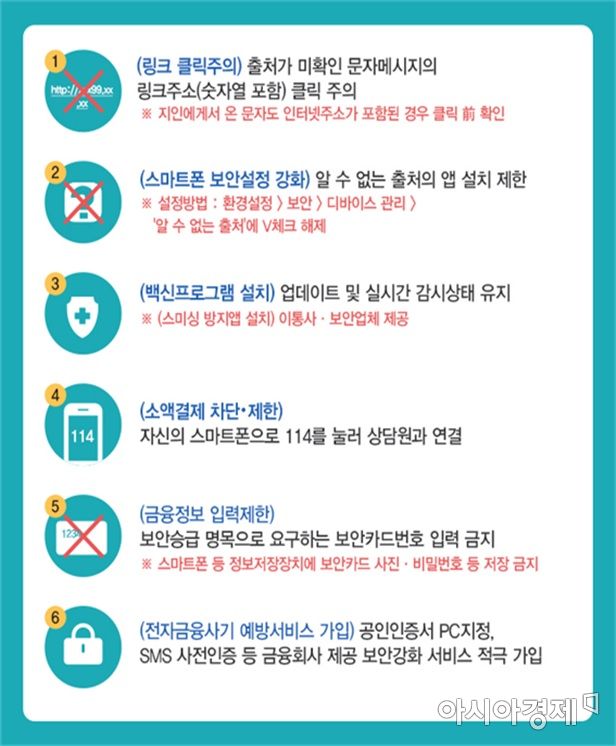
Additionally, the government provided precautions to prevent smishing fraud.
Do not click on internet addresses (URLs) of unknown origin included in texts about parcel tracking, holiday greetings, mobile gift certificates, transportation tickets, or performance tickets giveaways. Strengthen smartphone security settings to prevent unauthorized installation of apps from unknown sources, and download and install apps only from official app markets rather than URLs of unclear origin.
Also, install antivirus programs provided by telecom companies, keep them updated, and maintain real-time monitoring. Never enter or disclose personal or financial information when requested under the pretext of security enhancement or updates. Emergency disaster relief payment notification texts do not include URL links, so do not click on any internet addresses in the message and delete them immediately.
If you receive a suspicious smishing text or suspect infection by malicious apps during the holiday, you can contact the 118 Counseling Center without an area code for free 24-hour consultation.
© The Asia Business Daily(www.asiae.co.kr). All rights reserved.

















