Development of Anticancer Drug That Kills Only Cancer Cells and Eliminates Resistance
Expectations for Non-Toxic Anticancer Nano Drug Development
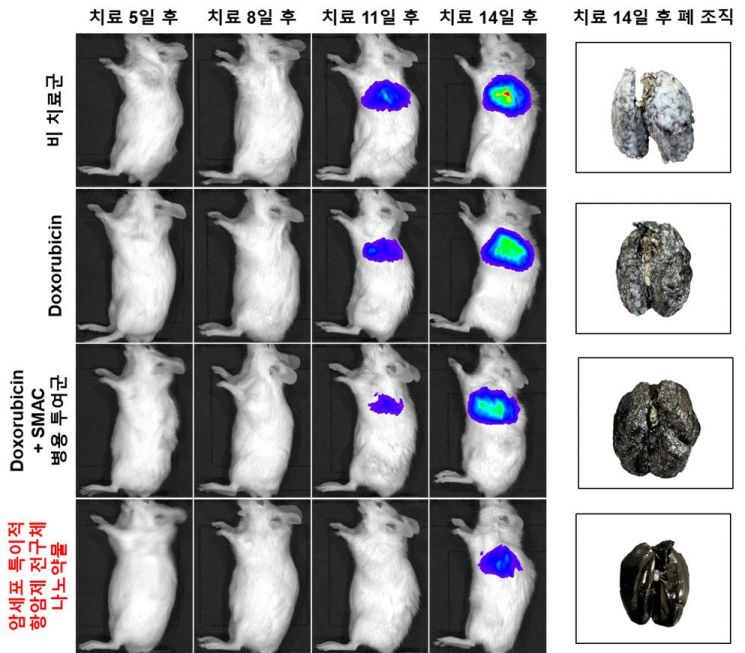 This is the result of evaluating therapeutic efficacy in an animal model of lung metastasis using bioluminescence imaging. The research team established a lung metastasis animal model using bioluminescent breast cancer cells and divided the subjects into groups receiving doxorubicin, a combination of doxorubicin and SMAC, and a cancer cell-specific anticancer prodrug nanomedicine. They tracked the growth rate of lung metastases and confirmed that the lung metastasis animal model treated with the cancer cell-specific anticancer prodrug effectively suppressed tumor growth.
[Asia Economy Reporter Junho Hwang] A new therapeutic substance that selectively kills cancer cells and breaks down their resistance has been developed. If clinical trials are successfully conducted, it is expected to become a treatment method that can maximize the effectiveness of chemical anticancer therapy.
The research team led by Dr. Kwangmyung Kim of the Theragnosis Research Center at the Korea Institute of Science and Technology announced on the 21st that they have succeeded in developing a cancer cell-specific anticancer prodrug capable of overcoming anticancer drug resistance. The related research results were published in the latest issue of the international journal Biomaterials.
Kills Cancer Cells and Suppresses Resistance
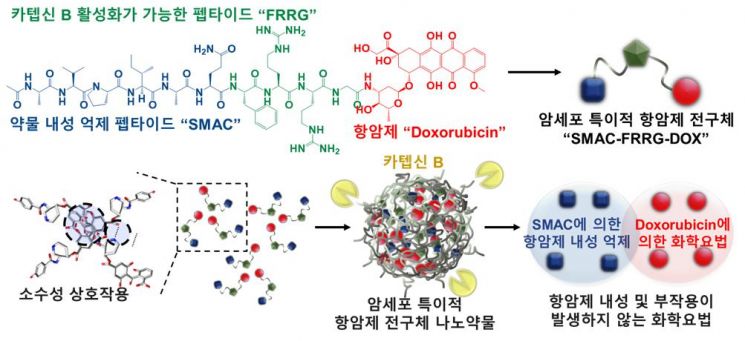
The researchers created a new drug by combining a drug that suppresses anticancer drug resistance (SMAC) with an anticancer drug (doxorubicin).
This drug circulates in the body and reacts with an enzyme (cathepsin B) that is overexpressed in cancer cells. It acts specifically targeting only cancer cells. When it encounters normal cells, it remains inactive and does not exhibit toxicity. This can minimize side effects caused by chemical anticancer therapy.
In particular, this drug releases both the anticancer agent and the resistance inhibitor simultaneously upon reacting with cancer cells. It can effectively suppress acquired anticancer drug resistance caused by anticancer treatment. This means it can minimize cancer recurrence or treatment failure. Chemical anticancer therapy effectively kills cancer cells and is used as a treatment for various cancers, but resistance to anticancer drugs is a cause of cancer recurrence or treatment failure.
Clinical and Technical/Industrial Issues Need to Be Addressed
Dr. Kwangmyung Kim stated, "This cancer cell-specific anticancer prodrug nanomedicine technology is expected to be utilized as a new anticancer agent that effectively suppresses anticancer drug resistance, which causes treatment failure in conventional chemotherapy, while reducing toxicity to normal cells, thereby preventing anticancer drug resistance and side effects."
He explained, "It is necessary to solve technical challenges such as the efficacy and toxicity of the anticancer drug itself, and considerations from an industrial perspective are also needed when actual production and clinical application are carried out."
© The Asia Business Daily(www.asiae.co.kr). All rights reserved.
![Clutching a Stolen Dior Bag, Saying "I Hate Being Poor but Real"... The Grotesque Con of a "Human Knockoff" [Slate]](https://cwcontent.asiae.co.kr/asiaresize/183/2026021902243444107_1771435474.jpg)


















