[Planning] Waste Crisis and Circular Resource Recycling in the Cement Industry
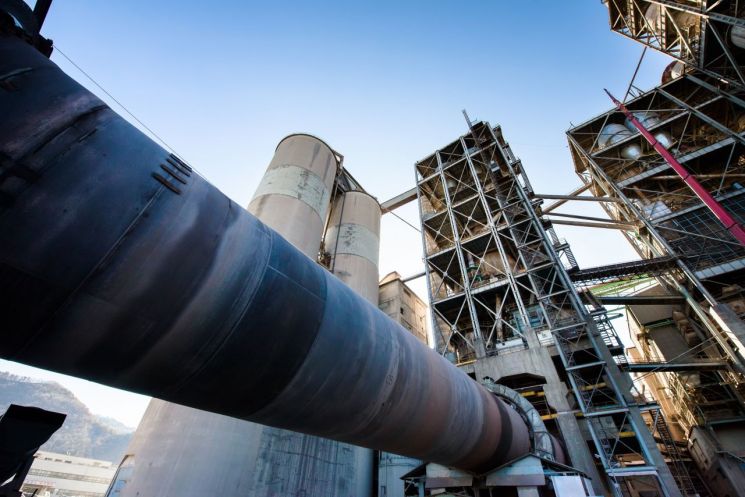 The appearance of a massive kiln. The inside of the kiln is heated up to 2000℃, melting all the main and auxiliary raw materials to produce clinker, a semi-finished product.
 [Photo by Korea Cement Association]
① Waste Crisis Due to COVID-19, Monsoon, and Typhoons: The Cement Industry as the Savior
[Asia Economy Reporter Kim Jonghwa] In 2018, the ban on waste imports by China and the blockage of illegal waste exports to Southeast Asia, including the Philippines, led to abandonment and illegal dumping, worsening the waste problem. Especially with the COVID-19 pandemic making contactless lifestyles common, the use of single-use plastic containers has surged, and the massive increase in waste due to flood damage during the monsoon season and the excessive packaging of gifts during holidays has caused waste generation to exceed capacity, making a 'waste crisis' inevitable.
Solving the 'waste crisis' starts with reducing disposable products and thorough waste separation. However, the problem cannot be solved by individual cooperation alone. Since the ban on marine dumping of land-based waste in 2016, the capacity for treatment through landfill and incineration has reached its limit. Moreover, the closure of the metropolitan landfill site, which handles about 30% of domestic waste, is approaching in five years. Securing alternative landfill sites is difficult due to the 'Nimby (Not In My Backyard) phenomenon' and opposition from environmental groups against new landfill development.
In this urgent crisis, the 'cement industry' is mentioned as the savior. Besides the existing methods of landfill and incineration, utilizing cement production facilities to recycle waste as circular resources can solve the waste crisis.
Cement is produced by mixing and grinding limestone, which accounts for about 90% of the main raw material, with natural supplementary materials such as clay, silica, and iron ore in certain proportions, then feeding them into a kiln along with fuel such as bituminous coal, heating to a maximum temperature of 2000℃ (gas temperature), melting, cooling, and producing a semi-finished product called clinker. Gypsum and other materials are then added to the clinker and finely ground into powder.
In this process, natural supplementary materials are replaced by recycling waste with similar chemical components. The main fuel, bituminous coal, is substituted with waste synthetic resins (waste plastics), waste tires, and others. Recycling waste in the cement industry transforms troublesome waste into 'circular resources,' which are environmentally non-harmful and economically viable materials among waste.
The method of recycling waste as circular resources in the cement industry is not simply mixing and burning. Since the enclosed kiln melts waste at ultra-high temperatures (2000℃), harmful substances are completely decomposed, making it environmentally superior. The ash remaining after combustion is mixed with raw materials and turned into cement products, resulting in no incineration ash generation, and heavy metals do not leak externally.
The expected benefits of recycling circular resources in the cement industry are significant. First, there is no need to damage the natural environment through mining for natural resources such as clay, silica, and iron ore. Utilizing discarded waste such as waste plastics and waste tires also enables the reduction of national environmental burdens such as greenhouse gases.
This is also welcomed by the government, which is promoting the transition to a 'resource-circulating society.' It suppresses waste generation throughout the entire process of production, distribution, consumption, and disposal, and returns generated waste and recyclable resources to the economic circulation system, minimizing the use of natural resources and energy.
Experts also emphasize the importance of the cement industry's role in solving the waste crisis. On June 29, at the 1st Plastic Forum keynote speech, Professor Kang Taejin, Emeritus Professor at Seoul National University, stated, "Utilizing cement kilns can fundamentally solve the problem of illegally abandoned plastic waste, and by collecting marine plastic waste, the main culprit of marine pollution, and using it as alternative fuel, we can address global environmental issues."
Professor Kang added, "Just as the cement industry solved social problems related to waste tires about 20 years ago, the current waste plastic disposal problem should also be resolved by using it as an alternative fuel replacing bituminous coal in cement manufacturing, thereby solving environmental problems."
© The Asia Business Daily(www.asiae.co.kr). All rights reserved.
![Clutching a Stolen Dior Bag, Saying "I Hate Being Poor but Real"... The Grotesque Con of a "Human Knockoff" [Slate]](https://cwcontent.asiae.co.kr/asiaresize/183/2026021902243444107_1771435474.jpg)
















