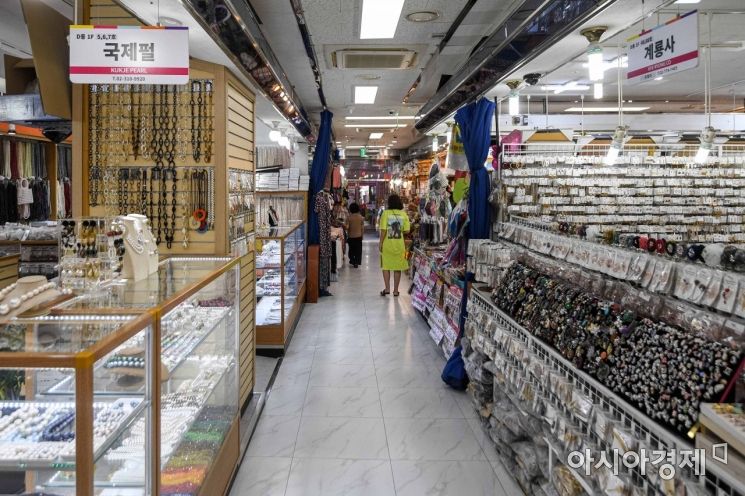
 On the 18th, with the number of confirmed cases of the novel coronavirus infection remaining in the 100s for the 16th consecutive day, Namdaemun Market in Jung-gu, Seoul, showed a quiet scene. Photo by Jinhyung Kang aymsdream@
[Asia Economy Reporter Choi Sunghye] The number of confirmed cases of the novel coronavirus infection (COVID-19) occurring in the community over the past two weeks has shown a clear decreasing trend. However, the government urged strict adherence to social distancing rules, considering the possibility of 'silent transmission' within the community, as the proportion of patients with 'unknown infection routes' reached about 27%.
According to the Central Disaster and Safety Countermeasures Headquarters on the 20th, the average daily number of new confirmed cases occurring in the domestic community from the 6th to the 19th of this month was 121, a decrease of 153.7 from 274.7 during the previous two weeks (August 23 to September 5).
The number of confirmed cases significantly decreased in both the metropolitan area and non-metropolitan areas. The average daily domestic confirmed cases in the metropolitan area were 91.3, down 116.7 from 208 in the previous two weeks. In non-metropolitan areas, the number of confirmed cases also decreased from 66.7 to 29.7 during the same period.
The Central Disaster and Safety Countermeasures Headquarters stated, "In the case of non-metropolitan areas, as of midnight today, the number of domestic confirmed cases was 17, marking the second consecutive day below 20 following 16 cases yesterday," and added, "Thanks to nationwide social distancing efforts, the number of domestic patients outside the metropolitan area is steadily decreasing."
Although the number of domestic confirmed cases in non-metropolitan areas surged to 121 on August 27, the Central Disaster and Safety Countermeasures Headquarters explained that the decreasing trend has continued with an average of 23.7 cases per day over the past week (September 13?19).
The reduction in cluster infections managed by health authorities is also notable. The number of cluster infections occurring in the past two weeks was 25, about 38% of the 65 cases in the previous two weeks.
However, despite the decline in confirmed cases, risk factors remain. Among the newly confirmed cases in the past two weeks, the proportion of patients whose infection routes are under investigation was 26.9% (507 out of 1,883), significantly higher than 19.9% (796 out of 4,008) in the previous two weeks.
When confirmed cases occur, rapid contact tracing, isolation, and testing are necessary to find 'hidden patients,' but if the routes are unknown, 'n-th transmission' cannot be prevented. Hidden patients pose a high risk of continuously spreading COVID-19 to those around them without realizing it.
The 'management rate within the quarantine network,' calculated as the proportion of newly confirmed cases who were classified as contacts and were in self-quarantine before testing positive, also fell short of the government's target of 80%.
The Central Disaster and Safety Countermeasures Headquarters expressed concern, saying, "Looking at the pattern of occurrence, sporadic cluster infections are appearing in many cities and provinces," and added, "There is a high possibility that latent infections in the community, which health authorities have not identified, are present." They further urged strict compliance with social distancing measures by stage, as well as personal hygiene practices such as wearing masks and handwashing, noting that "the number of patients in the metropolitan area remains high, and large-scale movement is expected with the Chuseok holiday starting in a week."
© The Asia Business Daily(www.asiae.co.kr). All rights reserved.

















