Kim Hyun-mi Nears Record as Longest-Serving Minister of Land, Infrastructure and Transport
Emphasized Housing Stability in Inaugural Speech
Rapid Rise in Sale and Jeonse Prices in Seoul and Capital Area
Watchful for Possible Price Drop as Buying Sentiment Weakens
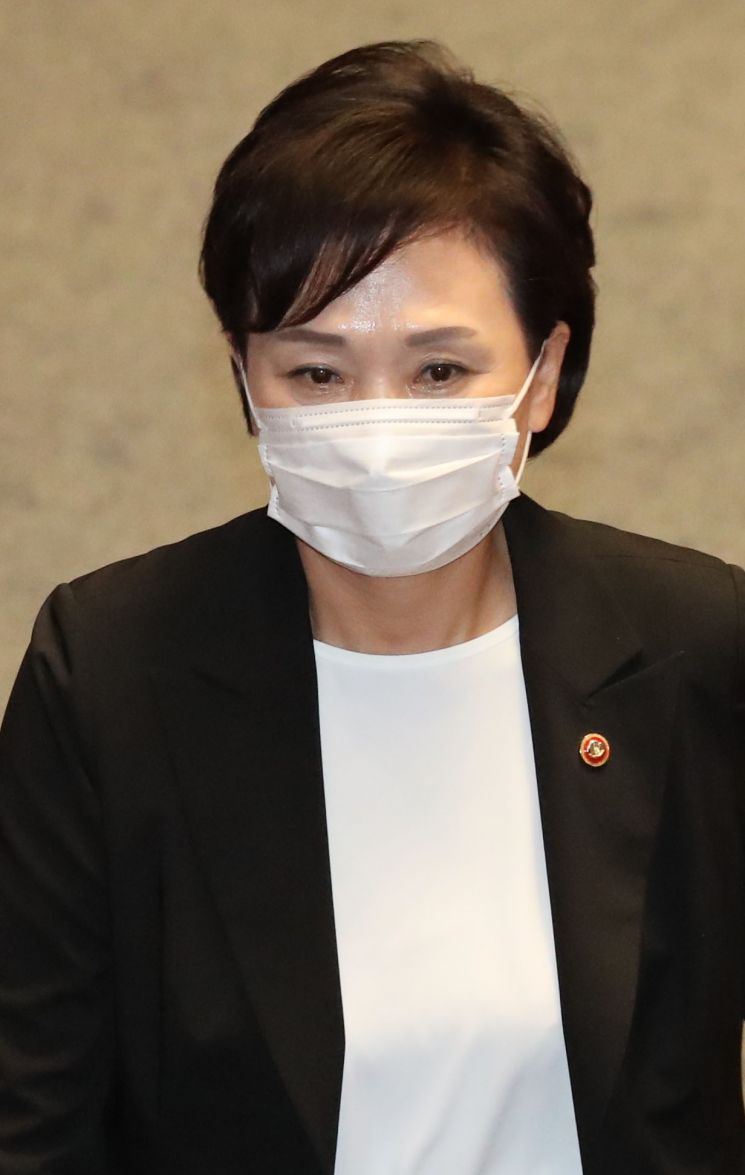 Minister of Land, Infrastructure and Transport Kim Hyun-mi is returning to her seat after answering questions during the government-related economic session at the National Assembly plenary meeting on the 16th. (Photo by Yonhap News)
[Asia Economy Reporter Moon Jiwon] Kim Hyunmi, Minister of Land, Infrastructure and Transport, is breaking the record as the 'longest-serving Minister of Land, Infrastructure and Transport.' At her inauguration, Minister Kim emphasized the need for policies that eliminate worries about housing and monthly rent. Although she has since introduced several strong measures, the market's evaluation has been generally cold. This is because the prices of sales and jeonse (long-term deposit rental) in Seoul and other metropolitan areas have risen significantly, making housing stability for ordinary citizens even more precarious. However, there is also growing expectation that housing prices may stabilize as buying sentiment weakens, especially in Seoul, following the announcement of the August 4 supply plan.
According to the Ministry of Land, Infrastructure and Transport on the 19th, Minister Kim took office on June 23, 2017. On the 23rd of this month, she will match the tenure of former Minister Chung Jonghwan of the Ministry of Land, Transport and Maritime Affairs, who served approximately 3 years and 3 months from February 29, 2008, to June 1, 2011, holding the record for the longest-serving Minister of Land, Infrastructure and Transport. From then on, Minister Kim will set a new record for the longest tenure.
At the time of her inauguration, Minister Kim expressed her determination to work for housing stability for ordinary citizens using PowerPoint (PPT) materials. She presented the 'housing ladder policy' as the first key policy the Ministry would focus on, explaining that "policies are needed that eliminate worries about housing, monthly rent, and moving."
Since then, the Ministry has introduced several measures to curb housing prices in the metropolitan area, but the pattern of temporary stabilization followed by sharp increases has repeated. According to statistics from the Korea Real Estate Board, from June 2017, right after Minister Kim took office, until last month, apartment sale prices in Seoul rose by 14.57%. During the same period, jeonse prices increased by 3.18%.
However, Hana Financial Management Research Institute, affiliated with Hana Bank, analyzed Korea Real Estate Board statistics on the 16th and explained that the apartment transaction price index rose by 45.5% over the past three years (May 2017 to May 2020). During this period, the average transaction price increased by 39.1%, the median transaction price by 38.7%, and the sale price index by 14.2%.
Minister Kim stated at the National Assembly's Land, Infrastructure and Transport Committee plenary session in July that she understood Seoul housing prices had risen by 14% for apartments and 11.3% for houses according to Korea Real Estate Board data during the Moon Jaein administration. However, the research institute explained that "the Ministry of Land, Infrastructure and Transport cited the lowest rising sale price index among Korea Real Estate Board statistics," adding that the sale price index is based on survey results of samples and may differ from actual market prices.
Minister Kim, a three-term National Assembly member, is generally known to receive favorable evaluations within the Ministry. One Ministry official said, "Because her tenure is long, she is very knowledgeable about related policies," adding, "When she attends reports, she even remembers the names of frontline staff."
However, given the many strong real estate measures introduced so far, criticism from the industry and market is considerable. A representative example is the registered rental housing system. The Ministry announced measures to activate rental housing registration in December 2017, but as the system was criticized for being exploited by multi-homeowners as a tax-saving tool, it was effectively abolished through the July 10 measures. This led to voices from rental business operators and experts alike saying, "The government frequently overturns existing policies depending on the situation, lowering policy credibility."
There has also been significant backlash from some multi-homeowners regarding increased holding taxes such as the comprehensive real estate tax and the substantial expansion of regulated areas. After the implementation of the two rental laws, including the lease renewal request system, which Minister Kim emphasized from the start of her tenure, at the end of July, criticism from landlords has also grown. While these laws aim to protect tenants who have suffered from landlords' 'power abuse,' there have been considerable side effects such as a decrease in jeonse listings and sharp price increases. Seoul apartment jeonse prices have been rising for 64 consecutive weeks.
However, as buying sentiment for apartments has recently weakened, especially in Seoul, some analyses suggest it is too early to judge Minister Kim's achievements at this point. According to the weekly KB Housing Market Trend released by KB Live On on the 17th, Seoul's buyer dominance index fell further to 92.1 from 96.2 the previous week. An index below 100 means there are more sellers than buyers in Seoul. KB Live On explained, "If this trend continues, sale prices are increasingly likely to stabilize or decline."
© The Asia Business Daily(www.asiae.co.kr). All rights reserved.

















